What the platform contains
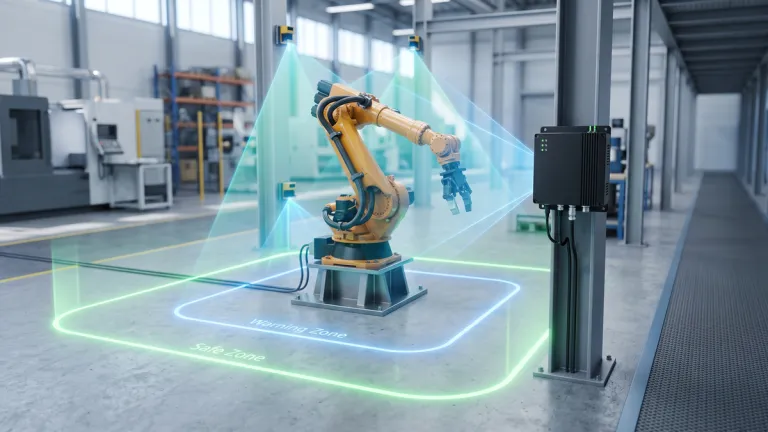
The robotics version bundles four layers. On the hardware side sits the NVIDIA IGX Thor compute module, an industrial-grade part intended for machines that share floor space with people. Above it run Halos OS and the Holoscan Sensor Bridge, which carry the safety-relevant software path between sensors and actuators. Around them Nvidia wraps simulation tooling and a certification testing programme, so behaviour can be exercised in simulation before it is exercised on a warehouse floor.
The target list is wider than humanoids: autonomous mobile robots, humanoid robots and surgical robots, in warehouses, factories and medical facilities. Those are different risk profiles. A surgical robot and a pallet-moving AMR share almost nothing except the requirement that a failure must not injure a person. Nvidia is selling a common structure underneath both.
The numbers Nvidia is transferring
Nvidia says the platform carries over 18,600 engineering-years of autonomous driving experience and 7 million lines of safety-validated code. That is the commercial argument: functional safety work is expensive and slow, and no robot maker wants to repeat it from scratch for every joint and every gripper.
The company also puts annual revenue from its physical AI technologies at close to $10 billion, roughly €9.2 billion at recent exchange rates. Barclays estimates the global humanoid robotics market at $200 billion by 2035, about €185 billion. That projection is roughly twenty times Nvidia's current physical AI revenue, which tells you how much of the story is still ahead of the shipping product.
Lines of code remain a soft metric. Seven million lines says nothing about how many survived an independent assessor, or how the stack behaves when a sensor returns garbage at the wrong moment. We run our own tests on the AI Arena rig for exactly this reason: vendor figures tend to describe the average case and skip the tail.
Agility Robotics is first
Agility Robotics is named as the first major commercial partner integrating Halos safety technology into Digit. Agility has been running Digit in logistics work for customers including GXO, which makes it a practical first reference point: the robot already walks through buildings where people work.
Safety certification is rarely granted to a robot model in the abstract. It is granted to a configuration, a site and a task. A stack that produces test evidence and traceability can shorten each of those conversations, but only if the evidence is accepted by whoever signs the assessment.
Europe's rules arrive first
For European deployments the timeline is set by two regulations. The Machinery Regulation (EU) 2023/1230 replaces the old Machinery Directive and applies from 20 January 2027. It explicitly covers machinery with self-evolving behaviour and safety functions that rely on machine learning.
Under the AI Act, an AI system used as a safety component of machinery covered by that regulation is classified high-risk, and the obligations for that group of products begin applying on 2 August 2027. In practice, a humanoid or AMR sold in the EU with an AI-based safety function will need technical documentation, logging, human oversight design and a conformity assessment involving a notified body.
A vendor-supplied safety stack can carry part of that load. It cannot carry the legal responsibility, which stays with the manufacturer placing the machine on the market.
Insurers sit in the same conversation. Industry reporting on Halos since its first showing at Automate 2026 has treated it as a possible common reference point for underwriters evaluating physical AI deployments. That framing comes from the industry, not from a regulator, and no notified body has published an opinion on the platform.
What is not settled
Only Agility has been named so far as a commercial partner. No public pricing for the robotics version has been released, and the licensing terms for Halos OS are not documented in public. Nvidia's physical AI revenue figure is a company number, not an audited segment breakdown.
Then there is the safety model itself. Traditional industrial safety assumed separation: fence the robot, stop it when a human crosses the boundary. Co-working humanoids assume contact can happen. Every risk assessment written under the old assumption has to be rewritten. Software can generate the evidence for that rewrite; it cannot perform the rewrite.
Does Halos for Robotics run on the same hardware as Nvidia's car platform?
No. The robotics version is built around the IGX Thor module, Nvidia's industrial line, while automotive safety stacks use the Drive AGX family. Both hardware families are sold in the EU. Neither arrives with a finished product certification attached.
If I build a robot on a vendor safety stack, is it automatically compliant with the EU AI Act?
No. An AI system acting as a safety component of regulated machinery is high-risk under the AI Act, and the assessment applies to the complete machine. A supplier stack is one input into the technical file, not a substitute for it.
Can a European company order Halos for Robotics today?
Nvidia's IGX and Jetson hardware is available through EU distributors. The software, integration and certification services around Halos for Robotics are handled per engagement, and no public price list exists.