The Data Bottleneck in Surgical Robotics
Developing healthcare robotics is fundamentally different from building warehouse automation or domestic service robots. In a surgical context, anatomical structures bend, press, slip, and respond dynamically to instruments. Soft tissue deformation varies widely across patients, and rare anatomical variations or equipment edge cases rarely appear on demand during physical trials.
Historically, gathering the massive physical datasets needed to train, test, and validate robotic control policies required thousands of hours of manual testing on cadavers, animal models, or expensive physical phantom rigs. This bottleneck slowed down iteration cycles and added millions of euros to product development budgets.
To eliminate this barrier, NVIDIA has released its Medical Physics Simulation framework under an open-source license. Available via NVIDIA's developer hub, the framework gives researchers and engineers full visibility into source code, simulation routines, and model configurations.
Hybrid Physics: Classical CUDA Engines Meet Generative AI
The framework merges two distinct approaches to simulation: deterministic classical physics and data-driven generative physics.
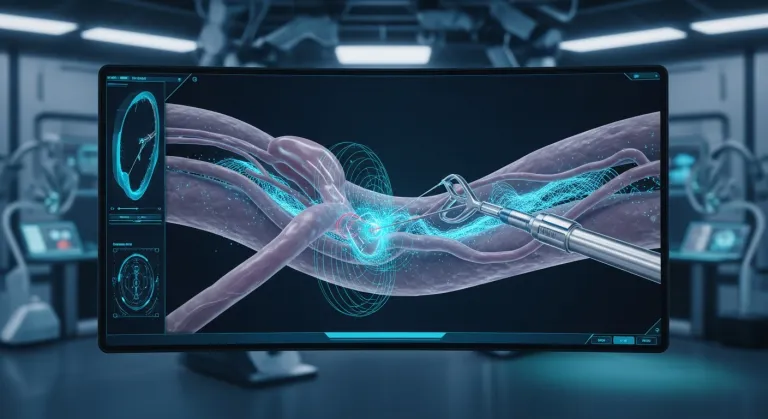
- Classical Physics Simulation: Built on NVIDIA CUDA, Warp, and Newton engines, this layer handles physical constraints such as contact mechanics, friction, instrument flexibility (e.g., catheters and guidewires), and kinematics.
- Generative AI Physics: Powered by NVIDIA Cosmos-H Dreams, this component uses generative AI trained on procedural dataset runs to simulate visual scene dynamics, acoustic scattering, and radiologic visual feedback (such as simulated intraoperative X-ray and fluoroscopy).
According to NVIDIA's technical benchmarks, running this unified stack natively on GPU instances enables massive scale. By running 8,192 parallel training environments concurrently, reinforcement learning algorithms achieve policy convergence in under 120 seconds—a process that previously required more than five hours on traditional CPU-bound physical engines.
European MedTech Impact: CMR Surgical and Clinical Datasets
European companies are already integrating this framework into active development pipelines. UK-based surgical robotics leader CMR Surgical—developer of the Versius robotic system—collaborated with Cambridge Consultants (Capgemini) to train Cosmos-H Dreams models on soft-tissue interaction mechanics.
Crucially, CMR contributed nearly 500 hours of anonymized clinical data gathered during real-world surgical procedures (including cholecystectomies, prostatectomies, hernia repairs, and hysterectomies) to the Open-H Embodiment dataset. This open sharing allows medtech startups across the European continent to train on real surgical dynamics without needing multi-million-euro data collection budgets.
Other global players, including Johnson & Johnson MedTech (building digital twins for its MONARCH endoluminal urology platform) and Medtronic Structural Heart, are utilizing the framework to generate simulated X-ray imagery for automated catheter navigation research.
Infrastructure & Deployment Costs for European Labs
Because the simulation stack is open source, European research groups and companies can deploy it on local hardware or within European cloud environments (such as Scaleway, OVHcloud, or Hetzner GPU instances) to maintain strict data sovereignty.
In our tests on local hardware in our AI Arena test rig, accelerated physics workloads benefit heavily from unified VRAM memory pools and high tensor core throughput. Below is an overview of estimated deployment hardware requirements and hosting costs in Europe:
| Deployment Tier | Recommended Hardware | Parallel Environments | Estimated Cost (EUR / USD) |
|---|---|---|---|
| Local Workstation | 1x NVIDIA RTX 4090 (24 GB) or RTX 6000 Ada (48 GB) | 256 – 1,024 | ~€1,800 / $1,950 (One-time hardware purchase) |
| EU Cloud Node | 1x NVIDIA L40S (48 GB) on Scaleway / OVHcloud | 2,048 | ~€1.35 / $1.45 per hour |
| Enterprise Cluster | 8x NVIDIA H100 / H200 HGX Node | 8,192+ | ~€18.50 / $20.00 per hour |
Regulatory Implications: EU AI Act and Medical Device Regulation (MDR)
For European companies, technical performance is only half the battle; regulatory acceptance is equally critical. Surgical robotics and AI-driven diagnostic instruments fall under Annex III of the EU AI Act as high-risk AI systems, requiring strict data governance, transparency, and reproducibility.
In addition, obtaining CE mark certification under the EU Medical Device Regulation (MDR 2017/745) requires comprehensive validation evidence. Open-source medical physics framework code addresses these regulatory demands directly in three key ways:
- Model Transparency: Full access to source code and model weights eliminates "black-box" simulation risks during notified body audits.
- In Silico Clinical Trials: Generating high-fidelity synthetic patient anatomies allows teams to produce statistically significant pre-clinical safety evidence without ethical risks.
- GDPR-Compliant Training: Training policies inside synthetic physical digital twins minimizes the need to handle sensitive patient biometric raw video feeds.
Is the NVIDIA Medical Physics Simulation framework free to use in commercial European products?
Yes. The core physics framework and reference scripts are open-sourced under permissive software licenses. Developers can inspect, modify, and build commercial products on top of the stack without licensing fees, though specific pretrained foundational weights may have individual usage terms.
Can synthetic data from this framework be used for CE Mark certification under EU MDR?
Yes. Regulators under the EU Medical Device Regulation (MDR 2017/745) increasingly accept in silico evidence and synthetic bench testing as part of technical documentation, provided the physics parameters and simulation validation methodology are clearly documented.
What software environment is required to run Isaac for Healthcare Medical Physics?
The framework runs on Linux (Ubuntu 22.04 LTS or later) with NVIDIA CUDA 12.x drivers, Python 3.10+, and the NVIDIA Warp and Isaac Lab libraries installed.