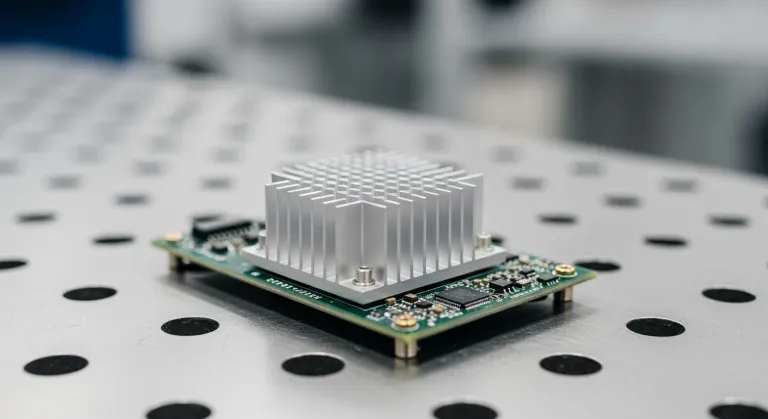
The Shift from Cloud Dependency to Edge AI Intelligence
As artificial intelligence shifts from simple text generation toward physical AI—including autonomous mobile robots (AMRs), industrial vision systems, and localized sensor processing—the reliance on distant cloud data centers is reaching technical and regulatory limits. Cloud latency, bandwidth costs, and network reliability create significant bottlenecks for real-time edge operations. NVIDIA’s latest focus on its NVIDIA Jetson lineup addresses these friction points by bringing server-class computing performance into power-efficient, credit-card-sized SOMs (System-on-Modules).
According to NVIDIA's latest announcement, the Jetson architecture is designed to support the complete lifecycle of physical AI—from computer vision pipelines powered by DeepStream to generative AI models running locally. By utilizing hardware acceleration through Tensor Cores, developers can now deploy quantized Vision-Language Models (VLMs) and Small Language Models (SLMs) directly inside factory machinery, retail cameras, and agricultural drones.
Jetson Hardware Lineup & European Pricing Matrix
To understand where edge hardware fits into industrial deployments, it helps to compare compute throughput, thermal envelopes, and acquisition costs across the primary Jetson configurations. Prices in Europe reflect regional distribution and VAT structures through official partners such as Arrow Electronics, Mouser Electronics, and Seeed Studio.
| Module / Dev Kit | AI Compute (TOPS) | Memory (RAM) | Power Consumption | Price (USD MSRP) | Est. EU Price (incl. VAT) | Primary EU Use Case |
|---|---|---|---|---|---|---|
| Jetson Orin Nano (8GB) | Up to 40 TOPS | 8 GB LPDDR5 | 7W – 15W | $249 | €265 – €285 | Smart cameras, entry robotics, drone vision |
| Jetson Orin NX (16GB) | Up to 100 TOPS | 16 GB LPDDR5 | 10W – 25W | $599 | €640 – €680 | Factory automation, edge video analytics |
| Jetson AGX Orin (64GB) | Up to 275 TOPS | 64 GB LPDDR5 | 15W – 60W | $1,999 | €2,150 – €2,300 | Autonomous vehicles, local LLM edge servers |
Running Generative AI at the Edge: Real-World Performance
Historically, running Generative AI required multi-GPU server nodes. However, optimization tools like TensorRT-LLM and quantized open-weights models (such as Mistral 7B, Llama 3 8B, and Phi-3) have altered the edge deployment landscape. A Jetson AGX Orin 64GB module operating at 50W can execute quantized 7-billion-parameter models at inference speeds suitable for real-time human-robot interaction.
In our own practical testing across our local testing setups detailed in the AI Arena benchmarks, running quantized open-weights models locally on dedicated hardware significantly eliminates external network latency. While high-end desktop GPUs like our workstation RTX setup deliver peak token throughput for heavy multi-user workloads, edge modules like Jetson prove that single-purpose local agents can function continuously within tight power budgets without relying on external cloud APIs.
The European Perspective: AI Act Compliance and Data Sovereignty
For European companies, deploying edge hardware is not merely an engineering choice; it is increasingly a regulatory strategy. Under the EU AI Act and strict GDPR mandates, transmitting raw audio, video feeds, or biometric data from industrial premises to external cloud servers introduces complex compliance requirements and potential security vulnerabilities.
- Data Privacy by Design: Processing video feeds locally on a Jetson module inside a factory or healthcare facility means sensitive raw data never leaves the local network. Only anonymized telemetry or text summaries need to be transmitted upstream.
- Zero Latency for Safety-Critical Systems: Industrial safety systems—such as automated emergency stops on robotic assembly lines—cannot tolerate network drops or cloud outage risks. Edge processing guarantees deterministic execution times.
- Operational Resilience: Isolated critical infrastructure (such as offshore wind farms in the North Sea or remote agricultural facilities in Southern Europe) can run computer vision models continuously even when satellite or cellular connections fail.
Software Stack: NVIDIA JetPack, Isaac ROS, and DeepStream
Hardware power is ineffective without targeted software integration. The Jetson ecosystem relies on the NVIDIA JetPack SDK, which provides a unified Linux environment alongside CUDA-X acceleration libraries. For robotics developers, the integration with Isaac ROS (Robot Operating System) offers hardware-accelerated ROS 2 packages, enabling rapid spatial mapping, visual odometry, and obstacle avoidance.
Furthermore, European manufacturing integrators widely utilize DeepStream SDK for multi-stream vision processing. A single Jetson Orin NX module can process up to 32 concurrent 1080p video streams running object detection and classification models simultaneously, significantly reducing hardware footprints in logistics hubs and smart transport infrastructure.
Availability across Europe
NVIDIA Jetson developer kits and production-ready system-on-modules are fully available across all 27 EU member states, as well as the UK and Norway. System integrators building industrial-grade solutions can acquire ruggedized Jetson enclosures directly from European embedded system vendors such as AAEON, Advantech, and Connect Tech, ensuring compliance with CE certification standards for industrial deployment.
Is the NVIDIA Jetson platform suitable for training AI models locally?
No. While Jetson hardware is technically capable of running small training routines or fine-tuning, it is optimized specifically for local inference. Model training should be performed on desktop GPUs, cloud clusters, or workstation rigs, after which the compiled model is exported via TensorRT for efficient deployment on Jetson.
How does edge AI processing help with EU AI Act compliance?
Edge AI keeps data processing local to the device. By processing sensitive biometric or operational data entirely on-site on a Jetson module, organizations reduce the risk of unauthorized data transfers, fulfilling GDPR data minimization principles and easing EU AI Act governance obligations.
Can Jetson modules run standard open-source models like Llama 3 or Mistral?
Yes. Utilizing NVIDIA TensorRT-LLM and optimized runtimes, Jetson Orin modules with 16GB or 64GB of RAM can run quantized 7B and 8B parameter open-weights models smoothly for localized conversational and decision-making tasks.