Why quantum computers remain so fragile
Quantum computers promise breakthrough changes in drug development, materials research, logistics, and climate modeling. So far, however, they remain mostly trapped in laboratories. The reason is not only the complexity of their construction, but above all the extreme sensitivity of the basic computing units — qubits.
Qubits, unlike classical bits that take values of 0 or 1, can exist in a superposition of both states simultaneously. Thanks to this, quantum processors can solve some problems exponentially faster than the most powerful classical supercomputers. But this advantage comes at a price: quantum states are extremely fragile. Temperature fluctuations, electromagnetic noise from surrounding electronics, or minor hardware imperfections can "throw off" a qubit within a fraction of a second. The best current quantum processors make an error approximately once per thousand operations. For truly useful computations, however, the error rate needs to be reduced to the level of one error per trillion operations.
This gap is what NVIDIA Ising — a family of open AI models that are meant to serve as the "control system" of quantum machines — is trying to bridge. "AI is essential for practical quantum computing. With Ising, AI becomes the control plane — the operating system of quantum machines that transforms fragile qubits into scalable and reliable quantum-GPU systems," said Jensen Huang, founder and CEO of NVIDIA, in the official press release.
Ising Calibration: AI that reads quantum graphs
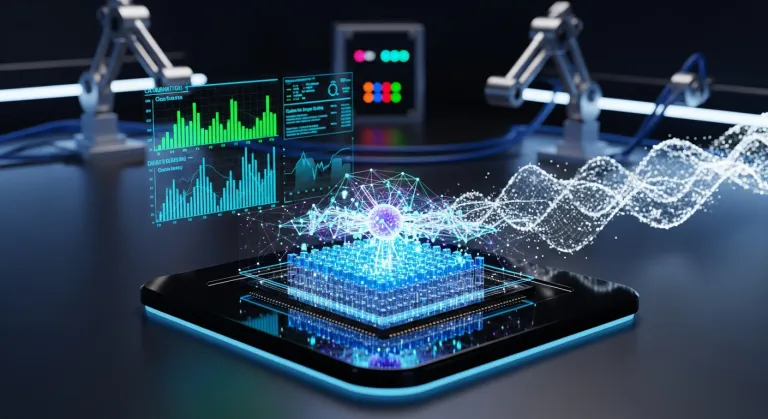
One of the two main components of the Ising family is the Ising Calibration model. It is a vision-language model (VLM) with 35 billion parameters that can read and interpret outputs from quantum experiments — specifically calibration graphs and measurement data that scientists normally analyze manually.
Calibrating a quantum processor is a process in which the parameters of individual qubits are tuned to achieve the best possible performance. In practice, this often means that researchers spend entire days examining complex graphs and gradually adjusting settings. Ising Calibration shortens this process to hours. The model is able to recognize when a qubit "drifts" — that is, when its parameters slowly change over time — and propose a specific correction.
NVIDIA trained the model on real data from partners using different types of qubits: superconducting qubits, quantum dots, ions, neutral atoms, as well as special platforms such as electrons on helium. This makes the model usable across different hardware architectures. The performance of Ising Calibration was verified on the new QCalEval benchmark, which NVIDIA developed in collaboration with quantum laboratories. The results are remarkable: Ising Calibration 1 outperforms Gemini 3.1 Pro by 3.27%, Claude Opus 4.6 by 9.68%, and GPT 5.4 by 14.5% in average score across six calibration tasks. For Czech readers, this means that the world's largest language models, which we know from ChatGPT or Claude, are not as effective in this specific scientific task as a specialized tool.
The model can also be deployed in a so-called agent workflow — an autonomous mode where the AI itself performs calibration iterations until the processor reaches the required specifications. Thanks to integration with the NVIDIA NeMo Agent Toolkit, developers can create their own calibration agents with minimal human supervision.
Ising Decoding: 2.5× faster error correction
The second pillar of the Ising family is Ising Decoding — a tool for quantum error correction (QEC). Even with perfect calibration, errors in quantum computation occasionally appear. The key is to detect and correct them before they accumulate and invalidate the entire result.
Ising Decoding uses 3D convolutional neural networks (CNN) to process so-called syndromes — measurements that reveal where in the quantum processor an error likely occurred. NVIDIA offers two pre-trained models: one optimized for speed, the other for accuracy.
According to official NVIDIA data, the fast model (Fast) with approximately 912,000 parameters is 2.5× faster and 1.11× more accurate than the current open-source standard pyMatching when working with a distance-13 code. The more accurate model (Accurate) with 1.79 million parameters achieves 2.25× higher speed and 1.53× better accuracy than pyMatching. For larger codes (distance 31), the accurate model can improve logical error rate (LER) by up to 3× compared to standard procedures.
For the average reader: lower latency and higher accuracy mean that a quantum processor can run longer without interruption, which is critical for performing more complex computations. NVIDIA demonstrated that the combination of the accurate model with PyMatching on a DGX GB300 server achieves latency of 2.33 microseconds per round — fast enough to control real quantum experiments in real time.
Openness as a competitive advantage
One of NVIDIA's most important decisions is that the entire Ising family is fully open. The models, training frameworks, datasets, and deployment recipes are available under the Apache 2.0 license on Hugging Face, GitHub, and build.nvidia.com. This means that researchers can freely modify, adapt to their own hardware, and run the models locally — without having to send sensitive data about their quantum processors to the cloud.
This approach is relatively rare in quantum research. Many teams have so far worked with closed tools or developed their own internal solutions, which made comparing results across laboratories difficult. Ising should bring standardization and accelerate collaboration between teams using different hardware platforms.
Among the first adopters are respected institutions such as Fermi National Accelerator Laboratory (Fermilab), Harvard School of Engineering, Lawrence Berkeley National Laboratory, Cornell University, University of Chicago, IonQ, IQM Quantum Computers, Infleqtion, Q-CTRL, and Yonsei University in South Korea. In Europe, for example, the British National Physical Laboratory (NPL) and Finnish startup IQM Quantum Computers have joined the project, indicating that the European quantum ecosystem is actively integrating AI into its work.
Hybrid future: when quantum computers become useful
NVIDIA Ising is not a standalone product, but part of a broader ecosystem of hybrid quantum-classical computing. The models are designed to work together with the CUDA-Q platform — NVIDIA's software solution for orchestrating computations across classical GPUs, CPUs, and quantum processors (QPU). For real deployment, the NVQLink technology is also key, which ensures low-latency connection between the quantum processor and classical accelerators.
This hybrid approach reflects the reality that fully quantum supercomputers are still distant. Rather than standalone quantum machines, the first practical systems will likely be specialized quantum accelerators connected to classical data centers, similarly to how GPUs accelerate machine learning today. According to analytics company Resonance, the quantum computing market should exceed $11 billion by 2030. However, this growth is conditional on solving engineering challenges such as calibration and error correction.
For Czech readers and companies, it is important that quantum computers are not yet commercially available as products for the general market. NVIDIA Ising is primarily a tool for researchers and developers. The Czech Republic has its representation in quantum research, for example through projects at CTU in Prague or the Czech Academy of Sciences, although direct participation in the Ising project has not yet been announced. With the European Union's increasing emphasis on quantum technologies within programs such as Quantum Flagship, however, open tools like Ising could facilitate involvement even for smaller European teams.
Where to start and what the limits are
Interested parties can download the models from Hugging Face or GitHub. In addition to the models themselves, NVIDIA also provides a so-called cookbook — a collection of recipes for deployment, fine-tuning, and quantization. Ising Calibration 1 is also available as an NVIDIA NIM microservice, which facilitates integration into existing development pipelines.
But it is necessary to maintain realistic expectations. Ising is a powerful tool, not a magic solution. Quantum computing remains a field where physical limits — cooling to temperatures near absolute zero, electromagnetic shielding, complexity of control electronics — still play a fundamental role. NVIDIA itself states that some products and features described in the press release are in development and their availability may change. Nevertheless, it is a signal that AI is becoming an indispensable part of the path to fault-tolerant quantum systems — that is, machines that can reliably function even when errors occur.
Can researchers in the Czech Republic use NVIDIA Ising for free?
Yes, the models are available under the open Apache 2.0 license, which means they can be freely used, modified, and distributed. They are available on Hugging Face and GitHub. Deployment via NVIDIA NIM microservices may require a subscription or credits depending on the specific platform, but the models themselves and training frameworks are free.
What is the difference between Ising Calibration and Ising Decoding?
Ising Calibration is a vision-language model that automates quantum processor calibration — it reads experimental graphs and proposes setting adjustments. Ising Decoding is a 3D convolutional neural network that corrects errors occurring during quantum computation in real time. Simply put: calibration ensures the processor works correctly, while decoding fixes errors that still occur.
When will quantum computers be available for ordinary companies in Europe?
The exact date is not known. Analysts estimate that the quantum computing market will exceed $11 billion by 2030, but this does not mean mass availability. The first practical deployments are expected in areas such as pharmaceutical research, materials science, and financial modeling, where hybrid quantum-classical systems are already being tested today. For smaller companies in the Czech Republic, the first contact will likely be cloud access to quantum simulators through large provider platforms.
PEREX: NVIDIA unveiled Ising — the first open family of AI models for quantum computers. Specialized tools accelerate qubit calibration from days to hours and increase error correction accuracy up to threefold. What does this mean for the future of hybrid quantum computing and European research?
TITLE: NVIDIA Ising: The first open-source AI models that stabilize fragile qubits for hybrid quantum computing