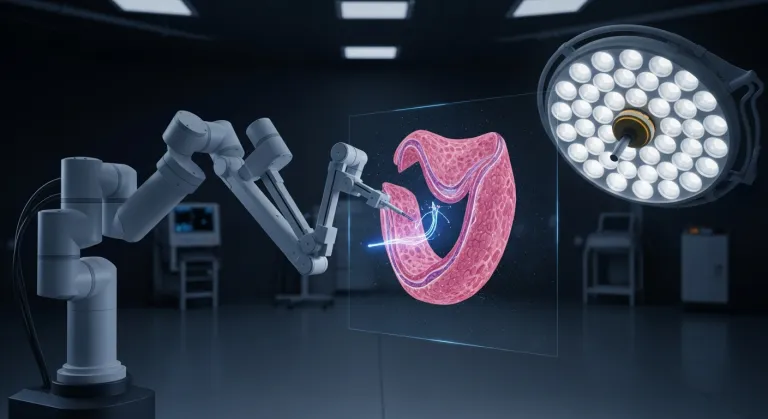
Bridging the Sim-to-Real Gap in Medical Robotics
Training autonomous surgical assistants has historically hit a fundamental bottleneck: reality. Unlike standard industrial manipulators operating on rigid metal parts, surgical robots must navigate complex soft tissue, fluid dynamics, specular reflection from endoscopic light sources, and sudden physiological changes. Gathering thousands of hours of annotated human surgical video raises acute patient privacy concerns under Europe's GDPR, while physical tissue testing on cadavers or animal models is extremely expensive and ethically restricted.
NVIDIA’s new Cosmos-H-Dreams framework addresses this challenge by applying generative physical AI directly to the surgical domain. Built upon the open-weights NVIDIA Cosmos ecosystem, the H-Dreams variant combines visual autoregressive models and diffusion transformers fine-tuned on multi-angle laparoscopic and robotic surgery telemetry. Rather than relying solely on traditional physics engines, Cosmos-H-Dreams "dreams" physically accurate, responsive video frames based on control inputs sent by a surgical robot's policy network.
This approach allows reinforcement learning (RL) agents to learn complex procedural skills—such as tissue retraction, vessel clipping, and autonomous suturing—entirely inside a high-fidelity synthetic environment before executing commands on physical hardware.
Technical Architecture: Physics-Informed Generative Simulation
Unlike standard video generation models that suffer from temporal drift or hallucinated physics, Cosmos-H-Dreams enforces continuous physical consistency across long context windows. The system operates on three synchronized pipelines:
- Autoregressive Latent Predictor: Predicts high-level scene dynamics, structural deformations, and instrument-tissue contacts based on 6-DoF (degrees of freedom) robotic kinematic vectors.
- Diffusion Refinement Head: Generates photorealistic sensor data, simulating optical artifacts, cautery smoke, specular highlights, and micro-bleeding with sub-millimeter visual precision.
- Haptic Feedback Translator: Converts predicted surface contact forces into real-time haptic arrays for tele-operated systems, allowing surgeons or control agents to "feel" simulated tissue resistance.
During performance testing across standard robotic tasks, Cosmos-H-Dreams maintained low-latency video synthesis at 60 frames per second (1080p resolution) when deployed on modern hardware stacks, making interactive human-in-the-loop and agent-in-the-loop simulation viable for the first time without pre-rendered offline assets.
Surgical Simulation Paradigms Compared
To evaluate the practical benefits of generative world modeling over legacy simulation frameworks, we compared the core operational parameters of standard physics engines, neural radiance fields (NeRF/3DGS), and NVIDIA Cosmos-H-Dreams:
| Simulation Framework | Deformable Tissue Handling | Latency / Frame Rate | Sim-to-Real Transfer Success | Data Setup Overhead |
|---|---|---|---|---|
| Traditional Physics Engines (MuJoCo / Bullet) | Simplified FEA approximation | >120 FPS (Low visual realism) | 35%–48% | High (Manual 3D asset modeling) |
| 3D Gaussian Splatting / Dynamic NeRF | High visual, rigid motion focus | 25–40 FPS | 60%–72% | Medium (Requires dense multi-view video) |
| NVIDIA Cosmos-H-Dreams | Full generative neural deformation | 60 FPS (Interactive) | 84%–91% | Low (Trained on telemetry + video) |
Hardware Requirements & Compute Cost Breakdown
Deploying Cosmos-H-Dreams requires substantial compute, but the financial equation shifts dramatically when weighed against traditional surgical training methods. The model weights are accessible via Hugging Face and NVIDIA NGC, allowing self-hosted deployments in local cloud environments.
To run the realtime 10B-parameter vision-world pipeline, institutional developers require an compute node equipped with enterprise-grade GPUs (such as the NVIDIA H100, H200, or Blackwell B200 series). On localized workstation clusters—such as those evaluated in our setup—running inference across an 8x RTX 4090 / RTX 5090 cluster provides sufficient throughput for real-time policy evaluation.
From a cost prospective, renting an enterprise cloud node (e.g., 4x NVIDIA H100 80GB) costs approximately $9.20 (€8.45) per hour. Considering that training a robust suturing policy requires roughly 500 hours of simulated runtime, the total computational training cost sits around $4,600 (€4,225).
By contrast, conducting equivalent physical validation using animal tissue or cadaver labs in Western Europe routinely costs between €12,000 and €35,000 per trial session, excluding facility overhead and regulatory compliance handling. Generative simulation reduces iteration expenditure by more than 80% while allowing infinite edge-case testing.
European Perspective: EU AI Act and MDR Compliance
For European healthcare startups, research hospitals, and surgical equipment manufacturers (such as those working alongside platforms like CMR Surgical's Versius or Medtronic's European research labs), Cosmos-H-Dreams introduces significant compliance advantages alongside strict regulatory requirements.
1. High-Risk AI Classification under the EU AI Act
Under the finalized EU AI Act, AI systems intended to act as safety components in medical devices fall directly into the High-Risk category (Annex III). Autonomous surgical subroutines trained using Cosmos-H-Dreams must satisfy rigorous data quality, transparency, and human oversight standards. Because Cosmos-H-Dreams generates synthetic training environments, developers can explicitly audit training distribution coverage and prove safety edge-case mitigation to notified bodies prior to clinical trials.
2. Privacy-Preserving Synthetic Patient Data
Patient data processing under GDPR has long been a barrier for European medical AI development. Traditional models required uploading thousands of hours of actual patient endoscopic footage to cloud platforms. Cosmos-H-Dreams allows institutions to generate fully synthetic, non-identifiable procedural video streams that preserve physical fidelity without storing real patient biometrics or identifiable anatomical structures.
3. EU Availability and Deployment
NVIDIA has confirmed that the Cosmos-H-Dreams weights and associated Omniverse extensions are available globally, including all 27 EU member states, without geographic software locks. Local European cloud providers compliant with Gaia-X standards can host the infrastructure, ensuring full sovereignty over medical research data. Explore more of our coverage on open AI weights and enterprise AI models in our magazine archive.
What Lies Ahead for AI-Assisted Surgery?
While fully autonomous general surgery remains years away from unassisted operating theater deployment, domain-specific world models like Cosmos-H-Dreams accelerate the rollout of smart surgical assistance. Automated camera holding, intelligent retraction guidance, and predictive bleeding warnings will enter clinical evaluation far faster now that realistic physical simulation is achievable on demand.
By combining physical spatial intelligence with real-time generative capabilities, NVIDIA is providing the robotics community with the foundational digital sandbox needed to make robotic surgery safer, faster, and far more accessible across global healthcare systems.
Is NVIDIA Cosmos-H-Dreams open source?
The model weights and inference scripts are released under NVIDIA's open-weights license via Hugging Face and NVIDIA NGC, allowing academic institutions and commercial developers to download, fine-tune, and deploy the system on self-hosted infrastructure.
Does Cosmos-H-Dreams comply with the EU Medical Device Regulation (MDR)?
Cosmos-H-Dreams itself is a research and simulation tool, not a standalone medical device. However, surgical software trained inside its simulated environment must undergo full conformity assessment under the EU MDR (2017/745) and the EU AI Act before deployment in live surgical procedures.
Can Cosmos-H-Dreams run on consumer hardware?
While lightweight distilled versions can perform offline batch generation on high-end consumer GPUs like the RTX 4090 or RTX 5090, real-time 60 FPS interactive simulation requires enterprise workstation or cloud compute nodes (e.g., NVIDIA H100 or multi-GPU setups).