What they're actually doing
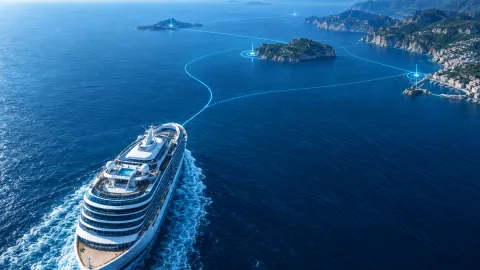
The core technology is Distributed Acoustic Sensing (DAS) — a technique that turns a standard fiber-optic cable into thousands of virtual acoustic sensors. A single strand of fiber can detect vibrations, track vessel movements, and pinpoint unusual activity along its entire length. The catch: laying that cable optimally isn't trivial. A straight line between two points might be cheap, but it probably won't give you the acoustic coverage you need.
This is where Strangeworks comes in. Their Aura platform evaluates thousands of deployment scenarios using whatever computational approach fits the problem — classical optimization, quantum-inspired algorithms, or actual quantum computing when hardware allows. As William Hurley, CEO of Strangeworks, put it: "Aura was built to help organizations solve complex optimization problems by selecting the most appropriate computational approach for each challenge." The platform already serves clients including BP, Deloitte, Lufthansa, and Raytheon (RTX).
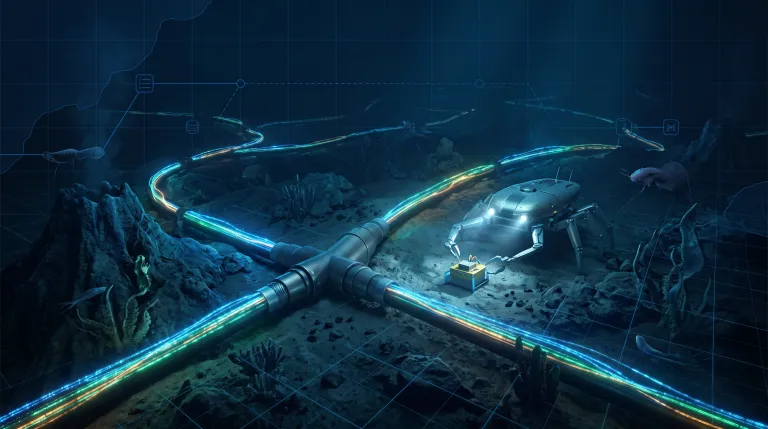
On the hardware side, Nauticus Robotics (NASDAQ: KITT) brings Aquanaut, an all-electric autonomous subsea robot capable of transforming from a streamlined AUV into a dual-arm manipulator for intervention tasks. Its ToolKITT autonomy software handles mission planning and sensor integration. "Aquanaut and our ToolKITT autonomy platform, combined with Strangeworks' advanced optimization capabilities, have the potential to dramatically improve how distributed sensing networks are designed, deployed, and maintained while reducing installation time and cost," said John Gibson, CEO of Nauticus.
How DAS sensing actually works (the short version)
DAS sends laser pulses down a fiber-optic cable and measures the backscatter caused by acoustic vibrations along its length. Every few meters of fiber becomes a sensing point. The result: one cable replaces hundreds of individual hydrophones, and it works with existing telecom fiber — meaning you can piggyback sensing on cables already laid for internet traffic.
The optimisation problem that Aura tackles is genuinely hard. You're choosing a path for a cable through variable seabed conditions, trying to maximise acoustic coverage of a target area, minimising the number of interrogator units (the hardware that sends and reads laser pulses), and accounting for shipping lanes, existing infrastructure, and environmental constraints. A simple shortest-path algorithm doesn't cut it — this is closer to a multi-objective vehicle routing problem with non-convex terrain, which is precisely the kind of problem Strangeworks' heterogeneous hybrid compute approach was built for.
Why Europe should care
Some numbers worth knowing: roughly 99% of intercontinental data traffic travels through subsea fiber-optic cables, and Europe hosts a disproportionate share of the world's cable landing stations. The UK alone has landing points for over 60 active cables; France and Ireland each host dozens more. The North Sea and Baltic Sea are among the most cable-dense waters on the planet.
Since 2023, there have been at least five documented incidents of subsea infrastructure damage in the Baltic Sea alone — affecting gas pipelines, power cables, and telecommunications links between Finland, Estonia, Sweden, and Germany. NATO responded in 2024 with the Baltic Sentry operation, deploying ships, drones, and patrol aircraft to monitor critical undersea assets. The EU followed with updated Critical Infrastructure Resilience guidance in late 2024.
DAS-based monitoring networks could give European navies and infrastructure operators real-time awareness of what's happening near their cables and pipelines — without requiring thousands of dedicated hydrophones or constant patrols. The Nauticus-Strangeworks approach targets a key bottleneck: the planning phase. If you can optimise where to lay sensing fiber, you can cover larger areas with less equipment and lower installation cost.
There's also an offshore energy angle. Europe currently has over 30 GW of installed offshore wind capacity, projected to reach at least 120 GW by 2030 under the EU's REPowerEU plan. Every wind farm relies on subsea power cables. DAS monitoring could detect anchor strikes, cable tampering, or seabed scouring before failures occur — and AI-optimised deployment could make that coverage economically viable at scale.
The economic case
A single transatlantic subsea cable costs between $200 million and $400 million (approximately €180–360 million) to build. When one fails — whether from an anchor drag, seismic activity, or deliberate sabotage — the repair vessel alone can cost $70,000–100,000 per day (€63,000–90,000), with repair operations typically lasting two to four weeks depending on depth and location.
Compare that to the cost of adding sensing capability to a cable during initial installation: it's primarily software and interrogator hardware, not fundamentally different cable. The business case for AI-optimised DAS deployment starts looking very compelling when you consider that the undersea cable market is projected to exceed $40 billion by 2030 globally.
Neither Nauticus nor Strangeworks has disclosed specific pricing or timelines for this collaboration yet. This is an exploratory partnership — a proof-of-concept phase, not a product launch. As Dr. Kjerstin Easton, VP of Autonomous Software at Nauticus, noted: "This collaboration will let us explore how advanced computational planning can complement autonomous subsea operations and help us better understand where these techniques can improve real-world deployment challenges." Translation: they're figuring out if this actually works at production scale, not just in a simulation.
What's actually new here
Individually, neither piece is unprecedented. Autonomous underwater robots exist (Oceaneering, Saab Seaeye, Kongsberg). Optimisation platforms exist (Gurobi, CPLEX, Google OR-Tools). DAS sensing has been used in oil and gas for over a decade (Schlumberger, Halliburton).
What's new — and genuinely interesting — is the combination: pairing a physically deployable autonomous robot (Aquanaut) with a heterogeneous compute platform that can model the deployment as a full optimisation problem, not just run a shortest-path algorithm. The collaboration also suggests a pathway from sensing deployment to data processing: once cables are in place, the same computational infrastructure could help make sense of the massive acoustic data streams DAS generates — terabytes per day for a single cable.
The risk, as with any optimization-for-the-physical-world project, is the reality gap. Seabed conditions, marine life interference, and operational weather constraints don't always match the model. But Strangeworks' track record with clients like RTX and BP suggests they understand that production-grade systems need to handle real-world noise.
What comes next
The companies hinted at future applications beyond deployment planning: port security, offshore energy, subsea telecommunications, environmental monitoring, and defense. For European readers, the most immediate relevance lies in the Baltic and North Sea, where NATO and EU member states are actively investing in subsea situational awareness.
We'll be watching for concrete results — a pilot deployment, a white paper with real-world metrics, or integration with an EU member state's maritime surveillance program. Until then, it's a promising convergence of three technologies (autonomous robotics, AI optimisation, and fiber sensing) that each work separately today, but have rarely been combined in a single deployment pipeline.
Is DAS sensing technology already deployed in Europe?
Yes — oil and gas companies have used DAS for pipeline monitoring in the North Sea for years. Telecom operators and research institutions (including Norway's SINTEF and the UK's National Physical Laboratory) have tested DAS on existing subsea telecom cables. What's new here is the AI-driven deployment planning layer.
Can existing subsea cables be retrofitted with DAS sensing?
In many cases, yes. DAS can work with standard single-mode fiber already in place, provided the fiber has a spare strand available. The interrogator unit connects at the landing station — no underwater hardware changes needed. This makes retrofitting existing cables significantly cheaper than laying new dedicated sensing cables, though coverage patterns depend on the existing cable route, which may not be optimal for sensing purposes.
Does this technology fall under any EU AI Act regulations?
The AI Act primarily regulates high-risk AI systems in areas like biometrics, critical infrastructure management, and law enforcement. Undersea sensing for critical infrastructure protection could potentially be classified as high-risk under the critical infrastructure provisions, but the current Nauticus-Strangeworks collaboration is exploratory R&D — well upstream of any deployable system that would trigger regulatory review.