The work, reported by Quantum Zeitgeist in mid-November, uses Qwen3-30B-A3B-Instruct-2507 as the classical base. That is a 48-layer mixture-of-experts model with a hidden dimension of 2,048, openly downloadable from Hugging Face.
The team removed eight contiguous transformer blocks, meaning both the self-attention and the MoE feed-forward parts, and inserted one QNN module. Residual connections stayed in place. That detail matters more than it sounds: when you substitute a layer type in the middle of a deep network, the skip path is what keeps gradients flowing and stops the model from falling apart during fine-tuning.
How the data gets onto the chip
Inside the module the hidden dimension is split into disjoint heads that are processed in parallel on NISQ-era quantum registers. The input is encoded as rotation angles, but angle encoding is not cheap in qubit terms: it needs one qubit per encoded feature, so the qubit count grows with the hidden dimension. That is precisely why the team partitions the 2,048-dimensional hidden space into k disjoint heads on separate registers and couples them with constrained classical mixers. Amplitude encoding would need only logarithmically many qubits, but it does not scale to a 2,048-dimensional hidden space.
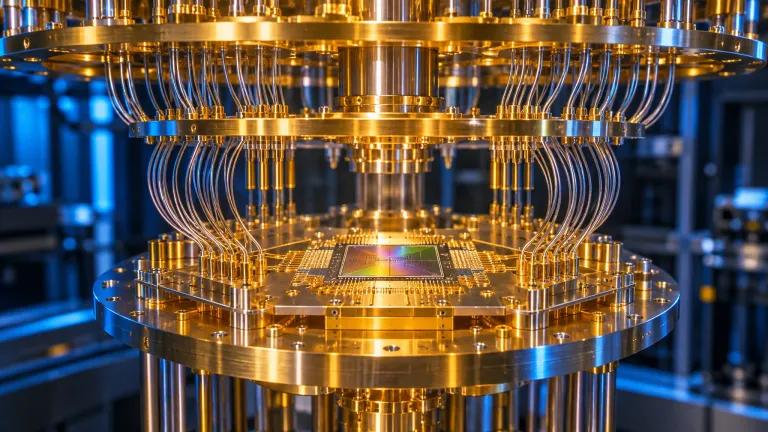
Running the modules on physical hardware rather than a simulator is the part that separates this from the pile of quantum-ML papers that never leave a laptop. IBM's Heron is a 156-qubit superconducting processor, and access to it is sold through the cloud rather than as a box you buy.
The arithmetic behind 16.33 percent
Sixteen percent of a 30B model is roughly 4.9 billion parameters. Those eight blocks were replaced by 145,281 quantum parameters. Divide one figure by the other and you get about 34,000 classical parameters per quantum parameter.
That ratio should be read with care. Parameter counts measure storage, not capability. A transformer block's weights do work that a quantum circuit instead expresses through entanglement and gate structure, so the two numbers are not the same kind of object. There is a second caveat specific to this model: Qwen3-30B-A3B is a mixture of experts, and only about 3.3 billion of its parameters are active per token. Much of the displaced 4.9 billion sat in expert matrices that were not all used on every forward pass.
The comparison flatters the quantum side. It does not make the result trivial. Earlier quantum-LLM work covered fine-tuning, distillation, natural-language generation, and proposals for quantum self-attention layers in smaller models. Putting a QNN into the core of a 30-billion-parameter model is a change of scale, not a change of slide deck.
Heron and the European footprint
Multiverse Computing is a Spanish company, founded in San Sebastián, with offices in Canada, Germany, the UK and the United States. The hardware side is American. IBM runs a quantum data centre in Ehningen, Germany, and offers EU data residency for quantum workloads processed there.
For a European team that is not a minor footnote. If the data feeding a circuit contains personal data, or embeddings derived from it, the processing location is a GDPR question and not just a latency question. A quantum layer that can only be executed in New York is a different procurement problem from one that can be executed in Baden-Württemberg.
What a token would cost
Nobody has published a price per token for a QNN layer, and that gap is the whole story. IBM meters quantum time by the second, not by output token. There is no published rate card that translates a circuit execution into a cost per generated word, which means the economics of this approach cannot be compared with an API bill yet.
The classical baseline it would have to beat is not standing still. Mistral Large 4 is listed at $0.70 input and $2.10 output per million tokens, with open weights. DeepSeek-V4.1-Flash runs at $0.30/$1.20 peak and $0.15/$0.60 off-peak under an MIT licence. Those are the numbers a European developer actually pays in 2026, and any quantum substitute gets measured against them per token, not per parameter.
On our own hardware
In AI Arena we run a single RTX 5060 Ti with 16 GB of VRAM. A 30B model at 4-bit is about 15 GB of weights before any KV cache is allocated, so Qwen3-30B-A3B does not fit comfortably on that card even with nothing quantum in the picture. This is where the realistic niche sits: not a desktop accelerator card, but racks where a 30B model already costs real money per hour to serve.
What the demonstration does not show
Three numbers are missing from the public description. Latency per generated token, throughput at batch size one, and how much of the training loop ran on the QPU rather than on a simulator with a quantum-inspired layer inside it. A 156-qubit Heron has no error correction, so each circuit needs mitigation, and mitigation costs extra shots on top of the ones you already spent.
Whether the perplexity gap holds when 30 or 50 percent of the blocks are replaced is also outside what has been published so far. Scaling a working 16.33 percent substitution to a larger share of the network is the question that decides whether this becomes an architecture or stays a demonstration.
Practical reading for European teams
If such a model ever reaches production inside the EU, the transparency duties of Article 50 of the AI Act already apply as of August 2026, quantum layer or not: AI-generated output has to be marked, technical documentation has to exist, and the provider registers with the European AI Office. A quantum block inside a transformer changes the compute stack, not the compliance obligations around it.
For now the useful action for a developer is to watch the open-weight side of this. Qwen3-30B-A3B is Apache-2.0 and can be pulled today, so the classical half of the experiment is reproducible on your own metal. The quantum half needs a Heron booking.
Could I reproduce this on a normal GPU server?
Only half of it. The Qwen3-30B-A3B-Instruct-2507 weights are openly downloadable and the classical model runs on GPU hardware, though 30B at 4-bit needs around 15 GB before context. The multi-head QNN requires a superconducting processor, and IBM sells access to Heron systems through its cloud. A GPU-only setup cannot execute the quantum blocks.
Does this mean large language models are moving to quantum chips?
Not from this result. 16.33 percent of one model's parameters were displaced and the remaining 83.67 percent still runs on classical hardware. The published description does not include latency or cost per token, and those two figures decide whether anything reaches production.
Does the EU AI Act say anything about hybrid quantum-classical models?
The Act regulates the system and its output, not the processor type. A provider placing such a model on the EU market falls under the same Article 50 transparency rules that took effect in August 2026, including marking of AI-generated content and registration with the European AI Office.