A Robot in the Living Room Is No Longer Sci-Fi
When in January 2026 Malaysian Minister of Science, Technology and Innovation Chang Lih Kang ceremonially opened the AI World Experience Centre in the digital city i-City near Kuala Lumpur, many people perceived the event as an attractive PR move. The opposite is true: it was the first step toward a long-term project whose ambitions far exceed tourist entertainment. Barely four months later, on 28 April 2026, the partners announced a specific plan — by 2030 they want to get robotics directly into residential buildings.
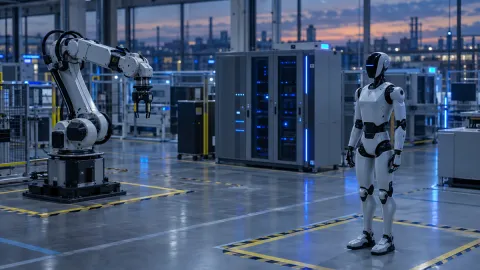
Company I-Berhad, the main developer of i-City, and Chinese firm AgiBot (AGIBOT Innovation Shanghai Technology Co., Ltd.) are not talking about a distant future. The first phase is already underway. i-City is currently testing robots in real conditions of hotel operations, commercial spaces and urban infrastructure. The next stage plans the construction of the so-called AI Tower — the world’s first residential tower fully integrated with humanoid robotics and artificial intelligence.
Who Is AgiBot and Why Does It Matter?
AgiBot is a relatively young but exceptionally dynamic Chinese company founded in 2023. It specializes in so-called embodied AI — artificial intelligence built directly into physical robots that learn and adapt to the real environment. According to analytics company Omdia, AgiBot was the global leader in humanoid robot deliveries in 2025 with a 39 % market share and more than 5,100 units produced. In total, the company had produced 10,000 robots by the end of March 2026.
The company’s portfolio includes several lines. Model A2 is a full-size humanoid robot capable of multimodal interaction and autonomous navigation, intended for example for presentations and showrooms. Compact X2 interacts with people and performs expressive movements, suitable for entertainment, research and education. Industrial G2 combines interactive intelligence with precise manipulation, while quadruped D1 serves for inspection in demanding environments. A separate category is the autonomous commercial robot C5 for cleaning large spaces.
AgiBot uses advanced reinforcement learning methods in the real world in its machines. This means that the robots are not trained only in virtual simulations, but directly in operation — and learn on the go. This approach enables faster adaptation to a specific environment, whether it’s a factory, hotel or apartment building.
What Exactly Are They Planning in i-City?
The main goal of the partnership is to create a closed commercial ecosystem where robots are not just demonstrated but actually work. In the first phase, which has been running since January 2026, AgiBot deploys technologies in the areas of real estate, hospitality, tourism and urban services. At the same time, the partners are focusing on so-called wellness and longevity applications — that is, using robotics and AI to support the health and quality of life of residents.
In spring 2026, I-Berhad announced the next phase: a plan to deploy 100 robots as part of AI World and to launch construction of the first residential units with full robotic integration. The concept counts on robots helping residents with common household tasks, assisting seniors, providing security monitoring and communicating with the smart home. Part of the vision is also the Robots-as-a-Service (RaaS) model, where residents or building managers will not buy robots but rent them as a service.
“By building the world’s first AI and robotic residential tower, we are creating a real testing environment and commercial platform for humanoid robotics. At the same time, we are laying the foundations for bridging advanced robotic capabilities into everyday life,” said Tan Sri Lim Kim Hong, Chairman of I-Berhad, in January 2026.
European and Czech Context: Cautious Optimism for Now
While Malaysia is going into the project of robotic households with full commitment, Europe remains more cautious. In the Czech Republic, humanoid robots have so far appeared primarily in industrial environments — for example, at this year’s Hannover Messe 2026 trade fair the Chinese PL-Universe ProWhite showed how embodied AI is changing manufacturing. However, no Czech residential developer has yet announced a project comparable to the Malaysian AI Tower.
The EU AI Act, which gradually came into force from 2024, classifies robots used in households and social care as higher-risk systems. This means that any commercial deployment of humanoid robots in European homes will be subject to stricter safety and ethical controls than in other parts of the world. On one hand, this may mean a slower adoption; on the other hand, European users should have greater certainty of privacy and security protection.
AgiBot has not yet officially announced its activities in the Czech Republic or Europe. Its expansion into Asia-Pacific began precisely in Malaysia and in 2026 it plans further steps in the region. Europe thus remains outside immediate reach for now, although the company’s global ambitions are clear.
What Do Experts Say?
Analysts following the humanoid robotics market evaluate the Malaysian project as one of the most ambitious attempts at commercial deployment in the residential sector. The key advantage is the closed ecosystem of i-City, where the partners control the infrastructure and operations. This allows robots to be tested in real conditions without the risk of failure in an unknown environment.
At the same time, experts point to technological and regulatory obstacles. Humanoid robots still face problems with fine motor skills, reliability in dynamic environments and safety of interaction with children or seniors. The RaaS model can lower these barriers by transferring responsibility for maintenance and updates to operators rather than individual users.
Summary: From Showroom to Living Room
The i-City and AgiBot partnership represents a concrete step from technology demonstrations to practical deployment. While the first phase in the form of the AI World Experience Centre serves as an exhibition and educational platform, the plan for 2030 aims at the full integration of robots into the everyday life of residents. Whether this vision is fulfilled depends on several factors: technological maturity, price affordability and — in the case of European countries including the Czech Republic — also on adapting the regulatory framework to the new possibilities of embodied AI.
What is embodied AI and how does it differ from ordinary artificial intelligence?
Embodied AI refers to artificial intelligence integrated directly into the physical body of a robot. Unlike chatbots or generative models, which operate only in a digital environment, embodied AI must process sensory data in real time, coordinate movement and interact with the physical world. AgiBot, for example, uses reinforcement learning in real operations, where robots learn manipulation and navigation directly in the given environment.
How does the Robots-as-a-Service (RaaS) model work?
RaaS works similarly to SaaS (Software-as-a-Service) — instead of buying the robot, the user pays a regular fee for its rental and operation. In the case of i-City, this means that robots will be part of the services of the building or apartment complex. The manager ensures maintenance, software updates and possible replacement. For residents, this eliminates high acquisition costs and technical responsibility.
Can the robots from i-City reach the Czech Republic as well?
Not in the foreseeable future. AgiBot has not yet officially announced expansion into Europe and its activities are focused on Asia-Pacific. Moreover, any commercial deployment of humanoid robots in Czech households would have to undergo certifications under the EU AI Act and other safety standards. While in Malaysia the project can advance quickly thanks to local regulation and a closed ecosystem, a similar vision remains in the theoretical realm in the Czech Republic for now.