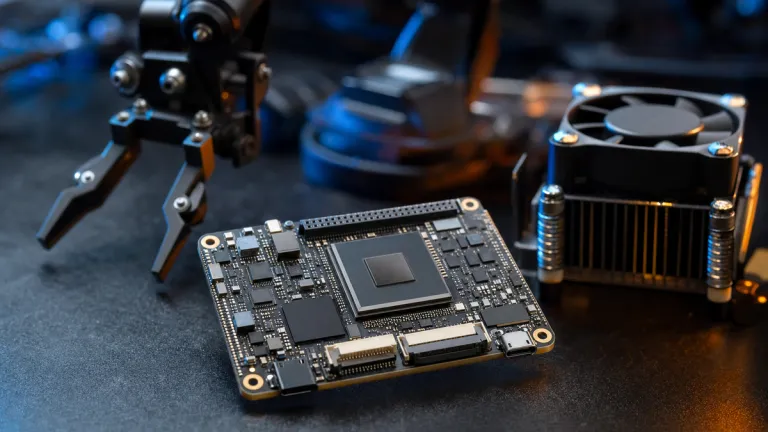
NVIDIA has announced the Jetson Orin Nano 2, a new module for robotics and edge AI. NVIDIA compares the 2× performance claim with the current Orin Nano Super and says the new module draws 40% less power at the same performance level; these are company claims, and independent benchmarks are not yet available. The announcement, reported by Wccftech, targets exactly the segment that has made the Jetson line a default starting point in robotics: compact devices that need real-time perception without a data-center power budget.
This is a focused update to our earlier Jetson coverage (#1070), which looked at how the platform brings edge AI and local generative compute to embedded devices. Here we concentrate on the newly announced Orin Nano 2 power and EU robotics numbers rather than repeating that broader story.
What NVIDIA announced
The Orin Nano 2 builds on the Orin Nano family, NVIDIA's entry point into embedded AI since 2023. The original Orin Nano delivered 40 TOPS of INT8 throughput in a 7–25W envelope, with the developer kit starting at $499 at launch. In December 2024, the software-enabled "Super" refresh lifted the same board to 67 TOPS and cut the kit price to $249. The Orin Nano 2 goes a step further: where the Super improved efficiency within the same hardware, this is a new module that NVIDIA says delivers a 2× throughput target relative to the Super's 67 TOPS, plus a 40% power reduction at equal performance.
That last number deserves the closest look. NVIDIA's 40% figure is a claimed result at equivalent performance, not a guaranteed 15 W operating limit. For example, a stack that runs at 67 TOPS on the Super at 25 W is the kind of workload NVIDIA says could draw around 15 W on the new module. That remains an estimate until independent measurements appear. For a battery-powered robot, it would mean a smaller battery or a lighter thermal design—if the claim holds.
The headline numbers, translated
NVIDIA has not published full specifications yet, so let's do the arithmetic with that caveat out front. NVIDIA's 2× comparison is with the Orin Nano Super's announced 67 TOPS. If that comparison holds, a conditional calculation puts the new module in the 130+ TOPS class; this is not an NVIDIA-published specification. That would be a substantial throughput level for a module the size of a credit card within a power budget a battery can realistically carry.
| Platform | INT8 performance | Power draw | Dev-kit price | Note |
|---|---|---|---|---|
| Jetson Orin Nano (2023) | 40 TOPS | 7–25W | $499 (8GB, at launch) | Family entry point |
| Jetson Orin Nano Super (Dec 2024) | 67 TOPS | 7–25W | $249 (16GB, at launch) | Current value pick, software boost |
| Jetson Orin Nano 2 (announced) | ~130+ TOPS (conditional derived figure, not an NVIDIA spec) | ~15 W at 67 TOPS (claimed 40% reduction, not an NVIDIA spec) | TBA | New announcement |
| Hailo-8L (Raspberry Pi AI Kit) | 13 TOPS | ~2W | ~$70 (vendor price as of 28 Aug 2026) | Budget starter |
The Orin Nano 2 rows are conditional calculations from NVIDIA's announced claims—2× performance against the Super's 67 TOPS, 40% lower power at equal load—not measured results and not NVIDIA-published specifications. Hailo-8L figures come from the vendor's published specifications. The point of the table is not precision—it is the shape of the field. The Orin Nano 2 does not have to beat every NPU per watt; it has to beat the previous generation per robot.
The real moat isn't TOPS — it's the stack
Raw TOPS sells slides, but what makes Jetson valuable in production is the surrounding software: JetPack, CUDA, TensorRT, Isaac ROS, DeepStream. That ecosystem is why developers do not switch away when a competitor posts a better per-watt number.
Consider Hailo: its accelerators have impressive efficiency for pure inference, and a Raspberry Pi AI Kit with a Hailo-8L costs around $70 — the cheapest serious entry into edge AI. But robotics is not a pure inference workload. You need sensor fusion, calibration, path planning, and the ability to run custom kernels when no pre-built operator fits. Jetson's advantage is that it runs the same CUDA stack as a desktop GPU — code graduates out of the lab without a rewrite.
Our own AI Arena benchmark rig exists for a different job: local LLM inference on a desktop RTX 5060 Ti 16 GB, measuring tokens/sec and time-to-first-token. A Jetson module will not win those comparisons, and nobody should buy one to serve chatbots. Its job is real-time perception with deterministic latency, in a power envelope a robot can carry.
European angle: EUR prices, GDPR and the AI Act
For European buyers, availability is the first question, and Jetson has an advantage over NVIDIA's data-center parts: as of 28 August 2026, developer kits ship through normal EU distribution, including Mouser, RS Components, Farnell and TME. For reference, the Orin Nano Super's $249 list price, as of 28 August 2026, is about €230 before VAT at current exchange rates — with national VAT, expect roughly €260–290 depending on the member state.
The regulatory angle matters just as much. Under the EU AI Act, a robotics system is high-risk only where it falls within the Act's specified high-risk categories, including certain AI safety components covered by listed product-safety legislation such as machinery. That means the maker of an autonomous robot carries obligations around risk management, technical documentation and data governance only when its use case qualifies. Local processing may reduce transfers and some data-governance burdens: if the perception model runs on the vehicle, the camera feed of a warehouse full of employees may never leave the device. Fewer transfers can make some GDPR and AI Act data-governance documentation easier to demonstrate, but this does not remove GDPR obligations.
This also fits NVIDIA's roadmap. At GTC 2025 the company unveiled Jetson Thor for humanoid robots. The Orin Nano 2 sits below it as the workhorse: not a humanoid brain, but the smart controller for the kind of robots European manufacturers actually ship in volume today — AMRs, logistics arms, inspection drones.
What a developer can actually do with it
The most interesting workload for the Orin Nano 2 is probably not another YOLO iteration, but a real vision-language model on the edge: a robot that interprets a scene, follows a natural-language instruction, and acts without phoning home. The 2× boost is what NVIDIA argues could make that class of work more practical, but independent benchmarks are not yet available. If you already prototype on an Orin Nano Super, your model code should carry over — staying on the same family and the same software stack is precisely NVIDIA's intent.
Our take is deliberately skeptical: treat 2× and 40% as engineering targets until independent benchmarks land. The Super update was a software change that NVIDIA said unlocked additional TOPS; the useful check for the Orin Nano 2 is the same discipline we apply in the AI Arena: measure it yourself, on your workload, in your power envelope, with your cooling. A board that makes your robot twice as smart is a nice demo. A board that survives a ten-hour shift on one battery is a product.
Is the Jetson Orin Nano 2 already orderable in Europe?
As of 28 August 2026, NVIDIA has not confirmed EU shipping dates. Watch EU distributors such as Mouser, RS Components and TME — they are typically the first to list new Jetson modules.
Will my existing Orin Nano carrier board fit the Orin Nano 2?
As of 28 August 2026, NVIDIA has not confirmed compatibility. Carrier-board and pinout compatibility must be confirmed from NVIDIA's specifications before ordering hardware; do not assume existing carrier boards will fit.
Can it run the local LLMs you benchmark in AI Arena?
Small models in the roughly 1–3B parameter range are the realistic ceiling on Orin-class hardware, and vision-language models in that range are exactly what edge robotics needs. But for serving chat models to users, a desktop GPU remains the right tool.