What the protocol actually does
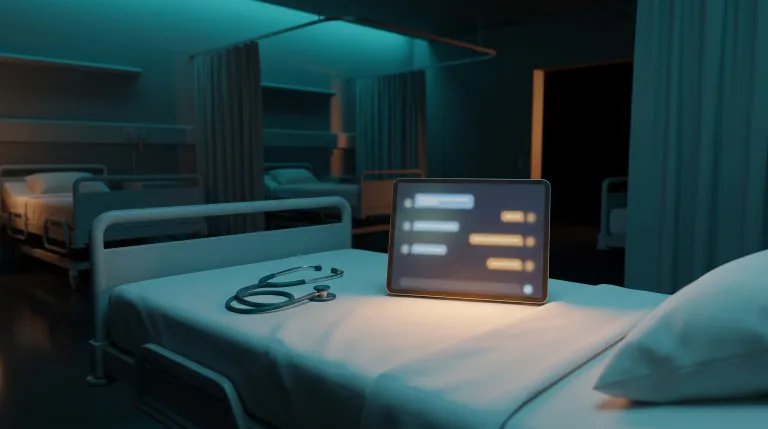
The paper, indexed in Cureus on August 12, describes a structured simulation framework rather than a one-off experiment. A novice critical care nurse sits down at a ChatGPT interface and faces a simulated family member in crisis — angry, frightened, demanding answers that the nurse is not yet experienced enough to give smoothly. The nurse practices de-escalation, clear crisis communication, and empathy under pressure, then reviews automated feedback generated by the model. This is a meaningful departure from most LLM-in-medicine research, which has focused on diagnostic accuracy or multiple-choice exam performance. The target here is an interpersonal skill: talking to a family when a loved one's condition is critical. That skill is notoriously hard to train at scale.Why simulation matters for nursing education
The traditional alternative is standardized patient training — hiring actors to play family members. It works, but it is expensive and does not scale. A hospital with a hundred novice nurses cannot easily run hundred of realistic crisis conversations per nurse per year. An LLM simulator can, at any hour, in any language, with infinite patience. The reported numbers from comparable ChatGPT clinical simulation studies are striking:- 90%+ of learners rated the scenarios realistic and clear
- 94% positively evaluated the AI's responses
- 97% found the automated feedback beneficial
- System Usability Scale: 91.5 / 100 (SD 8.40)
The cost calculation nobody published
Role-play conversations are short and token-cheap. Assuming one 20-minute session consumes roughly 30,000 input tokens (system prompt, scenario backstory, conversation history) and 15,000 output tokens (the simulated family member's answers), here is what a single training session costs at current August 2026 API prices, converted at about 1.08 USD/EUR:| Model | Input / output per 1M tokens | Cost per session |
|---|---|---|
| GPT-5.6 Sol (OpenAI) | $0.20 / $1.20 | ~$0.024 (~€0.02) |
| DeepSeek-V4-Pro | $0.435 / $0.87 | ~$0.026 (~€0.02) |
| GLM-5.2 (API) | $1.00 / $3.20 | ~$0.078 (~€0.07) |
| Mistral Large 3 (EU-hosted) | $2.00 / $6.00 | ~$0.15 (~€0.14) |
| Local open-weight model (GLM-5.2, MIT) | free weights | marginal electricity cost |
The European angle: GDPR, AI Act, and the nursing shortage
There are three reasons this protocol fits Europe particularly well. First, GDPR. A ChatGPT simulation contains no real patient data — the family member is synthetic. No consent workflows, no data-processing impact assessments for sensitive health data, no risk of leaking identifiable patient information into a cloud LLM. In a legal department's eyes, this is one of the cleanest AI training tools available. Second, the AI Act picture just changed. Earlier in 2026, European hospitals braced for full high-risk compliance this August. The EU's AI Omnibus (Digital Simplification Package), enacted in mid-2026, deferred the major high-risk deadlines to December 2027 and simplified the burden. A staff-training simulator is not on the high-risk list anyway, but the lighter, later timeline removes the compliance anxiety that was stalling pilots. The direction of travel — documentation, oversight, transparency — remains, but hospitals have room to experiment now and build proper processes by 2027. Third, the nursing shortage is a European strategic problem. Germany alone is short of hundreds of thousands of nurses; national health systems across the EU are competing for the same shrinking pool of experienced staff. Training that offloads repetitive de-escalation practice from senior nurses to an AI simulator frees experienced staff for the cases where they are genuinely irreplaceable.Local models are the more interesting next step
The protocol was built on ChatGPT, which is available across the EU in enterprise and GDPR-compliant configurations. That works. But for hospitals with strict data-residency policies, an open-weight model is the natural evolution. In our own testing at AI Arena, we run 7–30B parameter models daily on a single RTX 5060 Ti 16 GB — and scripted role-play of the kind this protocol needs does not require frontier-grade reasoning. It requires consistent character behavior and solid guardrails, which modern open-weight models handle well. GLM-5.2, released under an MIT license, is a particularly interesting option: free weights mean the entire simulation can run on hospital hardware behind the firewall, with a marginal cost per session of essentially zero.What still needs work
The obvious limitation is cultural and linguistic validation. The model handles major European languages well, but de-escalation phrasing is culturally loaded. A scenario validated in an English-speaking context may land very differently in Prague, Madrid, or Berlin. Human oversight and periodic validation remain mandatory — nobody should hand crisis communication training entirely to a language model without an experienced nurse reviewing the outputs. For European nursing academies and hospital education departments, the bottom line is that LLM-based simulation training has left the demo stage. It is a documented, peer-reviewed protocol, deployable today, at prices between two and fourteen euro cents per session. The regulation has moved in a favorable direction, the data-protection picture is clean, and the remaining work — cultural adaptation, validation, educator buy-in — is exactly the kind of thing European healthcare systems can do themselves.Do nurses need technical skills to run the simulation?
No. The protocol is designed for educators — the prompting templates and scenario structure are part of the published workflow. The nurse only faces a chat interface similar to a messaging app, which lowers the barrier to adoption considerably.
Can LLM simulation replace training with human actors?
Not entirely. Human standardized patients remain valuable for formal, high-stakes assessment. LLM simulation is best suited to repetitive, scalable practice — giving novice nurses hundreds of low-cost repetitions before they ever face a real family in crisis.
Is the study tied to a specific ChatGPT version?
The protocol describes ChatGPT as the simulation engine, but LLM versions change frequently. Educators should re-validate scenario behavior whenever the underlying model is updated, since response style and guardrail behavior can shift between versions.