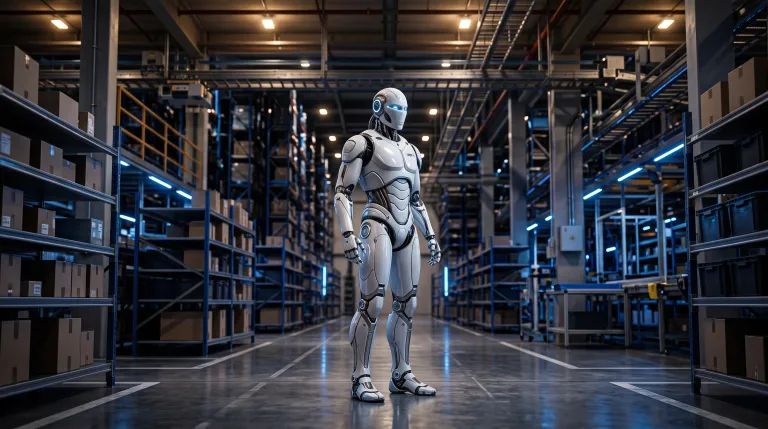
If you still treat humanoid robotics as a science-fair category, the deployment data says otherwise. Current reporting on the humanoid wave describes machines that no longer just walk, wave and open doors on command. UBTECH's Walker S2 is working automotive assembly plants, Agility Robotics' Digit v5 operates uncaged in logistics environments, and both handle real tasks: box stacking, quality control, trailer loading. The line between human and machine is blurring in the most practical way possible — the same physical work can now be done by a person or a robot at comparable, if still lower, productivity.
From lab demo to production tool
The category itself has changed definition. Early humanoid demos focused on balance and the spectacle of bipedal locomotion. Today's machines are designed as cobots — collaborative robots built for human-centric infrastructure. They use the same door handles, stairs, pallets and hand tools as people, which removes the expensive requirement to redesign workplaces around machine-specific interfaces.
What changed in the last few months is the pace of live deployment. Major manufacturers moved humanoids into assembly and logistics pilots alongside human workers, and financial institutions launched dedicated humanoid robotics investment products. This is no longer a research curiosity; it's becoming an industrial procurement category.
The market numbers, converted to EUR
Here's the financial picture confirmed by recent coverage, converted to EUR at an approximate rate of 1 USD ≈ 0.90 EUR:
- Market value today (2025–2026): $2.0–3.28 billion (≈ €1.8–2.9 billion).
- 2035 forecast: $38–40 billion (≈ €34–36 billion) per Goldman Sachs and Barclays, with potential OEM-level industry impact up to $750 billion (≈ €675 billion).
- 2050 long-term estimate: Morgan Stanley models a global installed base of 1 billion units representing a $5 trillion (≈ €4.5 trillion) market.
The spread between today's $2–3 billion and the multi-trillion long-term scenarios is enormous — the market is implicitly pricing in major execution risk. The near-term trajectory, however, is verifiable: installed units scaled from about 2,000 in 2024 to 15,000 in 2025, with roughly 60,000 projected for 2026. China alone has reported a production milestone of about 100,000 humanoid units — a figure that exceeds projected global installations, suggesting capacity is being built well ahead of demand.
What a humanoid actually costs to run
Two figures matter here. Agility's Digit v5 targets up to 20 operational hours per day at an estimated run cost of about $2 per hour (≈ €1.80). UBTECH's Walker S2 operates at 30–50 % of human productivity in specific industrial tasks such as box stacking and quality control.
Put those together and the economics become concrete. At €1.80 per hour for 20 hours, a single robot's daily running cost is around €36. European employers, even in lower-wage member states, pay considerably more than that for one day of gross labour costs. The catch is the productivity gap: at 30–50 % of human throughput, you need roughly two to three robots to match one worker's output. That still pencils out on pure hourly cost — but total cost of ownership also includes supervision, maintenance, charging infrastructure and safety measures, which published figures rarely include.
The EU angle: the AI Act no longer waits
For European buyers, the regulatory context changed this summer. The transitional period for general-purpose AI is over: the EU AI Act is now in active, legally binding enforcement — including compliance audits, model recalls and financial penalties — led by the EU AI Office and national authorities since August 2, 2026.
Two obligations matter directly for humanoids:
- Article 50 transparency: it is mandatory to notify people when they interact with an AI system, to watermark synthetic content and to label deepfakes. A humanoid with a conversational interface working in a German warehouse must clearly inform workers that they are dealing with a machine.
- GPAI obligations: general-purpose models above explicit compute thresholds (1025 FLOPs) face documentation and oversight duties. A humanoid's perception model alone may not cross that line, but a manufacturer embedding a frontier GPAI model in the control stack inherits those obligations.
Additionally, safety-critical robotics falls under the AI Act's high-risk provisions, and GDPR governs the camera and sensor data humanoids collect on the job. European operators should treat compliance as a procurement criterion today, not an afterthought.
The signal beneath the forecasts
For a factory or logistics operator, the honest benchmark is not the trillion-dollar forecasts but the combination of the 30–50 % productivity figure and the €1.80-per-hour operating cost. That maths works for narrow, repetitive, high-volume tasks — box stacking, quality control, palletising — not for general-purpose labour. Pilots in those tasks are the right first step; full warehouse automation needs different economics.
For developers, the lesson is integration. Modern humanoids are AI platforms with bodies, and the European winners will be the teams that combine reliable perception, compliance-ready data handling and pragmatic task scoping — not the ones chasing the most impressive demo.
Are humanoid robots cheaper than human workers today?
In pure run cost, yes — about €1.80 per hour for a machine that can operate up to 20 hours a day. But at 30–50 % of human productivity, plus supervision, maintenance and charging costs, total cost of ownership is only competitive in narrow, repetitive tasks — not general labour.
Does the EU AI Act apply to humanoid robots?
Yes. Since August 2, 2026, enforcement is active. Humanoids with conversational or generative AI must comply with Article 50 transparency obligations, including telling humans they are interacting with a machine; safety-critical robotics falls under high-risk provisions; and sensor data processing must respect GDPR.
Which tasks make sense to pilot first?
Box stacking, quality control, palletising and trailer loading — the tasks where the published productivity data (30–50 % of human output) is measured and where 20-hour operation improves return on investment. Start narrow, measure real uptime and compare against your actual labour cost per hour.