
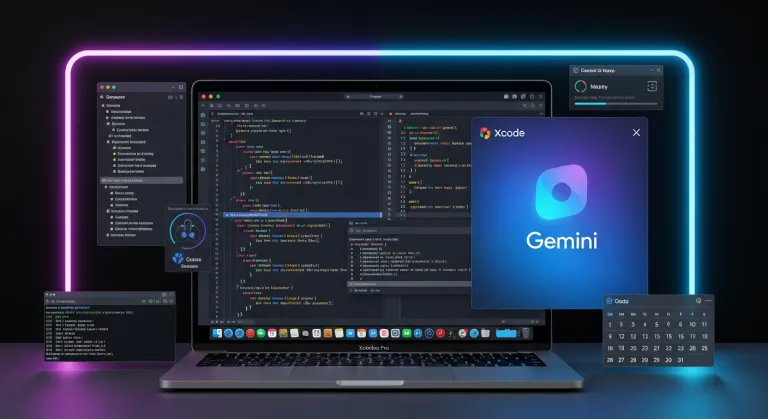
During this year's WWDC conference we saw many announcements, but one of the most significant pieces of news came from a different camp. Google officially announced that its state-of-the-art Gemini models will now be fully integrated into the Apple ecosystem for developers. This move isn't just about technical compatibility; it's a strategic play that connects two of the largest technology worlds and gives developers the tools to bring their apps to life using generative AI in a native environment.
Native integration: Gemini at the heart of Apple frameworks
The key announcement is the opening of Apple's Foundation Models framework to third parties. Starting with the release of iOS 27, macOS 27, and beyond, cloud model providers can implement the new LanguageModel protocol. This means developers no longer need to build complex bridges between their app and Google Cloud — Gemini models can be called directly through Apple's native interfaces.
This approach brings several fundamental advantages:
- Unified interface: Developers use standard Apple tools to call models, reducing code complexity.
- Faster development: Thanks to the Firebase Apple SDK, Gemini models can be implemented almost immediately.
- Optimization: Native integration enables better device resource management when calling cloud models.
Gemini vs. the competition: Where does Google stand?
To understand the significance of this move, we need to look at what the competition offers. While Apple Intelligence relies on a combination of its own models and collaboration with OpenAI (ChatGPT), Google is aiming for deeper integration into the developer workflow with Gemini.
If we compare the capabilities of current top-tier models in a programming context:
| Model | Strengths for developers | Context window |
|---|---|---|
| Gemini (Google) | Multimodality, deep integration into Xcode and Firebase | Extremely large (suitable for entire repositories) |
| GPT-4o (OpenAI) | Logical reasoning, broad community | Large |
| Claude 3.5 Sonnet (Anthropic) | Coding and nuanced text understanding | Medium to large |
In the context of developer tools, Gemini has the edge thanks to direct integration into Xcode. This means a programmer doesn't have to switch between browser and editor — AI helps them write, fix, and explain code directly in the environment where they work.
Firebase AI Logic: AI without backend management
Another pillar of the announcement is the expansion of Firebase services. For many smaller teams and startups, the biggest barrier to implementing AI is the need to manage their own servers, handle scaling, and maintain data security. Firebase AI Logic solves this problem. Developers can add Gemini capabilities to their applications without the need to manage backend infrastructure. This is ideal for agile development, where you want to quickly test new features with real users.
Impact on the Czech market and European developers
What does this mean for a Czech developer or a tech company in Prague or Brno? Above all, the democratization of access to cutting-edge AI. The Czech startup scene, which is strong in SaaS and mobile applications, will now gain tools that previously required huge engineering teams to manage AI infrastructure.
Availability and language: Gemini models already feature excellent Czech language support. Integration into iOS apps means that a Czech user can interact with their app in Czech and receive relevant responses, with the model understanding local context.
Regulation and the EU AI Act: For European developers, it is crucial that Google emphasizes security and data control in its Firebase integration. In the era of the EU AI Act, the ability to clearly define how data is processed (within Google Cloud infrastructure in the EU) is a critical factor for the successful deployment of a product on the European market.
Pricing: How much does it cost?
Google offers several access tiers, which is important for budget planning:
- Free Tier (within Google AI Studio): For experimentation and smaller projects, there is a free version with certain rate limits on requests per minute.
- Pay-as-you-go (Vertex AI / Firebase): For production applications, you pay based on actual usage (number of tokens). Pricing is in the range of a few USD per million tokens, which is a very efficient model for most applications.
- Enterprise: For large corporations requiring high throughput and specific SLAs.
Do I need my own servers to use Gemini in an iOS app?
No. Thanks to the Firebase AI Logic integration, you can use Gemini cloud models directly without having to manage or run your own backend infrastructure.
Is Gemini's Czech language quality good enough for complex interactions?
Yes, Gemini models are trained on a broad range of languages including Czech. For developers, this means they can create apps with natural Czech-language communication without needing additional translation layers.
What are the main benefits of integrating Gemini directly into Xcode?
The main benefit is increased productivity. A developer can generate code, find bugs, and optimize algorithms directly in the editor without leaving their working environment and switching between apps.




