Continuous Video Understanding: Overcoming the Pause-and-Think Bottleneck
Until recently, deploying frontier artificial intelligence models to control physical hardware suffered from a fundamental latency problem. Older embodied systems—including the previous generation Gemini Robotics ER 1.6 released in April 2026—relied heavily on static image snapshots or intermittent video samples. A robot had to pause, capture a photo, send the frame to a cloud server, wait for high-level plan generation, and only then execute a discrete motor command.
Gemini Robotics ER 2 eliminates these awkward stop-and-think delays by integrating directly into the Gemini Live API. The architecture supports a 128,000-token input context window and up to 64,000 output tokens, maintaining continuous spatial-temporal awareness across live multimodal video, audio, and text feeds. By evaluating video frames as a continuous stream, the model plans future workflow steps simultaneously while the hardware executes current physical maneuvers.
High-level reasoning in ER 2 is decoupled from low-level motor execution. Developers declare lower-level control interfaces—such as custom VLA models, navigation APIs, or user-defined tools—as callable functions. ER 2 can also natively call external services like Google Search to pull context from the web or query internal enterprise operational systems before instructing a robotic manipulator to proceed.
Key Benchmarks: Precise Timing and Task Verification
Determining whether a complex physical task has been completed successfully—such as verifying whether a cap is fully tightened or a liquid measurement is accurate—is a major bottleneck in automation. DeepMind equipped ER 2 with updated video evaluation capabilities focusing on progress classification and moment-finding.
In quantitative evaluation benchmarks published in the official Google DeepMind announcement, Gemini Robotics ER 2 demonstrated notable upgrades across spatial and temporal metrics:
- Precision Moment-Finding: ER 2 achieved 91.3% accuracy at identifying the exact video frame where a critical event occurs (such as the instant a container reaches capacity), operating with a 0.96-second mean absolute distance and 4x faster execution speed compared to larger legacy baselines.
- Continuous Progress Classification: The model reached 57.4% accuracy in categorizing ongoing video feeds across five distinct completion brackets (0–20%, 20–40%, 40–60%, 60–80%, 80–100%), allowing hardware to self-correct or retry failed sub-steps without restarting entire procedures.
- Expanded Spatial Instrument Reading: Spatial Visual Question Answering (VQA) now extends beyond basic circular dials to read digital displays, linear scales, rulers, and liquid thermometers across 10 distinct instrument categories.
Comparing Embodied Planning Generations
| Feature / Metric | Gemini Robotics ER 1.6 (April 2026) | Gemini Robotics ER 2 (July 2026) |
|---|---|---|
| Base Architecture | Gemini 1.5 Pro / Flash hybrid | Gemini 3.5 Flash |
| Video Input Mode | Static frames / Periodic snapshots | Continuous bidirectional streaming |
| Orchestration Latency | Multi-second batch execution | Sub-second live streaming |
| Moment-Finding Precision | Standard frame detection | 91.3% accuracy (0.96s mean delta) |
| Multi-Robot Collaboration | Single-agent focus | Native cross-hardware orchestration |
Multi-Robot Collaboration: European Hardware Meets Shared Intelligence
One of the most practical additions in ER 2 is native support for multi-robot coordination. No single physical form factor can handle all industrial tasks; wheeled rovers excel at rapid indoor transit, humanoids navigate uneven terrain, and stationary articulate arms deliver high-speed precision assembly.
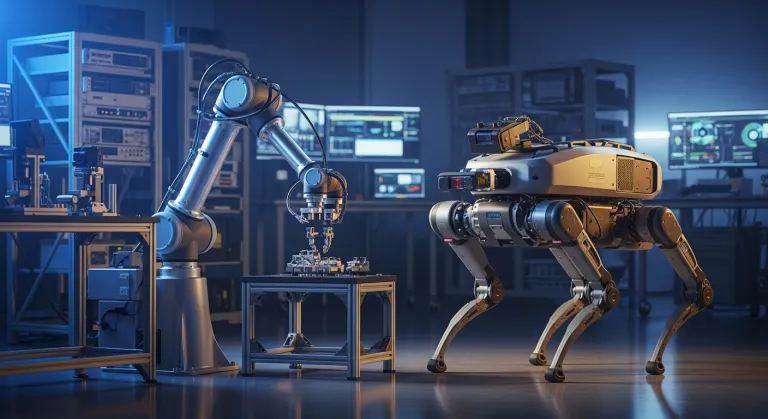
Gemini Robotics ER 2 establishes a unified semantic scene model shared across heterogeneous machines. In technical demonstrations, DeepMind showcased task handoffs between diverse platforms, including pairing Boston Dynamics quadrupeds and Apptronik Apollo humanoids with Franka F3 Duo robotic arms—developed by Munich-headquartered Franka Robotics. By sharing spatial knowledge across different physical embodiments, one robot can position a workpiece while a secondary arm performs precision assembly, coordinating through a single cognitive engine.
EU Availability, AI Act Compliance, and Enterprise Realities
Gemini Robotics ER 2 is accessible immediately to developers through Google AI Studio and the Gemini API via public preview endpoints (gemini-robotics-er-2-preview and gemini-robotics-er-2-streaming-preview), alongside private preview access on the Gemini Enterprise Agent Platform. API access follows standard Google AI Studio and Vertex AI pricing tiers, including a free tier for testing and prototype development. Code samples and integration templates are available on DeepMind’s GitHub robotics repository.
For European enterprises preparing to deploy embodied AI on factory floors or in logistics hubs, ER 2 enters a strictly regulated landscape. Under the phased implementation of the EU AI Act—with mandatory Article 50 transparency rules coming into full force in August 2026—deploying autonomous physical agents carrying continuous video cameras requires careful compliance management:
- Workplace Surveillance & GDPR: Continuous visual data collection in European facilities triggers strict data minimisation rules under GDPR. Operational setups must process raw video locally or ensure data streams routed to cloud endpoints undergo immediate redaction of personal visual data.
- High-Risk AI System Classification: Under Annex III of the AI Act and the EU Machinery Regulation, physical AI agents operating in shared human environments are designated as high-risk systems, mandating rigorous risk assessments, human oversight mechanisms, and hardware kill-switches.
- Hybrid Sovereign Architectures: While high-level temporal reasoning is handled via ER 2's cloud endpoints, European manufacturing firms are increasingly pairing cloud orchestration with local Small Language Models (SLMs) and sovereign edge compute to maintain operational resiliency if internet connectivity drops.
Does Gemini Robotics ER 2 control low-level robot motors directly?
No. Gemini Robotics ER 2 acts as a high-level cognitive planner. It interprets sensory feeds (video, audio, text), plans multi-step tasks, and issues API commands or function calls to specialized lower-level controllers and Vision-Language-Action (VLA) models that manage joint movements and balance.
Is Gemini Robotics ER 2 available for testing in the European Union?
Yes. European developers can access the preview endpoints through Google AI Studio and the Gemini API under standard global developer rates, including the standard free evaluation tier.
How does ER 2 handle unexpected errors during physical execution?
Thanks to continuous progress tracking (achieving 57.4% accuracy across 5 completion stages), ER 2 constantly compares live video streams against expected outcomes. If a grip slips or an object falls, the model detects the discrepancy in real time and adjusts the plan without resetting the entire task workflow.