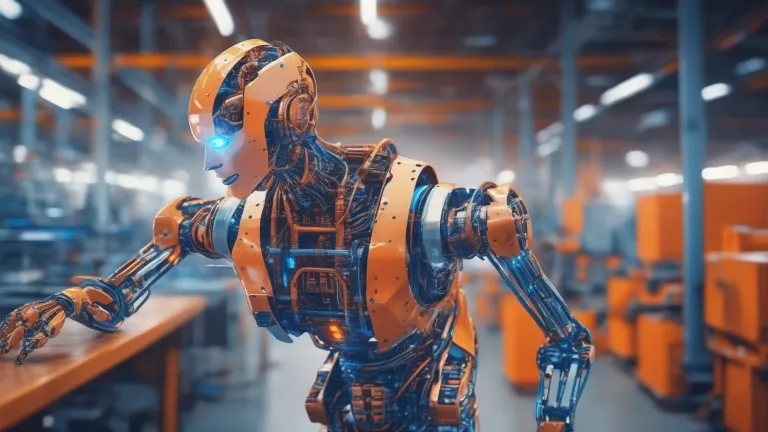
Munich vs. Silicon Valley: Europe has its own answer to physical AI
That physical AI — i.e., artificial intelligence that understands the three-dimensional world and can physically act within it — is one of the hottest topics of 2026 is no secret. While American companies like Tesla (Optimus) or Figure AI are raising billions in investments, a startup has meanwhile grown in Munich that approaches it differently.
Microagi, founded in 2025, does not develop its own humanoid. Instead, it builds a software layer — a platform called Atlas, which is hardware and model agnostic. In other words: a single interface that understands robots from Unitree, UBTECH, or anyone else, and which under the hood uses the most powerful available AI models — including Google's Gemini.
"Our goal is to bridge the gap between a robot that impresses on stage and a robot that reliably works on the line," explains Bercan Kilic, founder of Microagi. To achieve this, the Atlas platform uses its own corpus of data from real-world operations and fine-tunes models precisely for specific customer tasks.
NVIDIA Blackwell and Google Cloud: Muscles for demanding training
The newly announced partnership gives Microagi access to the most powerful AI infrastructure available: NVIDIA RTX PRO 6000 Blackwell Server Edition GPUs (G4 instances on Google Cloud) and NVIDIA GB300 NVL72 rack systems (A4X Max instances).
What does this mean in practice? Training models for physical AI is extremely computationally intensive — a robot must process video, spatial data, tactile sensations, and all of this in real-time. The Blackwell architecture is optimized for these purposes, and Google Cloud gives the startup the ability to scale as needed, without the necessity of building its own data centers.
Microagi will also utilize the Gemini Enterprise Agent Platform for processing multimodal information — primarily video from robot cameras. This is crucial for understanding the physical context: a robot must know not only what it is holding, but also where it is, how to grasp it, and what will happen if it lets go.
Task-specific models: Why one universal brain is not enough
Microagi's key philosophy is to train specialized models for individual robotic platforms and specific operational roles. A robotic waiter in a hotel needs a different "brain" than a robotic arm in a factory.
This approach makes sense: a universal humanoid robot that could do everything from folding boxes to making coffee is still a distant future. However, specialized models trained on a narrow set of tasks can be deployed today — and this is where Microagi is heading.
Customers in hospitality or industry will be able to acquire robots with pre-configured Microagi models tailored directly to their operations. No months of integration, no vendor lock-in.
European context: AI Act and opportunity for local players
For the European market, Microagi is also interesting from a regulatory perspective. The EU AI Act requires transparency, traceability, and robustness for high-risk AI systems — and a European startup that builds an agnostic layer between hardware and AI models can be more attractive to EU companies than closed solutions from the USA or China.
For Czech companies considering the deployment of robotics in manufacturing or logistics, this means one more thing: in Munich, just a few hours' drive from the Czech border, a player is growing who understands European legislation and builds solutions independent of a specific hardware supplier.
Numbers worth noting
Microagi has experienced rapid growth. In less than two years of existence, it has opened a research center in Zurich and offices in London and New York. Its technology already powers robots from Unitree (a Chinese manufacturer of humanoids and quadruped robots) and UBTECH (one of the world's largest manufacturers of humanoid robots).
Google Cloud is also strategically betting on the partnership: in April 2026 alone, it announced a $750 million investment to support agentic AI among its partners, and the partnership with Microagi fits perfectly into this strategy.
"Robotics is becoming one of the most challenging battlegrounds for AI," commented Tobias Halloran, Director of Startups EMEAI at Nvidia. "It requires massive datasets from the physical world, accelerated computing, and a complete platform that transforms models into intelligent machines."
What's next
Microagi has not yet announced specific dates for the commercial deployment of its software packages. One thing is clear, however: the race for physical AI is intensifying, and Europe — thanks to startups like Microagi, but also thanks to the influx of capital into Germany's NEURA Robotics (35 billion euro valuation) — is certainly not playing second fiddle.
The combination of Munich software, Google's computing power, and Nvidia's hardware is a signal that the era of robotic demos is over. Now it's about who will be the first to deliver robots that truly work in real-world operations.
What is "embodied AI" or physical artificial intelligence?
Embodied AI is artificial intelligence that understands the physical world — it can perceive space, objects, and interact with them through a robotic body. Unlike language models like ChatGPT, which only work with text, physical AI must process video, depth sensors, and tactile sensations in real-time.
Is Microagi also available for Czech companies?
Microagi is a European company based in Munich, so cooperation with Czech businesses is geographically and regulatorily close. The Atlas platform is designed to be hardware-agnostic — theoretically, it can work with any robot a company acquires. However, a specific offer for the Czech market has not yet been officially announced.
How does Microagi differ from Tesla or Figure AI?
Tesla (Optimus) and Figure AI develop their own humanoid robots and their software — these are vertically integrated solutions. Microagi, on the other hand, does not build hardware, but a software middleware layer that works with robots from various manufacturers. Its advantage is independence from specific hardware and the ability to fine-tune models to each customer's needs.