
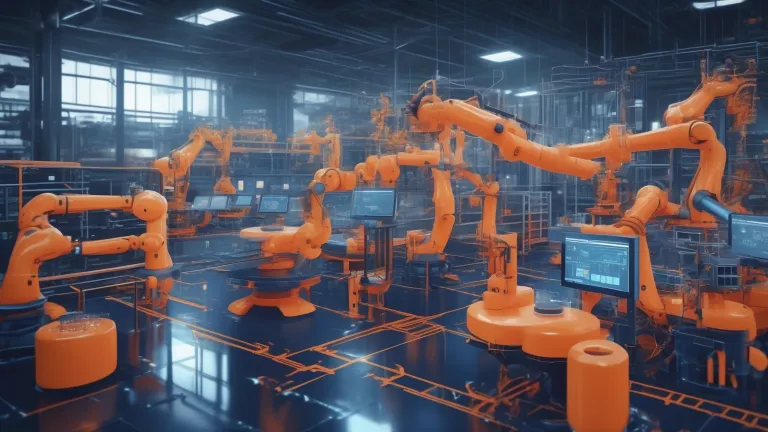
From machine monitoring to autonomous action
Predictive maintenance is nothing new — sensors on motors and gearboxes report vibration or temperature, and software predicts when a machine will break down. But that is exactly where most industrial AI systems stop: they generate an alarm or a chart and wait for someone to notice. IntelliAM AI, based in Sheffield and listed on the London Stock Exchange, wants to close that loop.
Its Industrial Intelligence Platform rests on three layers. The first, IntelliAM 53, collects and cleans data from sensors, programmable logic controllers (PLCs), maintenance systems, and historical records — creating a unified, trustworthy picture of machine health. The second layer, Decipher, explains the data: it monitors deviations, defect rates, and line performance in real time, and using large language models it can answer questions like "why did line three go down last night" in plain language.
The newcomer is the third layer, Enigma — so-called agentic AI. Simply put, it is software that does not wait for a command but independently proposes the next step, and if the company permits it, executes it straight away. Enigma can issue a maintenance work order, send a technician to a specific machine, suggest a change to equipment settings, and evaluate whether the intervention helped. It learns from the results, so its subsequent recommendations should become more accurate.
215 percent at Müller and 16 billion data points
According to an announcement published on the occasion of the London Stock Exchange launch, the IntelliAM platform processes over 16 billion industrial data points annually, and the company works with half of the world's twelve largest food manufacturers. Enigma was developed in live operation at Müller, Hovis, and SKF.
The strongest argument is the result from one Müller plant: over twelve months, the average mean time between failures (MTBF) improved by 215 percent. In other words — the lines ran without unplanned downtime more than three times longer than before. Müller representatives spoke about the deployment directly at the platform's London premiere.
IntelliAM also adds macroeconomic math: the British food manufacturing industry generates gross value added of 37.3 billion pounds annually. A productivity increase of just 2 percent would bring the economy 746 million pounds per year, while a 5 percent leap would mean 1.865 billion pounds — without building a single new factory.
"Factories don't have a data problem — they have a decision-making problem"
"The UK's future productivity growth will come less from building new factories and more from improving the performance of the equipment we already have," said IntelliAM CEO Tom Clayton. "Manufacturers don't have a data problem, they have a decision-making problem. The opportunity is to use agentic AI to turn trusted industrial data into better operational performance."
The personnel dimension is also important. Food manufacturing in the UK — much like in the Czech Republic — is grappling with a shortage of technical professionals and unfilled positions. According to the company, Enigma is not meant to replace people but to act as a "multiplier" for those who remain: it captures the knowledge of experienced engineers and passes it on to operators right at the line, so that limited expertise reaches further.
Agentic AI is becoming the standard in industry
IntelliAM is not alone. Back in July 2025, Dutch company IFS Ultimo introduced an agentic "digital colleague" for enterprise asset management that autonomously monitors work requests and generates safety incident reports on its own. Agents for industry and energy were also launched this year by SLB and SoundHound. However, the trend has a downside too — Gartner analysts warn that over 40 percent of agentic AI projects could be cancelled by 2027 due to costs and unclear return on investment. Results like Müller's are therefore exactly what the market needs to see: measurable impact in live operation, not a demo.
What it means for Czech manufacturers
The Czech Republic is one of the most industrially dense economies in Europe — manufacturing accounts for roughly a quarter of GDP, and domestic food and engineering companies face the same challenges as their British counterparts: ageing machinery, costly downtime, and a shortage of maintenance workers. The IntelliAM platform is offered as a B2B service in English, and Czech localization has not yet been announced; deployment moreover begins with a data readiness audit, so it is not an off-the-shelf solution. For Czech companies, however, the core principle is what matters: agentic AI can leverage existing sensors and maintenance systems that many plants have had for years and turn them into concrete savings. And because Enigma only intervenes in production management within the boundaries of company-approved rules and minimizes data transfer outside the enterprise, it also aligns with the requirements of the European AI Act on human oversight of autonomous systems.
What exactly does the term agentic AI mean?
Agentic AI refers to systems that not only answer queries or generate alerts, but independently plan and execute multi-step tasks — for example, issuing a work order, assigning a technician, and evaluating the result after the repair. The degree of autonomy is determined by the company: the agent can only recommend, or — within permitted boundaries — act directly.
How much does the IntelliAM platform cost, and who can use it?
There is no public price list — it is a tailored enterprise solution whose cost depends on the number of lines, sensors, and scope of deployment. Implementation starts with a Foundation phase, i.e. an audit of the plant's data and technology readiness. Interested parties must contact the company directly.
Will autonomous AI in factories take people's jobs?
Experience from early deployments rather suggests the opposite. The industry has long been grappling with a shortage of technicians and maintenance workers, so agentic systems take over routine data monitoring and administration, while decisions about interventions and the actual repairs remain with people. AI here functions as a tool that makes the knowledge of experienced workers accessible even to less experienced colleagues.




