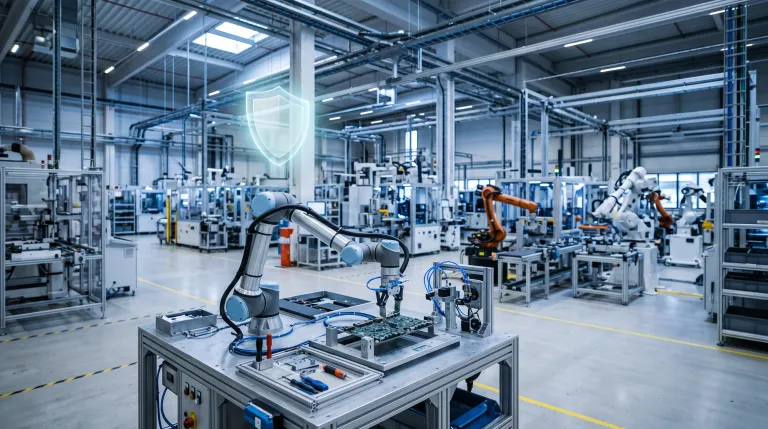
What actually happened
NVIDIA launched Halos for Robotics on June 22, 2026, extending the safety architecture developed for its autonomous-vehicle programme into industrial robotics and physical AI. The platform was designed as more than a software stack: it includes the NVIDIA Halos AI Systems Inspection Lab, which NVIDIA describes as the first lab accredited by the ANSI National Accreditation Board (ANAB) specifically for physical AI functional safety and AI safety.
The new piece, first reported by the Greater Geneva Bern area (GGBa), is that CertX of Fribourg and its parent company SGS of Geneva now recognise inspection reports from that lab and issue third-party compliance certifications. In practical terms, the loop looks like this: NVIDIA performs the deep technical inspection of a robotic system, and a European certifier with no commercial stake in your product validates the result against recognised international standards.
What the certification covers
This is not a vague "AI quality check". The evaluation assesses autonomous physical AI and robotic systems against concrete technical frameworks:
- IEC 61508 — the foundational functional-safety standard for electrical, electronic and programmable systems.
- ISO 13849 — the machine builder's standard for safety-related parts of control systems, already used across European factory equipment.
- ISO/IEC TR 5469 — the newer technical report on AI in safety-related systems, covering data quality, model validation and uncertainty.
That combination matters because it bridges two worlds: classical machine safety, which European factories already live with, and AI behaviour, which most legacy machine-safety standards were never designed to handle.
Why Switzerland and why now
This is a genuinely European story, even though the platform itself is American. CertX is a Swiss-based certification specialist, and SGS, headquartered in Geneva, is one of the world's largest testing and certification groups, with a dense network of offices across EU member states. For European robotics companies, that matters: buying a robot with a certification from an EU-recognised body side-steps a lot of procurement, insurance and liability friction down the road.
The timing is also important. The EU AI Act's high-risk obligations, originally expected to bite in August 2026, were recalibrated by the EU Digital Omnibus package, pushing binding conformity assessments for most high-risk systems to late 2027. But machine-safety law in Europe applies today. A certified safety case is becoming part of the spec sheet, not an optional extra — and companies that certify now will not be scrambling when the deadlines actually land.
SGS clearly treats this as a serious business line: the group targets at least CHF 200 million in additional annual revenue from its Digital Trust segment by 2027, compared with 2023 levels.
The numbers behind the program
NVIDIA's Halos effort is not a small research side-project. The ecosystem already includes 40+ organisations — robotics manufacturers, safety vendors and certification bodies. Under the hood, the safety architecture incorporates:
- 18,000+ engineering years of vehicle safety development,
- 21+ billion safety transistors,
- 7+ million lines of safety code,
- 22,000+ platform safety monitors.
Those figures come from NVIDIA's own materials, so treat them with the usual marketing discount. What matters operationally is that the program has been running in autonomous vehicles long enough to produce real inspection and certification workflows — not just slideware.
The unglamorous truth
There is a pattern in physical AI: impressive demos, then a long silence when questions turn to insurance, liability and regulatory approval. Certification is the unglamorous layer that separates a demo robot from a deployable product. For European warehouse operators, cobot integrators and factory-automation buyers, a third-party safety certificate from an established European body is exactly the kind of paperwork that unlocks real purchase orders.
One important limitation: this certification path is tied to the NVIDIA robotics stack. Systems built on other hardware platforms will need to look for equivalent safety cases elsewhere. That is not a criticism of the program — it is simply how functional-safety certification has always worked, from aircraft parts to car brakes. The standard matters more than the brand, and here the standards are international and well understood in European manufacturing.
Does CertX certification under the NVIDIA Halos program satisfy the EU AI Act?
Not automatically. The Halos certification is based on IEC and ISO functional-safety standards, which feed into the technical documentation regulators will expect. But EU AI Act high-risk conformity is a separate legal procedure, currently scheduled for enforcement in late 2027 after the Digital Omnibus recalibration. In practice, Halos certification gets you most of the engineering evidence — the legal filing itself remains your responsibility.
Who can apply for this certification?
Robotics manufacturers and physical-AI system builders that participate in the NVIDIA Halos ecosystem. NVIDIA says 40+ organisations are already involved, including robot makers, safety vendors and certification bodies. The inspection starts at the NVIDIA Halos AI Systems Inspection Lab; CertX and SGS then handle the certification based on its reports.
What does certification cost?
No public price list has been published. Functional-safety assessments of this kind are typically quoted case-by-case, depending on system complexity, the standards applied and the depth of inspection required. Expect it to be a significant four-to-five-figure investment for a serious industrial robot, in line with established machinery certification practice.