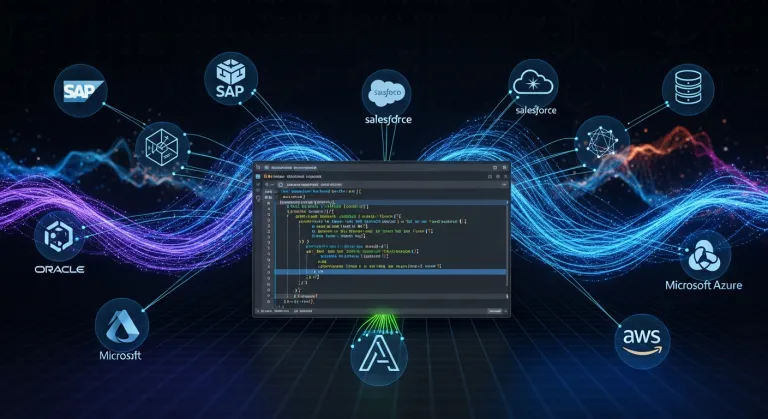
While development agents can generate algorithms at lightning speed, their ability to securely communicate with SAP, Oracle, or Salesforce databases has been limited until now. The new offering from SnapLogic enables developers to create production integrations directly in the environment where they work, while maintaining full control over security and data governance.
The world of software development is undergoing a fundamental transformation. Tools like GitHub Copilot, Cursor, or the new Claude Code are no longer just advanced autocomplete tools for programmers; they are becoming autonomous agents capable of independently designing and implementing entire parts of applications. However, with this capability comes a new problem: how to ensure that these AI systems don't just handle the code logic itself, but also the secure and governed connection to sensitive enterprise data?
Company SnapLogic has just answered this challenge by announcing the general availability of its new services: SnapCode and SnapLogic MCP Server. These tools aim to eliminate the risk of so-called "shadow IT," where AI agents generate unverified and dangerous connections between systems that the IT department cannot control.
The Problem: Speed vs. Governance
Until now, the situation in enterprise environments was often such that developers using AI tools drastically accelerated code writing, but when trying to connect a new application to an existing ERP system (e.g., SAP), they hit a barrier. They either had to wait weeks for IT security approval, or attempted improvised solutions that were prone to errors and security incidents.
As SD Times reports, AI coding agents are changing the way software is built, but the need for trusted connections to enterprise systems remains the same. SnapLogic decided to solve this problem by bringing integration directly into the integrated development environment (IDE) that programmers already use.
What is SnapCode and How Does It Work?
SnapCode is the first developer experience built on a so-called headless integration layer. In practice, this means that a developer can, within their environment (e.g., VS Code with the Claude Code extension), submit a prompt in natural language: "Create real-time synchronization between Salesforce and our internal ERP system with role-based access control."
Instead of the AI agent merely generating a piece of code that could fail in production, SnapCode generates a production-ready integration pipeline. These solutions leverage more than 1,000 pre-built components (so-called "Snaps") for systems like Oracle, Snowflake, Workday, or ServiceNow. The resulting code is fully owned by the developer and can be managed using standard workflows (CI/CD).
Model Context Protocol (MCP): The Key to Security
The key pillar of the entire solution is the SnapLogic MCP Server. MCP, or Model Context Protocol, is an open standard that enables AI models to securely interact with external tools and data. SnapLogic uses this protocol to provide AI agents with governed access to integration operations.
Thanks to the MCP Server, AI agents can securely:
- Deploy integrations into production environments.
- Run and validate ongoing data flows.
- Manage existing integration processes through standardized tool calls.
Comparison: SnapLogic vs. Traditional iPaaS and AI Assistants
If we were to compare the new architecture with existing approaches, the difference is clear:
| Feature | Traditional iPaaS (e.g., MuleSoft) | AI Coding Assistants (e.g., GitHub Copilot) | SnapLogic (SnapCode + MCP) |
|---|---|---|---|
| Focus | Centralized integration management | Code/logic generation | Governed AI-driven integration |
| Development Speed | Moderate (requires manual configuration) | High (but without system context) | Very high (natural language + ready-made Snaps) |
| Governance | High (central control) | Low (risk of unverified code) | High (integrated MCP protocol) |
Practical Impact for Czech and European Companies
For the Czech market, which is strongly represented by manufacturing companies, banking, and technology startups, this announcement has several significant implications:
- Compliance with EU AI Act: European AI regulation places great emphasis on the transparency and security of high-risk systems. Thanks to its ability to provide audit trails and centralized control, SnapLogic helps companies meet the requirements for governed AI processes, which is critical for European enterprises.
- Development Efficiency: According to internal benchmarks, SnapLogic states that integration deployment can be up to 70% faster. For Czech companies seeking savings in IT costs, this is a strong argument for adopting agentic AI.
- Availability: The tools are primarily targeted at the global enterprise market. Although the tool interfaces (such as Claude Code) do not include full Czech localization, the technical documentation and the integration logic itself are universal. For Czech developers, it is key that the tools support standard global systems (SAP, Salesforce) that are commonly used in the Czech Republic.
Pricing Policy: SnapLogic primarily targets the enterprise segment. Specific prices are not publicly available and are determined based on the company's needs (custom pricing). Various access levels exist for developers, but for full deployment within a corporation, direct contact with the sales department is required.
Is SnapCode available for developers who don't use Claude Code?
At launch, SnapCode primarily supports the Claude Code environment and its extension for Visual Studio Code. However, SnapLogic states that it plans to expand support to other popular AI coding environments.
How is the security of sensitive data handled when generating integration via AI?
The data itself does not pass through the LLM (language model) in an ungoverned form. SnapCode generates only the logic and structure of the integration process, while the actual execution and data access take place through the secured SnapLogic platform under the oversight of the MCP server.
Can this tool replace a regular integration architect?
No, it is not meant to replace, but to empower. The architect still defines security policies and rules within the SnapLogic platform, while the AI agent (thanks to SnapCode) takes over routine and repetitive tasks in the actual writing and deployment of integration scripts.