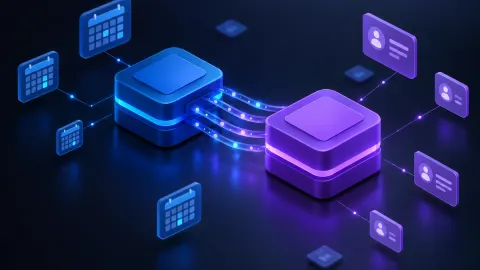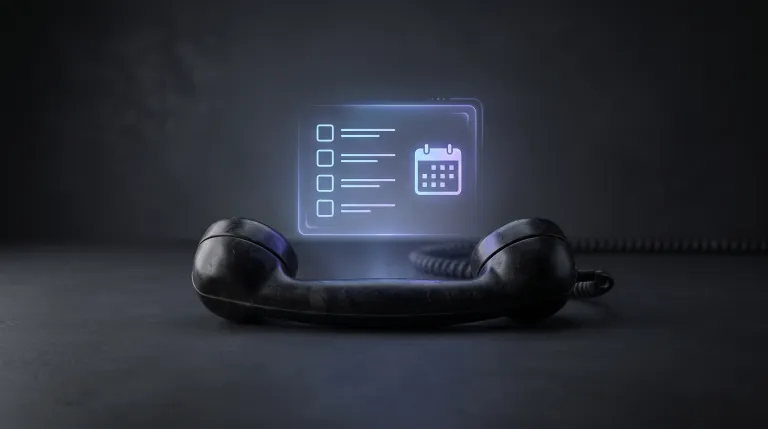
There is a rule of thumb in service businesses: a call that isn't handled in the first minute usually becomes a voicemail, and a voicemail often becomes a customer lost to the competitor down the street. The pitch behind DenwaFlow is that AI should not merely capture the message — it should act on it while the caller is still on the line.
On 13 August 2026, ISZ.AI announced the launch via EIN Presswire, so treat this as a company announcement, not an independent test. With that caveat, the described capabilities are worth a close look, because they represent where phone AI is heading in late 2026.
What DenwaFlow actually does
According to the announcement, DenwaFlow performs live tasks during the call rather than just collecting information:
- Scheduling and modifying appointments — checking the calendar, finding a slot, confirming the change;
- Handling orders and cancellations — processing a request end-to-end;
- Answering FAQs — opening hours, pricing, locations;
- Triggering staff notifications — so a human gets pinged when a rule says the AI should not decide alone.
The system is configured around individual company rules: operating hours, required caller intake data, and explicit conditions for human escalation. The target list reflects that design — dental offices, medical clinics, beauty salons, real estate agencies, field-service providers, manufacturers and B2B sales teams. These are verticals where the phone is not a nice-to-have; it is the front door of the business.
Why task completion is a bigger deal than it sounds
Classic IVR menus and early "voice receptionists" were message-taking machines. They asked callers to speak slowly, promised a callback, and delivered a transcription. DenwaFlow's approach is different: it treats the call as a workflow that must be completed, with the LLM deciding what to do next.
That is a much harder engineering problem than text chat. A phone loop has a brutal latency budget — speech recognition, reasoning, and speech synthesis need to fit into something that still feels like conversation. Then there is barge-in (the caller interrupts the AI), heavy accents, background noise and, in the EU, a dozen languages. In our own production AI work and in the benchmarking we run on the AI Arena rig, we have seen how quickly a promising model fails when you put it behind a microphone with a real human on the other end. A fluent demo is not a reliable deployment.
The broader 2026 landscape makes this kind of agent feasible: the market has shifted from standard pre-trained LLMs to inference-time reasoning models that plan multi-step tasks autonomously. DenwaFlow is one of the more concrete examples of that trend crossing into a mundane, high-volume channel — the phone.
European reality check: GDPR, AI Act and data flows
For European companies, the launch text raises more questions than it answers. The announcement does not mention EU availability, supported languages, or data processing locations. That silence is itself information.
GDPR and health data. Two of DenwaFlow's core target industries are dental offices and medical clinics. Call content will frequently include health information, which is a special category under Article 9 GDPR, subject to much stricter conditions than ordinary personal data. The business deploying the agent is the controller; it needs a valid legal basis to process this data, and it should be able to demonstrate it.
Transfers to Japan. ISZ.AI is based in Osaka. The good news: the EU has recognised Japan's data-protection regime as adequate, so transferring personal data to a Japanese provider is legally possible with safeguards. The open question is whether DenwaFlow routes call data through Japan, the EU, or a US cloud at all — and the announcement does not say.
Caller awareness under the AI Act. European law generally requires people to be informed when they are interacting with an AI system. For a phone agent, that means the bot should introduce itself as an AI rather than pretend to be human. The EU's AI Omnibus (Digital Simplification Package) enacted in mid-2026 pushed back the main high-risk compliance deadlines to December 2027, but interaction transparency should be treated as default anyway — if only for customer trust.
Call recording and consent. If calls are recorded for quality or training purposes, national ePrivacy rules and call-monitoring consent requirements kick in. None of this is a reason not to use an AI phone agent; it is a checklist to run before switching the bot on. Answering "we'll handle that later" is not acceptable risk management for a dental clinic's phone line.
The missing numbers: pricing and benchmarks
The press release discloses no pricing — no subscription tier, no per-minute rate, no free tier. It also publishes no success metrics: no percentage of calls handled without escalation, no average handling time, no ROI study. For a tool whose whole pitch is measurable operational improvement, that is a notable gap.
In our experience, the two numbers that determine whether a voice agent survives in production are cost per completed call and the human-escalation rate. If the bot handles most routine calls and costs less than a receptionist's per-call labour cost, it wins. If a third of calls still need a human, the savings shrink fast. European buyers should ask ISZ.AI for a pilot with their own call recordings, in their own language, and keep a stopwatch on the latency.
DenwaFlow is a legitimately interesting launch — but as an announcement it is currently a product concept with defined capabilities, unknown pricing, and unmeasured performance. For European businesses, the smart move is to pilot, verify, and complete the GDPR checklist before connecting it to a phone line. The AI can wait; the compliance homework cannot.
Are any companies already running DenwaFlow in production?
The launch announcement names no customers, case studies or measured results. Before a pilot, a reasonable buyer asks for reference deployments and call-log samples in their own language.
Does DenwaFlow integrate with existing calendars, CRMs or booking systems?
The announcement does not say. This matters more than the voice model itself: appointment scheduling in production means writing to a real practice calendar, not showing a nicely formatted confirmation message.
Who is liable if the AI makes a mistake, such as double-booking?
The deploying business is accountable for how calls are handled by the agent. The AI Act does not shift that responsibility away, so a clear escalation path and an audit trail of what the AI decided — and why — are essential from day one.