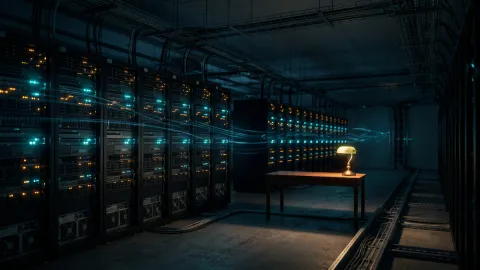
Four chips for millions and a private server
The Czech National Bank has acquired four Nvidia H200 graphics accelerators, which are installed in a Dell PowerEdge XE7740 server. According to estimates, the price of one such card is around one million Czech crowns, bringing the total hardware investment to over four million crowns excluding the server itself and additional infrastructure. For a state institution whose primary task is to monitor inflation and stabilize the financial system, this is a significant yet carefully considered step.
The Nvidia H200 is among the most powerful datacenter chips available today. Unlike standard graphics cards in gaming computers, this is specialized hardware for artificial intelligence and scientific computing. Each chip features 141 gigabytes of HBM3e memory and can process massive language models directly at the hardware level. This enables it to quickly analyze long documents, compare regulatory texts, or process thousands of public posts.
Which models run inside the CNB
The central bank decided not to use commercial cloud solutions like ChatGPT Plus or Claude Pro, and instead deployed exclusively open-source models that it fully controls. Employees access them through an internal platform called ČNB AI Chat.
Two large language models are available by default:
- GPT OSS 120B from OpenAI – an open variant of the model with 120 billion parameters, capable of processing complex texts and responding to queries in natural language.
- Qwen 3.5 122B from Chinese Alibaba – a model with 122 billion parameters, ranking among the best open-source systems originating from Asia.
For advanced analysts and technical teams, the model Mistral 7B from the French startup Mistral AI is also available. It is a smaller but highly efficient model, whose compact size makes it suitable for faster tasks or specific internal workflows.
The advantage of the open-source approach is that the bank can see how the model works, and data never leaves its physical servers. This is crucial when working with sensitive regulatory information or personal data.
What artificial intelligence does at the Czech central bank
The goal of deploying AI is not to replace human experts, but to accelerate and streamline their work. The CNB is already testing several specific use cases in pilot operation.
The first area is regulatory document analysis. European regulations such as MiCA (crypto-asset regulation) and DORA (financial sector cybersecurity) are extensive and technically complex. The AI model can quickly summarize key points, compare different versions of documents, and flag inconsistencies.
The second area is financial market supervision. The CNB analyzes materials from supervised institutions – banks, insurance companies, or investment firms. Artificial intelligence helps detect inconsistencies in license applications or statutory documents before a human can manually review them.
The third, equally important area is reputational monitoring. The bank operates an internal dashboard that uses AI to continuously track public discussion about supervised institutions. The model classifies and clusters thousands of posts from media and social networks so that analysts can promptly identify potential reputational risks or warning signs.
Why own hardware instead of the cloud
One of the main reasons the CNB invested in its own server is security and independence. As CNB spokesperson Jaroslav Krejčí stated, a local model provides the greatest value where users need to process content that is sensitive in terms of confidentiality, regulation, or data protection.
When using commercial cloud services, data would have to leave the bank's internal network and travel to the provider's servers – often abroad. For a state institution working with information about the stability of the Czech financial system, this is an unacceptable risk. Own infrastructure means full control over where data is located and who has access to it.
This approach also corresponds with the trend across Europe. The European Union, through the AI Act and other regulations, is placing increasing emphasis on transparency and sovereignty in data processing. The CNB is thus setting an example of how state institutions could approach deploying artificial intelligence without losing control over sensitive information.
What the CNB plans next
The current Dell PowerEdge XE7740 server allows expansion with an additional four H200 cards without needing to change the base hardware. The bank therefore plans to gradually increase computing capacity within a one to two year horizon.
In the next phase, the CNB wants to deploy artificial intelligence for automating internal processes and, in the long term, also for communication with external entities. Specifically, it is considering possible chatbots for the public or for specific target groups, such as in the area of statistical reporting.
This step fits into the broader strategy of the CNB's innovation lab, which experiments with modern technologies. The bank previously attracted attention by purchasing bitcoin, and Governor Aleš Michl spoke at the prestigious Bitcoin 2026 conference in Las Vegas, USA, this year. The investment in its own AI infrastructure thus shows that the CNB does not intend to fall behind in the field of artificial intelligence either.
A Czech example for European central banks
What the CNB is building is not unique on the international scale, but in the context of Central Europe it is an exceptionally progressive step. Major international banks such as JPMorgan have already deployed internal AI tools for hundreds of thousands of employees, and the Bank for International Settlements has even issued official recommendations on how central banks should approach language models.
The Czech National Bank is thus setting an example that even smaller economies can build on cutting-edge technologies while maintaining control over their data. For ordinary users, this means that Czech financial supervision will likely be faster and more efficient – and therefore safer.
Why doesn't the CNB use regular ChatGPT like everyone else?
ChatGPT and similar commercial services send data to the operator's servers, often to the USA. For a state institution working with sensitive regulatory information, this would pose a security and legal risk. The CNB therefore prefers to run open-source models on its own hardware, where it has full control over the data.
What is the difference between Nvidia H200 chips and regular graphics cards in a computer?
The Nvidia H200 is a datacenter accelerator designed for artificial intelligence. It has 141 GB of special high-speed memory and the performance of thousands of traditional graphics cards combined. Standard gaming cards are designed for display output and games, while the H200 is optimized for processing massive language models.
Can an ordinary person access the AI tools used by the CNB?
Access is exclusively internal for CNB employees. However, the public can use commercial versions of similar models – for example, ChatGPT from OpenAI, Qwen from Alibaba, or Le Chat from Mistral. The CNB does not plan to open its platform to the public in the future, but is considering creating public chatbots for specific agendas.