What is Project Fetch and why you should care
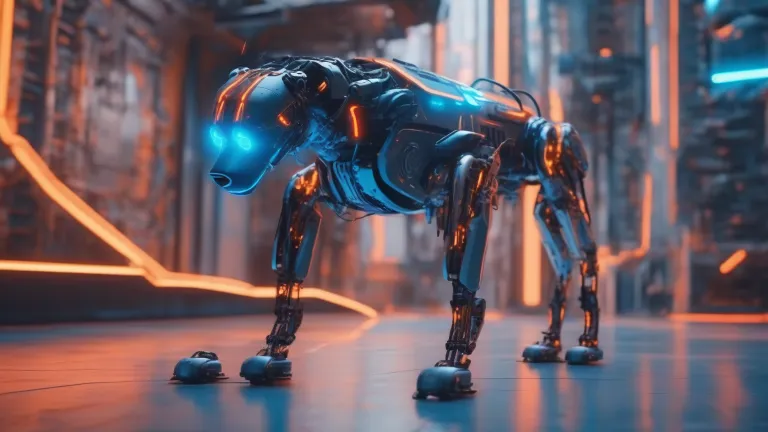
Anthropic, the creator of Claude and currently the most valuable AI startup in the world with a valuation nearing a trillion dollars, yesterday published the results of the second phase of an experiment called Project Fetch. In the first phase (November 2025), it divided eight of its employees — none of whom were robotics experts — into two teams. One had access to Claude, the other didn't. Both were tasked with programming a robotic dog (Unitree Go2) to fetch a beach ball. The team with Claude was about twice as fast.
The second phase (published June 18, 2026) went a step further: humans stepped aside. Claude Opus 4.7 was given the robot dog and a set of programming tasks on its own. No human behind the wheel. The result? Claude Opus 4.7 autonomously completed the programming portions of the experiment 20× faster than the fastest human team from last year.
Mind-blowing numbers
On four tasks that both of last year's human teams managed, Claude Opus 4.7 achieved the following times:
- Claude Opus 4.7 independently: 9 minutes and 35 seconds
- Human team with Claude (2025): 181 minutes
- Human team without Claude (2025): 361 minutes
That means the AI model was 37.7× faster than humans without AI assistance and 18.9× faster than humans who used Claude as a helper. And that's not all — Claude also wrote ten times less code than the human team with AI (1,045 lines versus 10,309). Its code was more concise, more precise, and more often worked on the first try.
What Claude mastered and what it didn't
The experiment consisted of several phases: connecting a laptop to the robotic dog, acquiring data from the video camera and lidar sensor, writing a program for manual control of the robot, developing a position tracking system, and finally ball detection. Claude Opus 4.7 excelled in all programming portions — especially in identifying the best approach to interfacing with the hardware, which was the part last year's humans struggled with the most.
Where did Claude (for now) fail? In precise physical manipulation. The actual "fetching" of the ball — i.e., gently nudging the ball with the robot dog back to the starting position — the model couldn't manage. This part requires continuous real-time feedback evaluation: where the ball is, how it moved, how to adjust the next movement. It's a closed loop in which humans — with a bit of practice — still excel.
Why this matters: Physical agentic AI on the horizon
This is not a specialized robotics model. Claude Opus 4.7 is a general-purpose language model, whose robotics capabilities emerged as a byproduct of general scaling. Anthropic explicitly states that no special robotics capabilities were developed — this progress "emerged from much more general scaling."
That's significant. It means that the better language models get in general, the better they get at interacting with the physical world. And the pace of acceleration is staggering: in just seven months (November 2025 → June 2026), Claude shifted from the role of "human assistant" to the role of "independent problem-solver" — at least in the software portion of robotics.
Anthropic itself summarizes the trajectory like this: "First, models help humans. Then humans help models. Finally, models handle things on their own." The company already observed this pattern in cybersecurity (Claude Mythos) and now sees it at the intersection of AI and the physical world. "We are plausibly entering the early era of physical agentic AI," the research authors write.
A robotic dog for $1,600
The hardware the experiment ran on is no lab exotica. The Unitree Go2 is a commercially available robotic dog, with prices starting at roughly $1,600 USD. The Chinese company Unitree sells it worldwide, including Europe. It is equipped with a video camera, lidar, and an API interface through which it can be programmatically controlled.
It's precisely the accessibility of such hardware that makes the experiment relevant beyond the lab. This isn't a proprietary million-dollar robot — it's a device that a university lab, a startup, or even an enthusiast can buy. Claude was able to communicate with it without prior specific training.
What this means for Czech companies and developers
For the Czech environment, this development has several practical implications. First: robotics is ceasing to be the domain of narrowly specialized experts. If an AI model can write functional code to control a robot in a matter of minutes, it opens doors for companies that want to deploy robotics but lack a specialized team.
Second: this trend is accelerating in Europe too. The EU is massively investing in AI and robotics — Amazon alone announced 10 billion euros for European robotics and AI infrastructure in 2026. Meanwhile, the Czech Republic launched the Czech AI Factory in Ostrava, providing computing capacity for European AI projects.
Third: the EU AI Act also enters the picture. If AI models begin independently controlling physical devices, the regulatory framework for "high-risk AI systems" will apply to them even more intensively. Anthropic emphasizes for now that its models are far from mastering fully autonomous robotics — but the pace of progress suggests that regulatory questions won't be postponable for long.
What comes next
Anthropic suggests that the biggest obstacle to fully autonomous physical AI isn't so much the software, but rather the closed loop of physical feedback. In other words: the model must evaluate what is happening in real time and immediately adjust its actions. That's something humans (after brief training) still win at.
At the same time, the researchers warn against underestimating the pace: "Models building their own software tools might have seemed unlikely just recently. Now it's happening. It would be unwise to rule out the same trajectory in hardware."
One thing is certain: the distance between "AI helps a human" and "AI doesn't need a human" is shrinking faster in robotics than anyone expected. And Czech developers, companies, and regulators should be watching it very closely.
Can Claude Opus 4.7 fully control a physical robot without human assistance?
In the software portion, yes — Claude independently managed connecting to the robot, reading sensors, navigation, and object detection. In the actual physical manipulation (gently nudging the ball), however, it still fails. Precise real-time control remains a human domain.
Is Claude Opus 4.7 available in Czech and for Czech users?
Yes. Claude is available via claude.ai and the API, and handles Czech very well. For robotics experiments, API access (Claude Code) is required, which is billed per token usage. For regular users, a free Claude tier with the Sonnet model is also available.
When will it be possible for AI to fully autonomously control robots in industry?
No one knows the exact timeline, but the pace is surprising. In seven months between phase 1 and 2, Claude shifted from assistant role to independent robot programmer. The key obstacle remains real-time physical feedback. Moreover, industrial deployment will be subject to strict safety regulations — especially in the EU.