Ten Thousand Robots in Less Than a Year
A number that recently sounded like science fiction is now a reality: AGIBOT (full name Zhiyuan Robotics) announced in March 2026 the production of its ten-thousandth humanoid robot. According to analytics firm Omdia, AGIBOT is currently the world leader in humanoid robot shipments. For comparison: the American Tesla Optimus or Boston Dynamics Atlas are still in the pilot deployment phase, while the Chinese are selling them in series.
AGIBOT offers several product lines. The flagship is the A2 series — a full-format humanoid robot for industrial use, available in A2 Ultra, A2 Lite, and A2-W variants designed for flexible manufacturing. The X series is intended for research and development, with model X1 being fully open-source. The newest platform is the Genie series (G1 and G2) focused on embodied AI — artificial intelligence that exists in a physical body and reacts to the real environment in real-time.
A Three-Way Partnership That Will Change Asia
Key news came at the AGIBOT Partner Conference 2026 in Shanghai, where Memoranda of Understanding (MoU) were signed between three companies:
- AGIBOT — supplier of humanoid robotic platforms with embodied AI
- NCS — a Singaporean technology firm specializing in system integration and digital transformation
- Anhui Huazhi Tiancheng Technology (HZTC) — a Chinese system integrator ensuring robot adaptation to specific environments
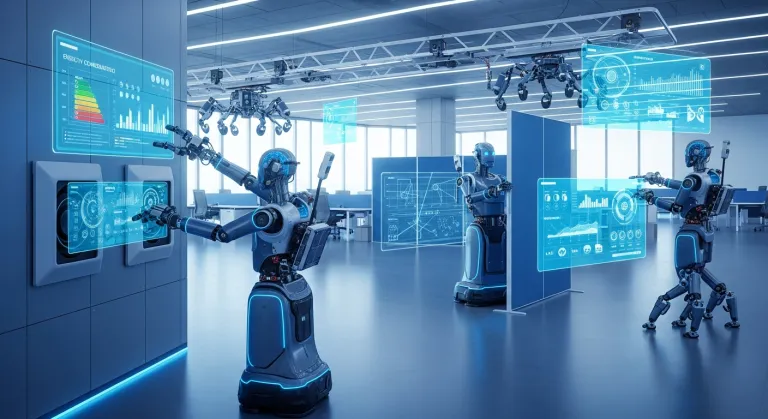
The goal is to deploy humanoid robots across the public and private sectors in Singapore and the wider Asia-Pacific region. Primary deployment areas include social services, smart building management, and public safety.
Sam Liew, CEO of NCS, emphasized that this is a combination of AGIBOT's technological foundation with NCS's deep industry knowledge: "We want to enable organizations to deploy physical AI in environments where critical services are at stake."
What These Robots Can Do
Robots deployed as part of this partnership will be equipped with:
- AI perception and situational awareness — the ability to read and interpret the surrounding environment in real-time
- Coordinated full-body movement with precise object manipulation
- Real-time mapping and navigation without the need for a pre-prepared environment
- Edge computing — data processing directly on the robot, without reliance on cloud connectivity
AGIBOT has also launched the AGIBOT World platform — a data ecosystem for training embodied AI models in realistic environments. Developers use the Genie Studio tool, which allows them to create applications for these robots without needing deep knowledge of robotics.
China as a Global Power in Robotics
The deployment of AGIBOT and NCS is not an isolated action — it is backed by a systematic state and commercial strategy. In 2023, 276,288 industrial robots were installed in China, representing 51% of the global volume. In three years, the number of installations increased by 75%. Today, more than 80,000 companies operate in the Chinese robotics sector, over 100 of which are listed on the stock exchange.
The Chinese government actively supports the development of humanoid robotics. Examples:
- Hangzhou adopted a robotics development plan for 2024–2029 with the goal of creating robots with "optimal bodies and the strongest brains"
- Nanjing is implementing a plan to create a high-quality robotics sector (2024–2026)
- Chongqing directs venture capital into robotics through a special innovation fund
- Tianjin New Area in Sichuan pays subsidies for the development of key algorithms and industrial AI models
The humanoid robot market in China is projected to reach a value of 105 billion yuan (approximately 14.5 billion USD) by 2030. The entire Chinese robotics industry could reach 400 billion yuan (about 55 billion USD).
What This Means for Europe and the Czech Republic
China's lead in humanoid robotics has direct implications for Europe. The manufacturing costs of Chinese robots are significantly lower than those of American or European competitors, thanks to state subsidies, an extensive industrial base, and cheaper components. This creates pressure on European manufacturers — including companies operating in the Czech Republic, which heavily utilize industrial automation.
Currently, there is no direct European equivalent to AGIBOT. The closest are the German company Agility Robotics (an American subsidiary) or ABB, which, however, specializes in traditional industrial robots. Humanoid robotics in the EU is still looking for its ecosystem. The EU AI Act will classify robots deployed in critical infrastructure as high-risk systems, which means stricter requirements for certification and transparency — this is an area where European regulation could slow down Chinese deployment in Europe.
For Czech companies involved in automation, logistics, or industry, developments in Asia are a signal: humanoid robots are ceasing to be an experiment and are becoming a commercial reality. The question is not whether they will come to Europe, but when and under what conditions.
What is AGIBOT and why is it important?
AGIBOT (Zhiyuan Robotics) is a Chinese startup based in Shanghai, which, according to analytics firm Omdia, is the world leader in humanoid robot shipments. In March 2026, it produced its ten-thousandth robot. It offers several lines of humanoid robots for industry, research, and public services, as well as an open platform for developing embodied AI applications.
Where exactly will AGIBOT robots be deployed in Asia?
The primary market is Singapore, from where deployment will expand to the entire Asia-Pacific region. The focus is on government and enterprise customers — specifically social services, smart building management, and public safety. The partners for integration and localization are the Singaporean firm NCS and the Chinese system integrator HZTC.
How does China fund and support the development of humanoid robotics?
The Chinese government supports robotics at both central and regional levels — through special development plans (Hangzhou, Nanjing), venture capital funds (Chongqing), and direct subsidies for research into algorithms and AI models (Sichuan). This significantly reduces the costs for Chinese companies and allows them to manufacture and sell robots at prices that European and American competitors struggle to match.