What Gartner is telling enterprises
On 17 August 2026, Gartner published its prediction that AI inference costs per agentic workflow will increase more than fivefold through 2028. The decisive words are "per agentic workflow". Gartner is not claiming that tokens themselves become more expensive. The claim is that the cost of a completed task, finished by an agent from start to end, will multiply.
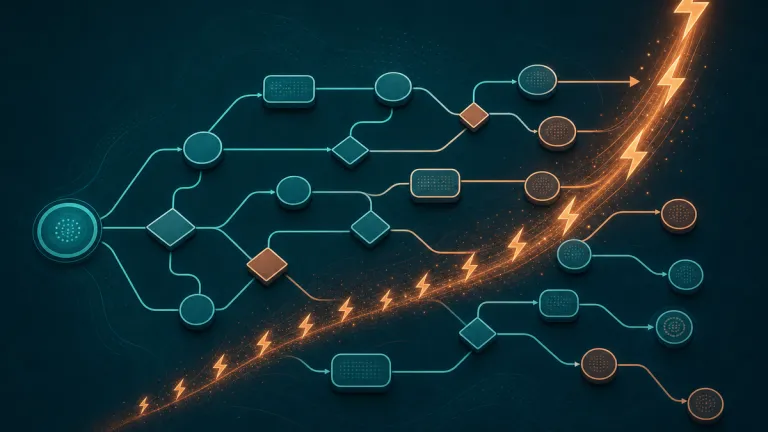
Why? Because an agentic workflow is not a single API call. It is a loop: the agent plans, selects tools, calls external services, reads the results, decides what to do next, and sometimes retries. One "small task" can mean dozens of model calls, and the context window grows with every step — the agent needs to remember what it already did. Costs that are invisible in a single chatbot exchange become the dominant line item.
The arithmetic of falling prices and exploding consumption
Two trends pull in opposite directions. First, per-token list prices at the major API providers have been repeatedly cut, driven by competition from open-weight models and falling inference hardware costs — the current OpenAI and Anthropic price pages show how cheap plain tokens have become. Second, the number of tokens consumed per completed task is growing much faster, because agentic architectures are token-hungry by design: multi-step reasoning, tool-calling loops and long histories multiply consumption.
That yields a counterintuitive scoreboard. Suppose per-token prices drop threefold, but the average agentic task consumes fifteen times more tokens than a plain question-and-answer exchange. The cost per finished task still rises fivefold. This 15 ÷ 3 = 5 arithmetic is a purely hypothetical illustration, not Gartner's internal data and not evidence of Gartner's methodology; it is simply a numerical way to show how falling per-token prices and rising token consumption can pull in opposite directions. Spread over the next two-plus years, a fivefold increase means per-workflow costs roughly double every year until teams change how workflows are built.
From our production experience: cost is a workflow property
At ai-jarvis.eu, we learned this lesson before agents became fashionable. Our article pipeline, transcription system and text-to-speech services are multi-step: content is fetched, cleaned, summarised, rewritten and checked — and every step has a price. The moment we started measuring cost per completed article instead of cost per API call, the expensive spots showed up immediately.
Agentic layers behave the same way, only more so. In AI Arena, where we benchmark local LLMs via Ollama on an RTX 5060 Ti 16 GB against cloud models, a recurring finding is that many subtasks do not need a frontier model. Summarising a document, extracting an address, or classifying a ticket is fine on a 7–14B open-weight model at a fraction of the price. The trick is routing: let the small model handle the routine steps and escalate only the hard ones.
The European angle: compliance can add engineering and monitoring costs
For European companies, there is an extra cost dimension. The EU AI Act can create engineering, monitoring and documentation costs: organisations may need to establish logging, audit records and, for higher-risk systems, human oversight. Logs and documentation do not necessarily require additional model calls or prompt tokens; they are often stored or reviewed outside the agent loop. Some compliance features, such as generating an explanation on request, can add inference cost if a team builds them as live model calls, but that is an architecture choice rather than an automatic effect of every audit entry.
GDPR and data residency add another layer. Whether an EU organisation may route sensitive workflows through US-hosted APIs depends on the GDPR international-transfer rules, the contractual safeguards in place, transfer-impact assessments and the nature of the data. Some transfers can be lawful with appropriate safeguards; in other cases organisations prefer EU-hosted or local processing for sovereignty and procurement reasons. That makes European providers such as Mistral or Aleph Alpha, and local open-weight inference, attractive options for teams that want to keep processing in the EU. Currency movements can also affect euro-denominated budgets: if a provider prices in USD, a weak euro makes the fivefold forecast feel even worse.
What to do before the bill arrives
- Measure cost per completed workflow, not per token. If you cannot say what one finished agentic task costs, you cannot manage it.
- Cache aggressively. Prompt caching is the cheapest optimisation we run; repeated prefixes otherwise get billed again and again.
- Route, don't escalate by default. Reserve frontier models for genuinely hard steps.
- Set budgets per workflow and kill runaway loops. A retry storm can burn more tokens than a hundred normal runs.
- Consider local inference for sensitive subtasks. An Ollama instance on a 16 GB GPU is not a vanity project; it is a cost and compliance instrument.
Bottom line
Gartner's fivefold prediction is not an argument against agentic AI. It is an argument for treating it as an industrial process with a measurable unit cost. The teams that survive the agentic build-out will not be the ones with the flashiest demos; they will be the ones that know exactly what one completed workflow costs — and how to drive that number down.
Does Gartner's forecast mean tokens will get more expensive?
No. The forecast targets the cost of a completed agentic workflow. Token prices are expected to keep falling; the problem is that agentic tasks consume many more tokens per completed job, so the per-task cost still rises.
How does the EU AI Act influence inference costs?
Compliance can create engineering, monitoring and documentation costs, and may influence architecture or provider choices. Logs and documentation do not necessarily require additional model calls or prompt tokens; the effect depends on how a system is built and what the AI Act requires for its risk category.
Should European companies avoid agentic AI because of this forecast?
No. The right response is to measure cost per workflow, cache aggressively, route routine subtasks to smaller models, and set hard budgets — the discipline described in this article.