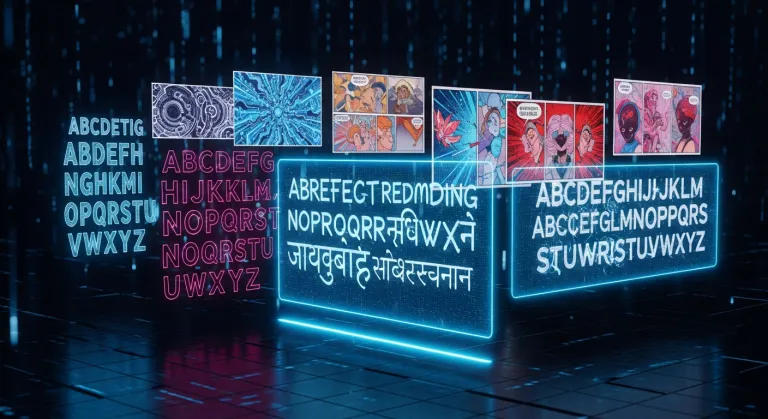
End of Blurred Letters: AI Finally Reads and Writes
One of the biggest struggles of diffusion models — the technology behind most current AI image generators — has always been text integration. Systems like DALL-E, Midjourney, or Stable Diffusion built images gradually from random noise, with small elements like letters receiving insufficient attention. The result was often nonsensical words, typos, or visually distorted characters that immediately betrayed the machine origin of the image.
ChatGPT Images 2.0 solves this problem, according to The Jerusalem Post, in a way that would have seemed like sci-fi just two years ago. The model now generates readable and accurate text in images, even in complex languages and demanding typographic tasks. This opens doors to practical applications: advertising banners, restaurant menus, infographics, comic bubbles, or directly printable materials that look professional and usable without additional edits in graphic editors.
Thinking Mode: When AI Plans, Not Just Draws
OpenAI did not reveal exact technical details of the new model, but hinted that Images 2.0 combines capabilities matching language models. This means the system no longer merely "draws," but actively plans the image in advance, understands context, and in some cases even checks itself before presenting the result to the user.
A key innovation is the operating mode called Thinking. In this mode, the model works slower but with significantly higher precision and depth. It can create a consistent series of images from a single prompt, maintain characters, styles, and objects across different panels, and generate outputs such as multi-page comics or complete storyboards. For creative professionals and marketing teams, this means a fundamental change: instead of assembling work from multiple tools, they can generate an entire campaign from a single text prompt, including different formats for social networks, web, or mobile applications.
Stronger in World Languages, But Not Everywhere
Another significant advancement concerns support for non-Latin scripts. Previously, generating text in Japanese, Korean, or Hindi was almost impossible — results suffered from errors and visual inconsistency. Images 2.0 handles these languages much better, making the model usable for global markets and multicultural content.
For Czech users, the situation is slightly more optimistic than for Hebrew speakers, where the system, according to The Jerusalem Post, still struggles and produces clumsy errors. Czech uses the Latin alphabet with diacritics, which has traditionally been easier for AI models than complex non-Latin scripts. Nevertheless, OpenAI does not explicitly showcase Czech in its official demos, so it is reasonable to expect good rather than perfect results with more complex diacritics or specific typography.
2K Resolution and Professional Use
Beyond text accuracy, the image quality itself has improved. Images 2.0 supports resolutions up to 2K, handles complex compositions, fine details, and subtle stylistic requests. Users can guide the model in detail, and the result corresponds much more faithfully to the prompt than in previous versions.
The practical impact is wide: marketers can create campaign concepts, restaurant owners visually attractive menus, game developers quick environment sketches, and teachers pedagogical infographics. Still, it is important to stay grounded — for final professional printing and brand identity, the human graphic designer still has the final say. AI is a powerful tool for design and prototyping here, not an absolute replacement for human creativity.
Where Are the Limits?
Despite significant progress, Images 2.0 is not perfect. The model still struggles with tasks requiring precise physical understanding of the world — for example, folding origami or complex depiction of three-dimensional objects. Repeated edits of the same image can also lead to quality degradation, a phenomenon known from earlier versions.
Speed is another compromise. While text output from ChatGPT is generated within seconds, complex images can take several minutes. In Thinking mode, this time extends further. In the context of what the model can do, however, this is still a relatively short time — especially compared to hours of manual graphic work.
Availability and Price for the Czech Market
ChatGPT Images 2.0 is available directly in the ChatGPT interface, so Czech users have access to it immediately if they use a paid subscription. OpenAI typically includes new image features in Plus ($20 per month) and Pro ($200 per month) tiers, while free version users can draw on a limited number of generations. For Czech companies and freelancers, this means a tool available for hundreds of korunas per month, not an investment in tens of thousands in software licenses.
Regarding regulation, the AI Act applies in the European Union, which requires labeling of content generated by artificial intelligence. Czech companies should therefore ensure that AI-created visuals used in commercial communication comply with transparency rules.
FAQ
Is ChatGPT Images 2.0 available for free?
Yes, but with significant limitations. ChatGPT free tier users can generate images in limited numbers. Full performance, higher limits, and access to Thinking mode require a Plus subscription for $20 per month or Pro for $200 per month.
Can ChatGPT Images 2.0 generate text in Czech?
Czech uses the Latin alphabet, which the model handles better than complex non-Latin scripts. Still, OpenAI has not published specific benchmarks for Czech, and minor errors may occur with more complex diacritics. For short captions and simple texts, the result is usable; for professional print materials, review is recommended.
How long does it take to generate one image?
Simple images are created within tens of seconds, complex scenes with text, comic pages, or precise infographics in Thinking mode can take several minutes. This is still significantly faster than manual graphic work, but slower than text generation.