For the past few months, sEMG wristbands looked like an answer to a question few people were asking: controlling AR menus and PC interfaces with finger gestures. Wetour's shift toward robot training data is more interesting. Physical AI and humanoid robots need massive amounts of human demonstration data, and cameras alone capture only part of it. Muscle signals capture the part cameras cannot: how much force the hand actually applies.
From AR wristband to robot teacher
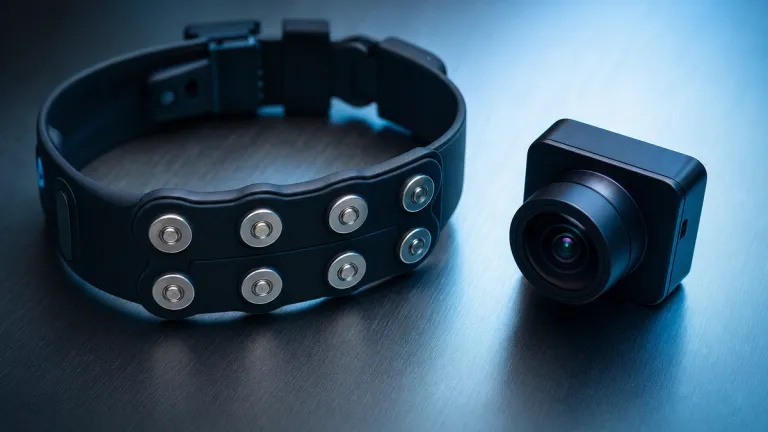
Wetour calls the new system a "dual-modal dataset capture" platform, and the naming convention tells you everything about the architecture. Conductor is the sEMG wristband that reads muscle activity through eight channels and estimates force intent. VisionLink is the first-person camera that records hand position and object interaction. Together they feed the Orchestra platform, which fuses the two streams into robot-training samples with both kinematics and dynamics.
The company had shown the wristband as a gesture controller for AR and PC interfaces back in May–June 2026. This week's announcement is a repositioning toward the robotics market, and it is a smarter bet strategically. Gesture control competes with decades of interface research; robot training data is a bottleneck that every humanoid-lab in the world is currently paying to solve.
The numbers worth remembering
The press materials contain a handful of concrete figures, and for once they are actually useful:
- 8 sEMG channels on the Conductor wristband, measuring forearm muscle activity through the skin.
- 20 joint angles for the hand, computed by the on-device model.
- 50.4 milliseconds of processing time for a one-second sEMG window with zero lookahead — meaning force estimation is effectively continuous rather than batch-delayed.
- Under 100 milliseconds of edge gesture-recognition latency on an NVIDIA Jetson Orin Nano platform, a commodity board that costs around US$249 before EU VAT.
- 21.8% frame loss for vision-only hand tracking in internal carrying tests, including a continuous 4.32-second dropout. This is the number that justifies the whole dual-modal approach.
There is a stock-market subplot as well: NASDAQ: WETO moved from a $5.72 close on August 28, 2026 to the $7.00 area around the announcement — a gain of roughly 22.38%. Quick math confirms the figures are consistent: 5.72 × 1.2238 ≈ 7.00. That is a solid pop for a small-cap robotics name, but as anyone who runs production AI systems knows (Yahoo Finance covered the release here), a demo day and a deployable product are two very different things.
Why muscle signals fill a real gap
Surface electromyography is not new. Myoelectric prostheses have used sEMG from the forearm to control artificial hands for decades, and Meta demonstrated an sEMG wristband as an AR neural input device as far back as 2024. What is new here is pairing the modality with first-person vision specifically to preserve the force dimension of manipulation data for robot learning.
A camera sees where the hand is. It does not reliably see how hard the fingers squeeze, and it stops seeing the hand entirely whenever an object occludes it, the hand leaves the frame, or motion blur smears the image. That is exactly what the 21.8% frame-loss figure illustrates. Muscle signals, by contrast, do not care about line of sight — the electrical activity of forearm muscles is measurable as long as the band is on the skin.
The physics matters for robot learning. Grasping an egg and grasping a hammer require different forces, and a vision-only dataset records the pose while guessing at the effort. The sEMG signal encodes the effort. The two streams together approximate what a robot actually needs to learn: a policy that knows both the trajectory and the torque.
The European angle nobody mentioned in the demo
For European robotics companies and research labs, the interesting part is not the marketing; it is the regulatory position of muscle data. An sEMG stream records physiological signals from an identifiable person, which puts it in the neighborhood of special-category data under Article 9 GDPR — depending on how it is used, it can qualify as data concerning health or as biometric data.
Wetour's edge-processing architecture helps here. Running the model on a Jetson-class device means raw muscle signals can be processed locally, with only pose and force estimates leaving the device. That aligns neatly with the GDPR principles of data minimization and purpose limitation. The company has not, however, published any concrete statement on European data residency or the EU availability of the hardware — both remain open.
On the EU AI Act front, the timing is notable. Since August 2, 2026, the AI Office and national market surveillance authorities directly enforce GPAI obligations and Article 50 transparency rules. Meanwhile, the 2026 "Digital Omnibus on AI" amendments pushed most standalone high-risk AI compliance deadlines to December 2027 and August 2028. A data-capture tool like this is not itself high-risk AI, but the robot that later gets trained on its output very well may be. European firms should document training-data provenance now, because retroactive documentation of human bio-signal datasets is a nightmare.
The honest bottom line
This is a promising research direction, not a proven production system. Wetour states plainly that core components — cross-modal correction during visual dropouts and live force-estimation calibration — remain "in validation" and under active development. That is more transparent than most announcements in this sector, and the 21.8% frame-loss disclosure is the kind of honest failure metric the robotics industry needs more of.
What a European developer can do with this today: not much, until Wetour announces pricing, SDK availability, and EU distribution. What a European robotics lab should do is watch the dual-modal approach closely. The idea of capturing force intent alongside visual demonstrations solves a genuine data-quality problem, and when the company releases an independent evaluation or a public dataset, the 20 joint angles and sub-100-millisecond latency will be well worth benchmarking against your own capture pipeline.
Is sEMG the same technology used in myoelectric prostheses?
Yes, the principle is identical — surface electrodes measure electrical activity from muscles through the skin. Prosthetic arms use those signals to control a mechanical hand in real time. Wetour's twist is recording the signals together with first-person video to create robot training data, rather than controlling a device directly.
Does collecting muscle signals count as health data under the GDPR?
It can. Physiological data from an identifiable person is sensitive, and depending on the purpose it may qualify as health or biometric data under Article 9 GDPR. Processing raw sEMG on an edge device instead of sending it to the cloud is a sensible first step, but European companies should still conduct a formal impact assessment before building datasets from employees.
When will Wetour's system be available in the EU?
No date, pricing, or distribution plan has been announced. The components are still in validation, so treat any purchase timeline as speculative. The stock is listed on NASDAQ as WETO, but listing does not equal European market availability.