It is easy to read a number like €6.1 billion and stop there. But the number is the least interesting thing about this decision. What actually changed on 11 September is that the European Union agreed, in writing, to bend its own procurement architecture — twice for US-made missiles and three times for Ukrainian drone components — because the alternative was leaving money on the table that Ukraine needs before winter.
What was actually approved
The package sits inside the €90 billion Ukraine Support Loan covering 2026 and 2027, which is split into €30 billion for budget aid and €60 billion for defence. Ukraine's 2026 defence share is €28.3 billion, and as of this month it is 100% committed. The Commission announced the €6.1 billion framework on 24 August, Ukraine's Independence Day, and finalised it after member states signed off on the derogations.
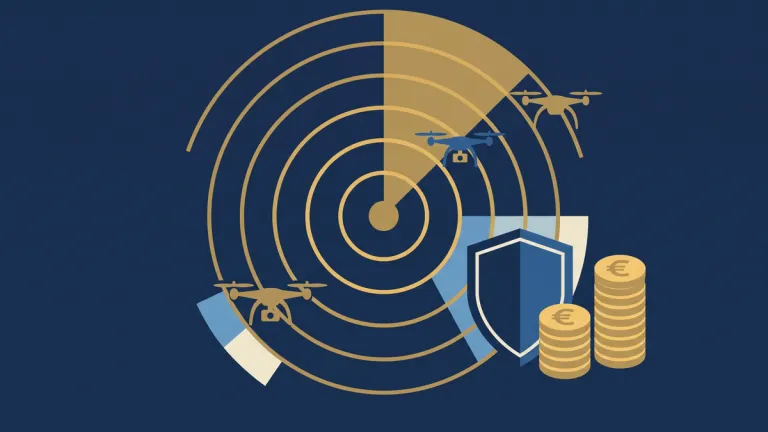
The shopping list is not abstract: air defence systems, PAC-3 interceptors for Patriot batteries, electronic warfare gear, radar, ammunition and drones. The urgency has a number attached to it too — 376 Russian missile strikes were recorded against Ukraine in July 2026 alone. Air defence is not a future requirement in this war; it is a weekly one.
The five waivers, explained without the jargon
EU-funded procurement normally comes with strings: buy from EU suppliers where possible, keep unit costs within set ceilings, follow standard tender routes. Derogations are the formal mechanism for stepping outside those rules.
Ukraine received three of them for Ukrainian-made drone equipment and components that exceed the standard cost limits — a recognition that in drone warfare, the cheapest option is often not the one that works, and that Ukraine's domestic drone industry is now a genuine defence supplier rather than a cottage sideline.
Two more cover US-manufactured PAC-3 Patriot interceptors, including purchases routed through NATO's PURL mechanism. Europe does not currently produce a Patriot-equivalent interceptor at the volume Ukraine needs, so the exemption is a practical admission: the money can be spent, but not on a purely European supply chain. For anyone in Brussels who talks about defence sovereignty, this is the uncomfortable sentence in the paragraph.
Where the money actually stands
Approval is not the same as delivery, and it is worth doing the arithmetic that the headline figures hide. Of the €28.3 billion allocated for 2026, €8.35 billion has been disbursed or transferred to Ukraine so far this year. A further €4.7 billion in disbursement requests is currently being processed by the Commission.
Add those together and you get roughly €13.05 billion — about 46% of the 2026 envelope either paid out or in the pipeline. That leaves around €15.25 billion approved in principle but not yet requested. Put differently: the €6.1 billion finalised this week represents about 21.6% of this year's defence allocation, and the full 2026 defence envelope is just under half of the €60 billion defence tranche in the two-year loan. The announcements are running ahead of the disbursements, which is normal for procurement — and worth remembering the next time a billion-euro figure appears in a headline.
Drones, electronic warfare and the AI question
Here is where this story stops being only about defence budgets. Modern drone warfare, electronic warfare and radar are software problems as much as hardware ones. Target recognition, jamming resistance, flight-path autonomy, sensor fusion — these are AI workloads, and the €6.1 billion package pays for a lot of them.
Under Regulation (EU) 2024/1689, the AI Act, systems placed on the market or put into service exclusively for military, defence or national security purposes fall outside the regulation's scope. That single word — exclusively — is doing enormous work. A targeting model built for a military drone sits outside the Act. The same code base adapted for a civilian survey, agricultural or inspection drone does not, and neither do the general-purpose models that sit underneath either of them.
Meanwhile the Act's general-purpose AI obligations took effect in August 2025, and binding Article 50 transparency duties, deployer obligations and national regulator enforcement arrived in August 2026. As our magazine coverage of the EU AI Act has followed, Europe now has the world's most developed AI rulebook — with a deliberate hole cut in it for defence. Procurement lawyers are currently reading that hole closely, because a supply chain that starts in a civilian AI lab and ends in a military drone is exactly the kind of thing written rules handle badly.
The squeeze on European suppliers
There is a second tension worth naming. The loan money is designed to flow to EU and Ukrainian defence suppliers. The derogations mean a meaningful slice will flow to American ones instead, because the interceptor gap is real and cannot be conjured away in a procurement cycle.
For European defence and dual-use technology firms, that is both an opportunity and a deadline. The drone, electronic warfare and radar segments are open to them under this framework, and demand is not going to fall. But the credibility test is capacity: whether European industry can deliver interceptors, sensors and AI-enabled systems at the volumes and prices that a war of attrition demands. The answer to that question will shape the next round of these packages far more than any exemption granted this week.
Questions readers are asking
Is the €6.1 billion new money on top of the €90 billion loan?
No. It comes out of the €90 billion Ukraine Support Loan for 2026–2027, which is divided into €30 billion of budget aid and €60 billion for defence. The €6.1 billion is a procurement package within that framework, and it completes the €28.3 billion defence allocation set aside for 2026.
Who is allowed to win these contracts?
Procurement under the package is open to both EU and Ukrainian defence suppliers. The five derogations widen that in two specific directions: PAC-3 Patriot interceptors manufactured in the United States, including through NATO's PURL mechanism, and Ukrainian drone equipment and components whose unit costs exceed the standard EU limits.
Does the EU AI Act apply to the AI inside these drones?
If a system is placed on the market or put into service exclusively for military, defence or national security purposes, the Act excludes it. Anything with civilian uses as well does not get that exclusion, and general-purpose models used along the way remain covered by the Act's GPAI obligations regardless of what they end up powering.
The honest summary: Europe has now committed every euro it planned for Ukraine's 2026 military needs. Getting it spent is a different kind of problem — and the exemptions signed this month are a reminder that when the rules and the requirement pull in different directions, governments rewrite the rules rather than delay the delivery.