End of the purely silicon chip era?
Data centers around the world are struggling with an increasing thirst for computing power. Each new generation of graphics processors brings higher speed, but at the cost of exponentially growing energy consumption. According to the International Energy Agency (IEA), global demand for electricity for data centers will double by 2030. Meanwhile, the physical limits of silicon are approaching – every further development step on traditional chips brings only marginal improvements.
Into this environment enters the British company Lumai, an Oxford University spin-off founded in 2021. At the end of April 2026, it presented the Iris Nova server, which is the first in the world to run real-time inference on language models with billions of parameters – while consuming a fraction of the energy compared to conventional systems.
How an optical processor works
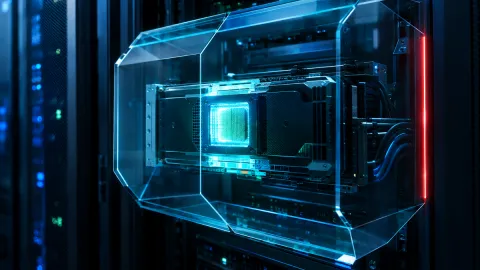
While traditional chips compute with electrons on two-dimensional silicon surfaces, Lumai moves computations into three-dimensional space using light. Their optical tensor engine uses photons instead of electrons, enabling millions of operations simultaneously thanks to massive spatial parallelization.
The Iris Nova server does not use a purely optical architecture, but rather a hybrid approach: the optical tensor engine handles mathematical computations, while the digital part takes care of system control and software. This combination means the server can be integrated into existing data centers without major modifications. It does not need to rely on expensive liquid cooling, which is often a necessity with powerful GPUs.
Lumai states on its website that the technology is built on standard manufacturing processes and requires no new materials. This is key for future scalability – the company promises up to 50-fold performance increase compared to current transistor-based accelerators on its roadmap.
Demonstration on Llama 8B and 70B
To prove that this is not just a laboratory curiosity, Lumai ran real inference on the Llama 8B and Llama 70B models on Iris Nova. Both models ran in real time, confirming that optical computing is no longer just a theoretical concept, but a technology ready for deployment.
The Iris server family includes three models: Nova (available now for evaluation), Aura, and Tetra. These should offer even higher capacity and cover a broader spectrum of deployments – from hyperscalers through enterprise data centers to research institutions.
According to Lumai's estimates, their servers achieve the same performance as conventional systems at only 10% energy consumption. Total cost of ownership (TCO) is also expected to be a fraction – the company speaks of 10% of the cost compared to GPU-based solutions.
Why it matters for Europe and the Czech Republic
The European Union has been pushing for sustainability of digital infrastructure for several years. The AI Act, which came into force in February 2025, explicitly emphasizes that artificial intelligence should be environmentally friendly. Member states and data center operators thus face increasing pressure to reduce their carbon footprint.
The Czech Republic is no exception. New data centers have been emerging in Prague and its surroundings in recent years, which must meet strict energy standards. Technologies like Lumai Iris Nova could play a key role in expanding AI capacity without the need for massive investments in electrical connections and cooling systems. For Czech companies and startups that want to deploy their own models, lower operating costs could mean a significant reduction in inference costs.
So far, Lumai is offering its servers primarily for evaluation to large players, but the trend is clear: if optical computing fulfills its promises, it could become an alternative to NVIDIA GPUs precisely in the area of inference, where the largest part of AI workload is concentrated today.
Behind the project are Oxford and the British government
Lumai is not another anonymous tech startup. The company emerged from research at Oxford University, its CEO Dr. Xianxin Guo graduated from the prestigious Royal Academy of Engineering program, and CTO Dr. James Spall was included in the Photonics 100 ranking in 2025. Lumai also received the Falling Walls Award 2025 for breakthrough of the year in science and was part of the first London cohort of the Intel Ignite accelerator.
The project is also supported by the British government through the ARIA (Advanced Research and Invention Agency). "Demand for existing AI processors requires urgent search for alternative scaling paths," said Suraj Bramhavar, ARIA's program director. "Lumai shows that optical processors could be one of these paths."
With the transition from the training period of AI to the era of inference, when models are deployed into operation and serve millions of users, the need for efficient inference servers grows geometrically. Lumai claims that we are just entering the post-silicon era – and its Iris Nova is to be one of the first proofs that this era has already begun.
Not yet available in the Czech Republic, but with global potential
Lumai currently does not offer a public cloud or direct sales to individual users. Iris Nova servers are intended for evaluation by partner organizations – hyperscalers, cloud providers, and large enterprises. For the Czech market, this means that immediate availability is not realistic, but if large European operators adopt the technology, Czech developers and companies could benefit from optical inference indirectly through cloud services.
The pricing model has not yet been published, but the company promises 90% savings in operating costs and one-tenth TCO. For comparison: renting powerful GPU instances for inference today costs thousands of dollars per month in the cloud. If optical servers truly offered comparable performance at a fraction of the price, they could significantly shake up the AI infrastructure market.
Is optical computing suitable for training AI models as well, not just for inference?
Lumai currently focuses exclusively on inference – that is, running already trained models. Training requires a different type of computation and optical processors have not yet been commercially verified in this area. For training, classic GPUs from NVIDIA remain the dominant solution.
Do data centers need to be rebuilt for optical servers?
No. Iris Nova uses a hybrid architecture and is designed for direct integration into existing data centers. It does not need special cooling or new materials, so deployment is technically similar to conventional servers.
When could the technology be available for smaller companies or developers?
So far, Lumai offers servers only for evaluation by large organizations. Broader commercial availability depends on the success of the first deployments and potential cooperation with cloud providers. Smaller companies will likely access optical inference only through cloud services that adopt this technology.