Why is AI Safety Certification So Complex?
Deploying an AI model into a production line or a medical device is not the same as launching a chatbot. Every system that can directly endanger human health or life must undergo a strict certification procedure. In industry, these are standards like IEC 61508 (functional safety, i.e., SIL — Safety Integrity Level), in medicine IEC 62304 for medical device software, and in the automotive industry ISO 26262 (ASIL — Automotive Safety Integrity Level).
The problem is that most AI frameworks — from PyTorch to TensorRT — were designed with an emphasis on performance, not safety certification. Integrating AI into certified environments has therefore historically meant years of development, costly audits, and compromises in system capabilities.
QNX OS for Safety 8.0: An Operating System with a Pristine Safety History
BlackBerry QNX is no newcomer to the technology world. This microkernel real-time operating system (RTOS) already powers over 275 million vehicles worldwide, and over 45 years of existence, it has built a reputation as one of the most reliable foundations for safety-critical applications. Key feature? The so-called microkernel architecture — each operating system component runs in isolation, so the failure of one process does not jeopardize the rest of the system.
The latest QNX OS for Safety 8.0 supports certification to the highest levels: ASIL D for automotive, SIL 3 for industry, and IEC 62304 for medical software. QNX states that it helps customers achieve these certifications with 100% success — a number you only say in this industry when it's truly accurate.
NVIDIA IGX Thor: A Computational Monster for the Network Edge
On the other side stands the new NVIDIA IGX Thor platform. It is industrial edge AI hardware built on the NVIDIA Blackwell architecture — the same generation of chips that powers the most modern data centers, just in a more compact and industrial design.
Performance is impressive: up to 5,581 TFLOPS in FP4 format (floatpoint 4-bit), with the option to expand with a discrete RTX PRO 6000 GPU. The platform includes a dedicated Functional Safety Island — a separate safety processor that monitors system operation independently of the main AI computing part. Hardware certification includes ISO 26262 and IEC 61508, supporting ASIL D/SC3 and ASIL/SIL 2 levels.
At the software layer, IGX Thor integrates three key NVIDIA stacks:
- Isaac — for robotics and autonomous movement
- Holoscan — for real-time sensor processing in medical devices
- Metropolis — for visual AI and intelligent surveillance systems
Customers receive each of these stacks with 10 years of software support via NVIDIA AI Enterprise, which is crucial for industrial deployment — production lines and hospital systems cannot afford to migrate to new software every two years.
QNX + IGX Thor Integration: What Does It Practically Mean?
The core of the collaboration lies in the direct integration of QNX OS for Safety 8.0 with NVIDIA IGX Thor. The result is a platform where BlackBerry's RTOS provides deterministic real-time control and safety certification, while NVIDIA adds computational power for AI inference — models for vision, language models, robotic motion planning, or diagnostic AI in medicine.
This enables scenarios that previously required complex and costly custom solutions:
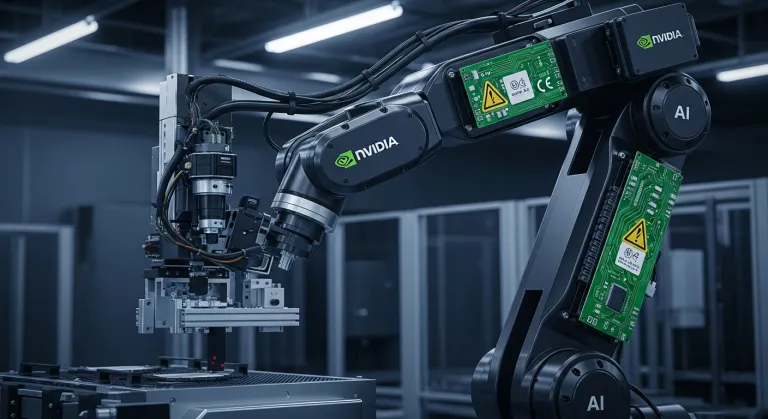
- Industrial Robotics: autonomous arms and mobile robots in factories with SIL 3 functional safety, capable of reacting to unexpected situations using AI without losing safety guarantees
- Medical Devices: AI-assisted surgery, image diagnostics, or real-time patient monitoring compliant with IEC 62304
- Industrial Automation: smart sensor systems, predictive maintenance, and autonomous inspection in high-risk environments
Context: Why Now and Why Is It Important?
The announcement comes at a time when industrial and medical AI is experiencing a significant surge in investment. NVIDIA GTC 2025 showed that interest in physical AI — meaning AI controlling robots, machines, and medical devices — surpasses interest in purely software applications.
Moreover, the regulatory environment is pushing companies to accelerate certification. The EU AI Act, which came into force in 2024 and is gradually taking effect, classifies AI systems in medicine, critical infrastructure, or industrial safety as high-risk. This means mandatory risk assessment, transparency, and — in many cases — precisely software safety certification. The collaboration between QNX and NVIDIA significantly simplifies customers' path to compliance with these requirements.
What Does This Mean for the Czech and European Scene?
The Czech Republic is one of the most industrially significant countries in the EU — the automotive industry, electrical engineering, and industrial manufacturing form the backbone of its economy. Manufacturers integrating AI into production processes or robotic systems must now contend not only with technical but also with the regulatory requirements of the EU AI Act.
The QNX OS for Safety 8.0 + NVIDIA IGX Thor platform offers precisely the type of pre-certified foundation that allows companies to accelerate their own development without having to build safety infrastructure from scratch. For domestic industrial automation integrators or companies developing medical devices, this means concrete savings of months of development and millions of Czech crowns in audit costs.
Availability on the Czech market is facilitated through NVIDIA hardware distributors and authorized BlackBerry QNX partners — prices depend on the specific configuration, from development kits to production systems IGX T5000/T7000.
What is BlackBerry QNX and why is it used in safety-critical systems?
BlackBerry QNX is a real-time operating system (RTOS) with a microkernel architecture, where each part of the system runs in isolation. This minimizes the risk that the failure of one component will jeopardize the entire system. QNX is certified for the highest safety levels (ASIL D, SIL 3) and powers over 275 million vehicles worldwide — which is why it is used wherever software failure can endanger life.
What is NVIDIA IGX Thor and how does it differ from standard graphics cards?
NVIDIA IGX Thor is an industrial edge AI platform designed specifically for deployment in factories, hospitals, or autonomous robots. Unlike standard consumer GPUs, it is certified for functional safety (ISO 26262, IEC 61508), includes an independent safety processor, and offers 10 years of software support. Performance reaches up to 5,581 TFLOPS in FP4 format — sufficient for real-time AI models.
How does the collaboration between QNX and NVIDIA relate to the EU AI Act?
The EU AI Act classifies AI systems in medicine, industrial safety, or critical infrastructure as high-risk, requiring software safety certification, risk assessment, and transparency. The integration of the pre-certified QNX OS for Safety with NVIDIA IGX Thor allows manufacturers to meet these requirements with significantly lower audit and certification costs than if they were to develop safety infrastructure from scratch.
