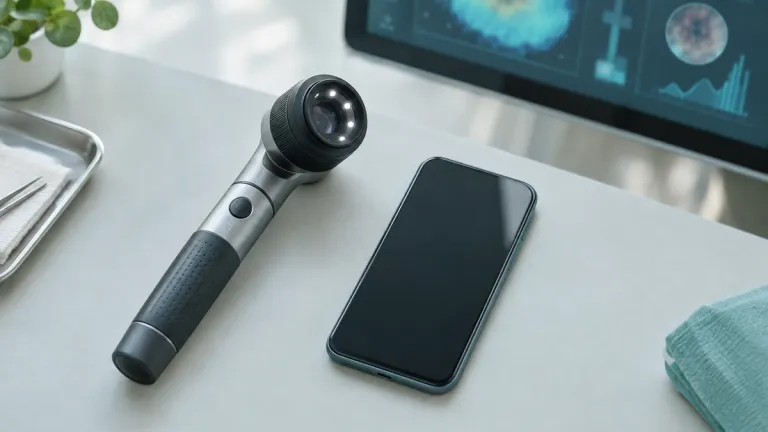
The setup
Two UK hospitals placed a fully autonomous AI triage step inside a live urgent suspected skin cancer pathway. Over 16 months, the system looked at clinical and dermoscopic smartphone images and decided by itself whether a referral was low-risk enough to close. The device is a CE-marked Class III medical product.
The cohort covered 8,391 patients, or 94% of all urgent suspected skin cancer referrals at the participating hospitals. Of the patients asked, 86% consented to autonomous AI decision-making. Those who declined did not enter the autonomous pathway.
What the figures show
- Autonomous discharge: 31% of cases at one hospital and 25% at the second, with no clinician review.
- Teledermatologist discharge: a further 24% and 25% of cases.
- Clinician time recovered: 2,851 hours over 16 months, described by the authors as a 62% gain in clinical capacity.
- Biopsy rate: 27%, against 43% in standard face-to-face pathways.
- Routine follow-up: down from 27% to 12%.
- Accuracy: above 98% sensitivity for invasive melanoma, squamous cell carcinoma and basal cell carcinoma, with 72.1% specificity.
- Missed cancers: six false negatives among 8,391 patients, five basal cell carcinomas and one melanoma in situ. No adverse outcomes were reported during follow-up.
Turning 2,851 hours into something countable
Read that time figure through the 20-minute appointment the authors use and you get 8,553 face-to-face slots, which is where their "more than 8,500 additional appointments" number comes from. Using a conventional 1,700-hour clinical year as a rough yardstick, 2,851 hours is about 1.7 full-time dermatologist posts recovered from a single triage step across two sites.
The UK context makes the arithmetic matter. Dermatology is among the specialties hit hardest by consultant shortages in the UK, so 1.7 recovered posts is not a rounding error.
Where the AI sat in the pathway
Earlier dermatology AI studies mostly had the model rank, flag or sort cases and left the decision with a clinician. This one put the model at the exit door. A quarter to a third of referrals never reached a human at all. The low-risk cases that did reach a teledermatologist were discharged at roughly another quarter.
A specificity of 72.1% looks weak next to sensitivity above 98%. For a triage filter the trade-off runs the other way: a false positive sends someone to a clinician, which is the pathway that already existed. A false negative is the failure mode that matters, and that is where the six cases sit.
The European rulebook around this
A CE mark under the Medical Device Regulation means the device has been assessed by a notified body for the European market. Class III is the highest risk class, so the bar for a dermoscopy system that decides discharges is a high one.
Two further pieces of EU law would shape any wider deployment. Under the AI Act, medical AI that acts as a safety component of a device regulated by the MDR belongs to the high-risk group listed in Annex I. The original Annex I deadline of 2 August 2027 was moved by the Digital Omnibus on AI — provisionally agreed in May 2026 and approved by the European Parliament on 16 June 2026 — to 2 August 2028, while Annex III systems such as biometrics and credit scoring moved from 2 August 2026 to 2 December 2027.
GDPR arrives at the same point. Dermoscopic images are health data under Article 9. Discharging a patient from a cancer pathway with no human in the loop is also automated individual decision-making under Article 22, which gives people the right not to be subject to such a decision unless a legal exemption applies. Explicit consent is one of those exemptions. That makes the 86% consent rate a legal basis for the pathway, not merely a measure of patient trust.
What the data does not cover
Two hospitals, one device, one health system. The authors report no adverse outcomes in follow-up, but 16 months is a short window for a melanoma in situ that was missed. The 72.1% specificity also means a large share of benign lesions still went to a clinician. The capacity gain comes from the cases the model cleared, not from the whole cohort.
The one number that carries the most weight is also the smallest. Six false negatives out of 8,391 patients, five basal cell carcinomas and one melanoma in situ, with no adverse outcomes recorded during the follow-up period.
Did patients have a say in whether AI decided their case?
Yes. The study reports an 86% consent rate for autonomous AI decision-making. The remaining patients did not enter the autonomous part of the pathway. In EU terms that consent also matters legally, because Article 22 GDPR restricts decisions taken solely by automated means.
How is this different from other dermatology AI tools?
Most published systems assist a clinician. They rank, flag or prioritise images and a person makes the final call. In this dataset the device made the call itself for 25% to 31% of referrals, depending on the hospital.
Does a CE mark mean the system can be switched on in EU hospitals?
No. CE marking is market access, not a deployment plan. Running it inside a national cancer pathway would also require GDPR-compliant handling of health data and the AI Act high-risk obligations that apply to medical devices, whose Annex I deadline now sits at 2 August 2028.