Listen to this article:
Faster than anything before: AI as a technological sprint
When ChatGPT launched in November 2022, few suspected how quickly generative AI would spread. Within three years, it reached 53% population adoption, while it took the personal computer decades and the internet more than fifteen years. This comes from the AI Index Report 2026, published annually by Stanford University.
However, the speed of adoption varies dramatically by region. While Singapore reports a 61% usage rate and the United Arab Emirates 54%, the United States placed only 24th with 28.3%. The data shows a strong correlation with GDP per capita — wealthier countries adopt AI faster, but there are exceptions, such as Singapore, which defies this curve through its size and digital maturity.
88% of organizations already use some form of AI, according to the report. And 4 out of 5 university students work with generative AI in their studies. These are numbers that belonged to the realm of science fiction just a few years ago.
China catches up with the US: the gap is only 2.7%
Back in 2023, America led in AI models by a wide margin. Today, the situation is dramatically different. The gap between the best American and Chinese model is only 2.7 percentage points according to Stanford HAI measurements. In February 2025, China's DeepSeek-R1 even briefly matched the top American model.
The US still maintains a lead in the number of top models (over 90% of significant "frontier" models in 2025 originated from American companies) and in private investment volume — $285.9 billion in the US versus $12.4 billion in China, a 23-fold difference. However, China leads in the number of publications, citations, patents, and industrial robot installations.
For European and Czech companies, this means one thing: the market is splitting into two poles, and European customers will increasingly choose between models from the US (OpenAI, Anthropic, Google) and China (DeepSeek, Qwen, Ernie). The EU, meanwhile, is trying to build its own capacities — for example, the Czech AI Factory in Ostrava project, which aims to strengthen European AI sovereignty.
Performance leap: from 60% to nearly 100% in one year
The technical capabilities of models are growing at a breathtaking pace. On the SWE-bench Verified programming benchmark, performance jumped from 60% to nearly 100% within a single year. Top models now match or exceed human-level performance on doctoral-level science questions, multimodal reasoning, and competition mathematics. Google Gemini Deep Think won a gold medal at the International Mathematical Olympiad.
Yet there is a so-called "jagged frontier" of AI capabilities: models that solve a math olympiad also read analog clocks with only 50.1% accuracy. And AI agents, despite their success rate on real-world computer task benchmarks (OSWorld) jumping from 12% to ~66%, still fail roughly one out of every three attempts.
The hidden cost: energy hunger and emissions
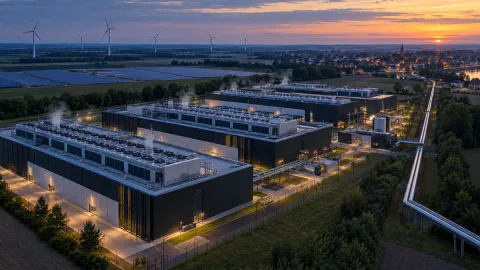
The speed of AI's spread also has its downside. Data centers and transmission networks now consume 1–1.5% of global electricity and produce approximately 1% of greenhouse gas emissions. According to the International Energy Agency (IEA), the consumption of large data centers has been increasing by 20–40% annually in recent years.
Training a single large language model can produce tens of thousands of tons of CO₂ — equivalent to the carbon footprint of hundreds of transatlantic flights. And what is less known: training alone accounts for only 20–40% of AI's total consumption, with the remaining 60–70% coming from inference — that is, the everyday use of models when you ask ChatGPT questions or generate images.
The United States hosts 5,427 data centers, more than ten times that of any other country. Nearly all cutting-edge AI chips, meanwhile, are manufactured by a single company — Taiwan's TSMC, which creates a geostrategic risk for the entire supply chain.
Safety lags behind: incidents are rising
While model capabilities grow, responsible AI is falling behind. The number of documented AI incidents rose from 233 in 2024 to 362 in 2025 — an increase of more than 55%. Nearly all developers report results on performance benchmarks, but reporting of safety tests remains inconsistent.
Researchers have also discovered an uncomfortable paradox: improving one aspect of responsible AI (such as safety) can worsen another (such as accuracy). In other words, a safer model is not necessarily the most useful one — and vice versa.
What this means for Czechia and Europe
The Czech Republic falls roughly within the European average in AI adoption. The Stanford report does not provide exact figures for Czechia, but the trend is clear — companies that don't start with AI today will be catching up with the competition tomorrow. The European Union, meanwhile, is pushing regulation through the AI Act, which is the first in the world to establish binding rules for the deployment of artificial intelligence.
The good news for Czech users is that virtually all major models — ChatGPT, Claude, Gemini, and DeepSeek — support Czech at a very decent level. Czech companies such as Ecomail are already integrating AI into their products, and the Czech AI Factory in Ostrava promises to strengthen local computing capacities. Nevertheless, the estimated value of generative AI for American consumers reached $172 billion annually by early 2026 — and the median value per user tripled between 2025 and 2026. This shows that those who use AI are gaining increasing benefit from it.
How fast is AI actually spreading compared to previous technologies?
Generative AI reached 53% population adoption within three years. For comparison: the personal computer needed several decades to reach a similar level of diffusion, and the internet approximately 15–20 years. This is the fastest technological adoption in recorded history.
Are Chinese AI models as good as American ones?
According to Stanford AI Index 2026, the gap between the best American and Chinese model is only 2.7%. Chinese models such as DeepSeek-R1 or Qwen already compete with GPT and Claude in many benchmarks, often at significantly lower cost. The US, however, maintains an edge in the number of top models and investment volume.
How large is AI's carbon footprint and what can be done about it?
Data centers consume 1–1.5% of global electricity. Training a large model produces tens of thousands of tons of CO₂. The largest operators (Google, Microsoft, Amazon, Meta) invest in renewable energy and strive for carbon neutrality. The average user can influence the footprint primarily by using AI efficiently — inference (everyday queries) accounts for 60–70% of the total energy consumption of AI systems.