From Tool to Essential Service
In recent years, we have become accustomed to perceiving AI as software that we download or log into via a browser. We see this with ChatGPT from OpenAI, Claude from Anthropic, or Gemini from Google. These models are great tools for increasing individual productivity. However, from the perspective of the global economy, this view is too narrow.
Imagine if your internet suddenly went down or there was a power outage. Modern society would immediately grind to a halt. A similar situation is now occurring with data and algorithms. Companies are no longer just addressing whether they will have AI, but how to ensure continuity of access to computational power, quality data streams, and models that drive their logistics, production, and customer support.
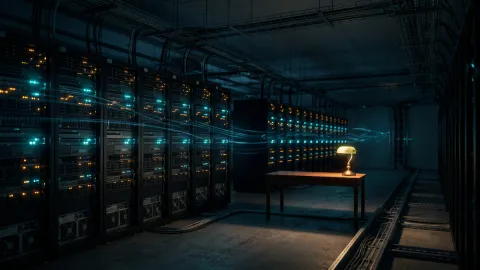
This shift means that investments in AI are moving from the realm of "IT software" to the realm of "strategic infrastructure." This includes not only the models themselves, but primarily data centers, specialized chips (GPUs), and the enormous amount of energy required to operate them.
Global Comparison: Who Controls the "Digital Power Plant"?
In the battle for dominance in this new infrastructure, three main blocks are clashing. Each has a different strategy, and each brings different advantages and risks:
- USA: Dominate in high-end models and hardware. Companies like OpenAI, Microsoft, or Nvidia define the standards. Their models (e.g., GPT-4o) offer the highest performance in benchmarks, but their cost and dependence on American infrastructure can be a risk for smaller states.
- China: Massively invests in its own infrastructure to avoid dependence on Western technologies. Models like DeepSeek or Qwen show that Chinese AI is technologically at a very high level and often offers an extremely efficient price/performance ratio.
- Europe (including the Czech Republic): Focuses on regulation and security. Through the EU AI Act, Europe strives to create rules for how this "infrastructure" should function to be safe and transparent. Although we lag in terms of pure computational power, European projects and companies (like the French Mistral AI) are trying to build sovereign alternatives.
For comparison, while the most modern models like Claude 3.5 Sonnet or GPT-4o show top results in logic and programming tests, their operation costs billions of dollars annually. For a regular user, it's a matter of subscription (approx. 20 USD/month), but for state administration or large industrial giants, it's a matter of billions in investments into their own cloud and data centers.
Practical Impact: What Does This Mean for Czech Companies?
For the Czech context, this change is crucial. The Czech Republic, as a country with a strong industrial base (automotive, mechanical engineering, logistics), cannot perceive AI merely as an "email writing application."
1. Digital Sovereignty and Data: If a Czech company manages its entire production using models hosted exclusively in the USA, it becomes extremely vulnerable to geopolitical changes or provider pricing policies. Building local solutions or utilizing open-source models (like Llama 3 from Meta) can be a path to greater stability.
2. Integration into Production: AI infrastructure means that sensors in Czech factories will directly "talk" to predictive models. This is no longer science fiction but a standard part of a modern automation chain. For Czech technology companies, this represents a huge opportunity in the area of integration and specialization in specific industrial verticals.
3. Availability and Price: For small and medium-sized enterprises (SME) in the Czech Republic, it is important to monitor costs. While large corporations will build their own "AI farms," smaller companies will use API services. It is necessary to monitor whether these services are available with low latency for the European market and whether they meet GDPR requirements.
Conclusion: Preparing for a New Reality
Considering AI as infrastructure changes the rules of the game. It's no longer enough to "try out ChatGPT." Companies and states must start thinking about energy intensity, data flow security, and their own technological independence. In this new world, the winner will not be the one with the best chatbot, but the one with the most stable, secure, and efficient connection between data, computational power, and the real world.
What exactly does it mean for AI to be "infrastructure"?
It means that AI ceases to be optional software and becomes a fundamental layer upon which other services run. Just as you cannot operate an e-shop without the internet or production without electricity, in the near future, you will not be able to operate a modern business without access to AI models and data streams.
How will the EU AI Act affect this infrastructure trend?
The EU AI Act sets rules for how these systems must be safe, transparent, and ethical. For companies, this means that when choosing an "infrastructure provider" (e.g., a cloud service with AI), they must ensure that the given model complies with European standards for privacy protection and data quality.
Can a small Czech company compete with giants like Google or OpenAI?
They have no chance of direct competition in building giant models (Foundation Models). However, their strength lies in specialization. A small company can build excellent "vertical AI" – that is, a model optimized for a specific Czech legislative process or a specific industrial process, which will work better and more reliably than a general model from OpenAI.