What the researchers actually did
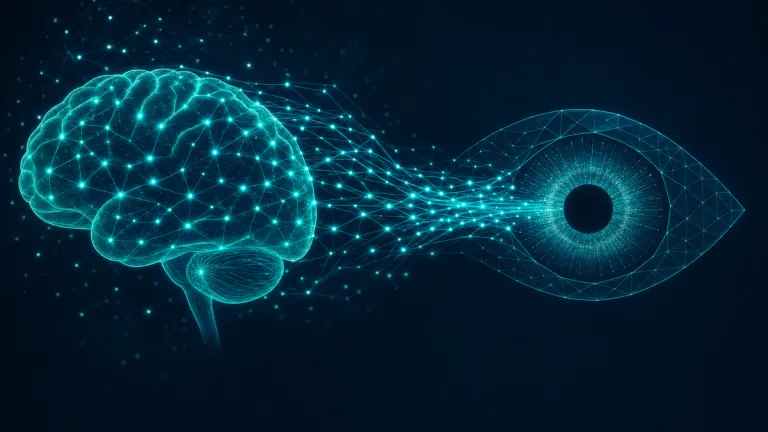
The core idea is technically elegant. The team combines fMRI measurements of human visual cortex activity with artificial neural networks to build what neuroscientists call an encoding model.
An encoding model works in one direction: take a visual stimulus — say, a photograph a person is looking at — and train an AI model to predict which cerebral voxels activate and how strongly. If the predictions match real fMRI recordings across many stimuli and people, you have more than a correlation. You have a computational hypothesis for how the biological visual system transforms complex scenes into internal representations.
As Quantum Zeitgeist reported on August 30, the project deliberately targets reciprocal progress: better computational models of the brain, and better AI architectures inspired by biological vision. Notably, the source report discloses no accuracy percentages, prices, or benchmark figures. This is fundamental research, not a vendor announcement — and treating it like a product launch would be a mistake.
Why the visual cortex is the ideal testbed
Vision is the most thoroughly mapped part of the human brain. Decades of research show a clear hierarchy: the primary visual cortex catches edges and orientations; later regions assemble shapes, then objects, then categories such as faces or scenes.
This hierarchy maps surprisingly well onto the layer structure of convolutional networks and modern vision transformers. Low-level layers respond to textures and edges, higher-level layers to objects — a similarity that is exactly why image-trained models make good encoding models for visual cortex. The model and the brain seem to converge on similar intermediate representations.
But the measurement problem is severe. fMRI does not record neural spikes; it records the BOLD signal, an indirect metabolic proxy sampled about once every second or two. Visual processing runs on the order of tens of milliseconds. The AI therefore learns from blurred, delayed, noisy observations. That is not an argument against the approach — it is the reason machine learning is needed in the first place. The encoder has to abstract away the noise and learn a stable mapping from pixels to cortex.
Mind reading? No. A useful computational loop? Yes
Every few months a headline claims that AI can read minds. This work is not that, and the distinction matters for readers deciding how to budget their attention.
The CMU researchers model the visual cortex's response to controlled visual inputs. That is a far cry from extracting private thoughts from a person sitting quietly in a scanner. The output is a predictive model of perception, not a wiretap on consciousness.
From an engineering standpoint, the genuinely interesting part is the closed loop. Decoding models try to reconstruct what someone saw from brain activity; encoding models predict how the brain will respond to what is shown. Together they form a testable, generative model of a biological perceptual system — something no lab could build with statistics alone. That is the real deliverable of this line of research.
The European angle: your neurodata is already regulated
The project is American, but brain-and-AI technology does not respect borders, and European rules are already catching up with it.
Start with GDPR. fMRI data is health data. Scan a person's brain and you are processing special-category personal data under Article 9 of the GDPR, which demands a valid legal basis, a data protection impact assessment in most cases, and strict purpose limitation. Any European collaboration on datasets of this kind — or any European company training on such data — inherits these obligations regardless of where the original research took place.
Then there is the AI Act. Under Article 50, which took effect in August 2026, AI-generated content must be disclosed. If an imaging model reconstructs a visual scene from brain data, that image is synthetic content and requires watermarking plus machine-readable tagging. Chatbot-like interfaces built on such models must clearly tell users they are interacting with AI. What was voluntary self-regulation twelve months ago is now binding law.
General-purpose AI supervision also switched on this month. Since August 2, 2026, the European Commission's AI Office has full legal authority to evaluate GPAI models, demand technical documentation, force recalls, and impose fines. A foundation model trained or fine-tuned on brain data and offered in the EU is squarely inside that remit.
For high-risk systems, the picture is more nuanced. The original August 2026 compliance deadline for stand-alone Annex III systems was formally deferred to December 2, 2027 under the EU's Digital Omnibus package, because CEN-CENELEC technical standards are not ready. The practical consequence: European developers get more runway, but the direction is settled. Build a medical-grade fMRI analysis tool, plan for the high-risk regime now rather than later.
The pragmatic bottom line
For European researchers and companies, three operational facts follow from this week's news.
First, treat neurodata as special-category personal data from day one — that means documented legal basis, minimized datasets, and a DPIA before large-scale work. Second, any visual output generated from brain signals is synthetic content under Article 50 and needs labeling infrastructure, not afterthought watermarks. Third, the AI Office now has enforcement teeth, and the grace period for general-purpose models is officially over.
The research itself deserves a calm reading. Impressive as the modeling is, it remains a scientific instrument, not a product. The most honest takeaway is also the most interesting one: after years of borrowing ideas from neuroscience to build AI, researchers are now using AI to test hypotheses about the brain itself. Europe can watch from the sidelines — or prepare the regulatory ground so that when this science matures, it lands in a legal environment that was ready for it.
Does this research mean AI can read minds?
No. The models predict how the visual cortex responds to controlled visual inputs using fMRI data. That is a far narrower task than decoding private thoughts, and current fMRI resolution cannot support anything close to mind reading.
Why did the EU postpone the high-risk AI compliance deadline?
The Digital Omnibus package delayed the Annex III high-risk deadlines to December 2, 2027 because the CEN-CENELEC technical standards needed for conformity assessment were not ready in time.
Is fMRI data protected under GDPR?
Yes. Functional MRI records the physiological state of a person's brain, which qualifies as health data under Article 9 of the GDPR. Processing it requires a specific legal basis and, in most settings, a data protection impact assessment.