
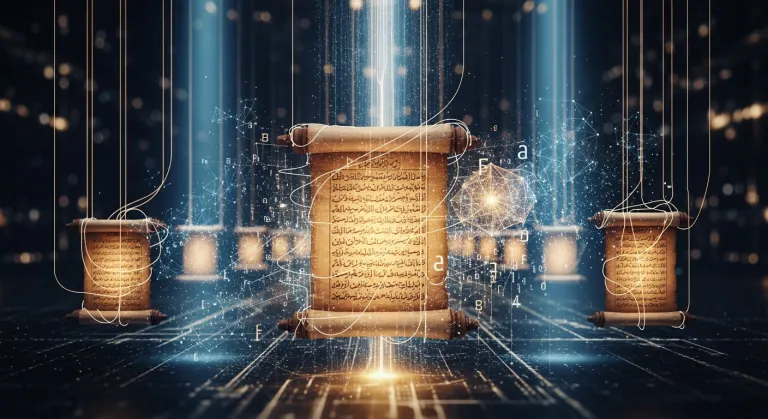
For many centuries, a certain portion of human knowledge remained hidden behind illegible characters and the physical decay of materials. Today, however, thanks to advances in large language models (LLMs) and computer vision, these barriers are beginning to crumble. Current research from Vietnam and France shows that AI is becoming a bridge between modern science and millennia of history.
Decoding Han Nom: When algorithms read history
One of the greatest technological achievements of our time is the work to make the Han Nom script accessible. This logographic script, used for centuries in Vietnam, poses a huge challenge for conventional translators and standard AI models alike. Unlike modern languages, where models have billions of pages of text available, Han Nom is considered a so-called low-resource language (a language with a low amount of available data).
The project carried out at the VNU-HCM Faculty of Natural Sciences uses specialized fine-tuning techniques. Instead of relying on general knowledge, models are trained on specific sets of historical documents, allowing them to recognize nuances of characters that a standard model like GPT-4o or Gemini 1.5 Pro would likely reject or misinterpret without specific training.
Comparison: General models vs. specialized AI
To better understand the difference, it is important to compare the capabilities of ordinary tools with these research models:
- ChatGPT (GPT-4o): Excels in context and modern languages, but when attempting deep analysis of Han Nom without external context, it often hallucinates or uses the closest similar characters from Chinese.
- Google Gemini: Offers excellent multimodal capabilities (image analysis), which is great for basic OCR, but lacks deep linguistic knowledge of historical dialects.
- Specialized research models: Are trained directly on historical corpora. Their accuracy in decoding old manuscripts is tens of percent higher than that of general models, even though they are not available to the general public as a paid subscription (e.g., ChatGPT Plus at $20/month).
Protecting monuments: Predicting degradation through data
While Vietnam focuses on interpreting text, in France AI is centered on the physical integrity of monuments. Under the leadership of experts such as Ann Bourgès, projects are underway that use predictive analytics to combat climate change. The goal is to answer the question: "How much will a crack in sandstone widen over the next 50 years?"
This approach uses algorithms that constantly analyze visual data from detailed images of monuments. AI can detect microscopic changes in the texture of materials that are imperceptible to the human eye. This enables preventive restoration before irreversible damage occurs, as is the case with the Strasbourg Cathedral.
Practical impact: What does this mean for us?
You might think that Vietnam or France are far from the Czech borders. The reality, however, is that the technologies used in these projects have a direct impact on our environment as well:
- Digitization of Czech archives: Similar techniques for decoding Han Nom can be applied to Old Czech or medieval manuscripts in Czech archives. This would enable automated analysis of historical documents, which would be immensely beneficial for historians and researchers across the EU.
- Protecting European heritage: Given that Europe faces similar climate challenges as France, implementing these AI systems into the management of Czech monuments (e.g., under the National Heritage Institute) would be a logical step toward modernizing the protection of our castles and churches.
- Regulation and ethics: Under the EU AI Act, great emphasis will be placed on how cultural data is used. Research in this area helps us define standards for "ethical AI" that protects the integrity of historical data and does not rewrite history according to current trends.
For the average user, this currently means that these tools are not directly available in applications like Canva or ChatGPT, but their development is shaping the future capabilities of all multimodal models we use daily. The ability to "see" and "read" more complex structures is gradually becoming a standard.
Can I use ChatGPT to translate old manuscripts?
Standard versions of ChatGPT can provide a basic estimate, but they are not suitable for historically accurate translation (such as Han Nom or Old Czech). They are prone to hallucinations and errors in interpreting unusual characters. The specialized models mentioned above are designed for this purpose.
Are these AI tools for monument protection available to commercial companies?
These are currently primarily academic and state projects. However, commercial use in the form of software for property managers or restorers is expected in the near future, especially with the rise of advanced computer vision.
What is the relationship between AI and privacy in archive digitization?
When working with historical data in the EU, GDPR regulations must be observed, even when dealing with old documents. AI systems must be designed so that their text analysis does not violate the integrity of personal data of individuals who are still protected by law.




