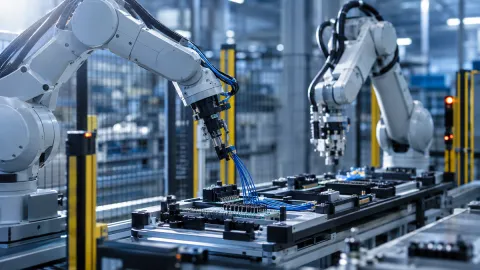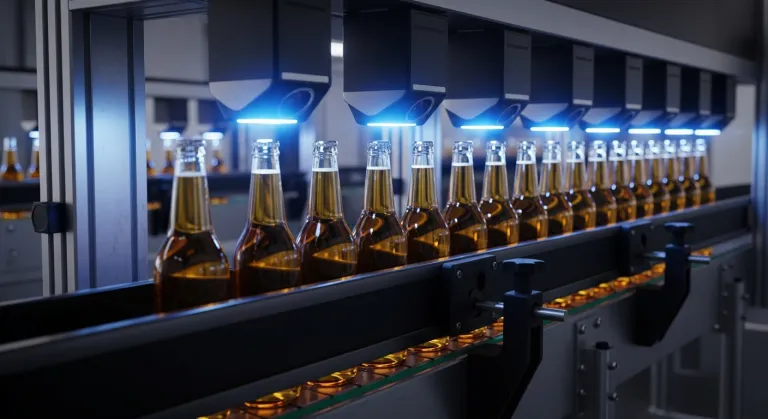
The brewing industry is undergoing a fundamental transformation. While it may seem that the beer filling process has remained the same for decades, beneath the surface a technological shift is taking place that directly affects production efficiency and sustainability. The key topic is the use of artificial intelligence (AI) to optimize processes involving returnable glass.
The Problem with Returnable Bottles: Why Isn't Standard Automation Enough?
Returnable bottles are an absolute cornerstone from an ecological standpoint — they enable reuse and significantly reduce the carbon footprint compared to single-use packaging. However, they present a major complication for automated production lines. Unlike new, perfectly clean, and identical bottles from single-use production, returnable bottles are "unpredictable."
They may have minor mechanical wear, micro-cracks, residues of old labeling, or contaminants that were not completely removed during washing. Traditional sensors based on simple rules (e.g., "if an object is interrupted, stop the line") often fail. They are either too sensitive, leading to frequent production stoppages, or too tolerant, overlooking defective units that could damage filling heads or compromise consumer safety.
This is where computer vision powered by neural networks comes into play. According to information from sources such as Europesays, these systems focus precisely on real-time quality inspection.
The Technology Behind the Breakthrough: Deep Learning vs. Traditional Sensors
To understand the difference, we need to distinguish between traditional "machine vision" and modern "AI computer vision." Traditional systems work with fixed parameters — they look for a specific color, shape, or light reflection. If the bottle tilts slightly or has a smudge, the system may fail.
Modern AI systems use convolutional neural networks (CNNs). These models are trained on thousands of images of both defective and intact bottles. They can perform what is known as instance segmentation, meaning they not only see the bottle but can precisely identify every pixel belonging to a crack, contaminant, or glass deformation.
Technology Comparison
| Feature | Traditional Sensors | AI Computer Vision |
|---|---|---|
| Flexibility | Low (fixed rules) | High (adapts to changes) |
| Detection of minor defects | Limited | Very high (micro-cracks) |
| Processing speed | Extremely high | High (thanks to models like YOLO) |
When compared with benchmarks in the field of object detection, the YOLO (You Only Look Once) model series, which is the standard for industrial AI, achieves extremely high accuracy in real time with minimal latency. This is crucial because filling lines move at speeds of thousands of bottles per hour.
Practical Impact: What Does It Mean for Breweries and Consumers?
The implementation of these technologies has three main pillars of impact:
- Economic efficiency: Reducing the number of defective products that reach circulation means fewer complaints and lower costs for recycling or disposing of damaged glass. For companies, this represents a direct return on investment (ROI) in the form of higher line throughput.
- Sustainability and EU regulations: Within the framework of the European circular economy strategy and efforts toward decarbonization, the use of returnable systems is a priority. AI enables this system to scale without the need for a massive increase in human crews at inspection stations.
- Consumer safety: Automatic detection of micro-cracks in bottles minimizes the risk of sudden bottle rupture during transport or when opening, which increases brand trust.
The Situation in the Czech Republic
The Czech Republic is among the absolute world leaders in brewing culture and production. For Czech breweries — from large industrial players to smaller craft breweries — adopting these technologies represents a strategic advantage. Although the cost of implementing an advanced AI system is higher than that of standard sensors (prices range in the hundreds of thousands to millions of crowns depending on complexity), for large breweries it is a way to address rising energy costs and the shortage of qualified industrial labor.
From a legislative perspective, it is important to mention the EU AI Act. Systems used in industrial automation are mostly classified as low-risk systems, meaning their implementation will not be subject to as strict regulatory barriers as AI in medicine or critical infrastructure, which facilitates their rapid market deployment.
Conclusion
Integrating artificial intelligence into the beer filling process is not just about technological improvement, but about the modern industry's ability to operate in harmony with the environmental demands of the 21st century. Computer vision gives machines "eyes" that are more precise and tireless than human ones, thus creating a bridge between traditional manufacturing and the digital future.
Can AI completely replace human inspectors in breweries?
AI systems are capable of performing routine, highly repetitive inspections with greater accuracy and speed than humans. However, human oversight remains essential for handling unusual anomalies, system maintenance, and decision-making in complex situations that require context.
Is this technology available for small craft breweries too?
Thanks to the development of cloud services and more accessible edge AI hardware, the technology is becoming more affordable. Small breweries often do not use fully automated lines, but they can implement smaller, modular systems for bottle quality inspection as part of their washing and filling processes.
How does AI affect the actual taste of beer?
AI does not directly affect the recipe or fermentation process, but it indirectly helps maintain quality. By ensuring a perfect seal through bottle integrity inspection and proper filling, it minimizes the risk of oxidation or contamination of the beer during storage.