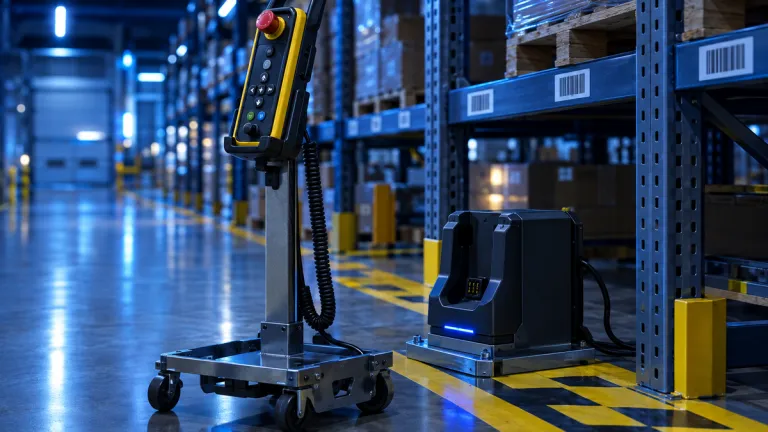
Memoranda of understanding are cheap. Safety architecture for a two-legged machine working next to people is not. The distance between those two things is where this announcement sits, and it is worth reading closely — not as a regulatory story, but as a commercial one: who is building the hardware, and what has been left for later.
What the two companies signed
Agility Robotics builds Digit, a humanoid already running in commercial sites. FORT Robotics makes safety and control hardware for industrial machinery. Their MOU turns what had been a component supply relationship into joint development work on three items: a safety pendant, on-robot communications, and the Offboard Safety Bridge, an interface that links Digit 5 to safety systems already present in a building.
The scope listed in the announcement covers joint hardware development, solutions engineering, regulatory compliance and deployment support for warehouses, manufacturing and logistics. The source material is the joint announcement carried by AIThority; both vendors maintain their own product pages at Agility Robotics and FORT Robotics.
Three layers, one purpose
The pendant is a sled that holds a tablet and carries an integrated emergency stop plus an enabling device. That second part matters more than it sounds. An enabling device is the industrial convention that the machine moves only while a person is actively holding the control in the ready position. Release it, and motion stops. Industrial robot cells have worked this way for years. Putting the same logic on a humanoid means the robot inherits a safety model that factory inspectors already recognise.
The on-robot communications layer is the piece the companies describe as internal to Digit 5. The Offboard Safety Bridge is the outward-facing one: it lets the robot participate in the facility's own safety chain, so a light curtain, a gate interlock or a conveyor controller and the robot share one view of what "stopped" means.
Read as an engineering outline, the three layers describe a machine that is meant to be bolted into an existing cell rather than dropped into a fenced-off corner. That is a design decision with consequences for the buyer, because it moves the integration work — and the liability for it — into the customer's own safety concept.
The only number in the announcement that measures anything
Agility says predecessor versions of Digit have accumulated more than 65,000 hours of operation across commercial deployments, naming Schaeffler, GXO and Toyota Motor Manufacturing Canada. That figure deserves a conversion. Sixty-five thousand hours is about 7.4 years of continuous running for a single machine. Spread across the three named customers, it is roughly 21,600 hours each, or close to two and a half years of round-the-clock operation per site. One of the named customers, Schaeffler, is a German company, though the announcement does not say where those hours were logged.
Field hours are the benchmark for this class of product. We measure tokens per second and VRAM on the AI Arena rig, and none of that tells you whether a machine stops when a person walks into its path.
What an MOU commits, and what it does not
No volumes. No prices. No dates. No statement about exclusivity, and no published technical specification for the Offboard Safety Bridge. A memorandum of understanding of this kind expresses intent; the commercial terms usually arrive later, in supply contracts that rarely get press releases.
There is a capital-markets footnote attached. Transaction filings connected to FORT Robotics' planned Nasdaq listing were submitted via Newbury Street II Acquisition Corp (NASDAQ: NTWO). Safety partnerships are useful material when investors are reading filings.
None of that makes the engineering fictional. A custom pendant sled with e-stop and enabling device is a real object with real bill-of-materials costs. It is the surrounding commercial picture that stays blurry.
The compliance work that stays with the buyer
None of the three layers removes a single obligation from the operator. For anyone in the EU planning to put a humanoid on a warehouse floor, product law changes on 20 January 2027. On that date, Regulation (EU) 2023/1230, the new Machinery Regulation, replaces the Machinery Directive. It is the first EU product law written with software-defined machinery in mind, and it explicitly addresses machinery with self-evolving behaviour and safety functions that depend on AI.
A partnership signed in the United States does not produce a CE mark. A European operator buying Digit 5, or any competing humanoid, will need a technical file, a risk assessment and a declaration of conformity, and the safety functions have to be assessed as part of the machine rather than as a software feature bolted on afterwards. The ISO 10218 series for industrial robots and ISO/TS 15066 for collaborative operation are the documents integrators work from when they build that argument.
The EU AI Act adds a second layer. AI used as a safety component in a product covered by EU product legislation falls under Annex I of the AI Act and travels through that product's own conformity assessment route. The separate Annex III high-risk obligations were deferred to 2 December 2027 under the Digital Omnibus on AI, so the timeline European buyers are actually working to is the machinery one.
Where a vendor MOU helps is narrow and practical: it is evidence that the safety functions were designed in rather than retrofitted, which is exactly the argument an integrator has to make in a technical file. What it is not is a shortcut past that file.
What would turn this into a product
Three items would move the story from intent to hardware: a published safety concept with a named certification path, a European pilot site with logged hours, and a price. None of them exist in the announcement. Agility has also not given a commercial rollout date for Digit 5.
What is the Offboard Safety Bridge technically?
It is described as an off-robot interface that connects Digit 5 to a facility's existing safety systems. The companies have not published a protocol, latency figures or certification details, so the practical answer today is that it is a stated design goal, not a documented product.
Does the MOU mean Digit 5 is cleared to work alongside people in the EU?
No. Compliance is per machine and per installation. In the EU that means the Machinery Regulation route, a risk assessment covering the whole cell, and a CE declaration. An MOU between two vendors changes none of that paperwork.
Can I buy or lease Digit 5 in Europe now?
No availability, pricing or launch date for Europe has been announced. The 65,000 field hours cited in the announcement relate to predecessor Digit units at named customers, and the announcement does not break those hours down by region.
What the announcement does state precisely is the architecture: a pendant sled with e-stop and enabling function, on-robot communications, and the Offboard Safety Bridge, developed jointly with compliance and deployment support attached.