
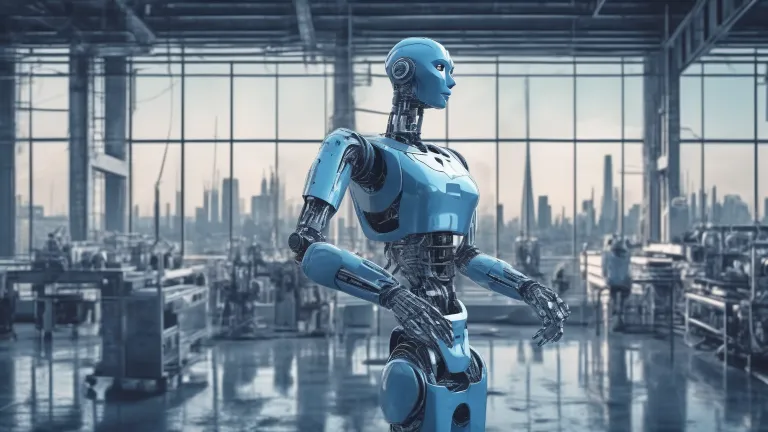
From Shanghai to London: AGIBOT Pushes the Boundaries of Humanoid Robotics
On July 1, 2026, an event took place in London that could have easily escaped the attention of European media newsrooms. AGIBOT — a Chinese startup formally known as AGIBOT Innovation (Shanghai) Technology Co., Ltd. — held its conference APC2026 (Asia Pacific Conference 2026) in the British capital. The name suggests an Asian focus, but the location in the heart of Europe says something different: the company is systematically expanding its reach beyond Asia and the Pacific.
APC2026 is not a one-off event. It is a global series of conferences — previous stops took place in Indonesia (June 2026) and Thailand (June 2026). London is so far the biggest step westward and also a signal that AGIBOT is taking the European market seriously. Conference theme: commercial deployment of humanoid robots in industrial environments.
15,000 Robots: A Number That Changes Perspective
Just three days before the London conference, on June 28, 2026, the milestone — fifteen-thousandth robot — left AGIBOT's production line. The milestone piece was the Genie G2 model, an industrial humanoid robot designed for manufacturing environments. This number is not just a marketing figure. For comparison: the entire global market for humanoid robots was still in the hundreds of units per year just two years ago.
Analytical firm Omdia, in its 2025 surveys, ranked AGIBOT first in the world for humanoid robot shipments. And indeed — the company's product portfolio is wide: the A2 series (Ultra, Lite, W), the X series (X1, X2), the Genie series (G1, G2), quadruped D1, or the commercial cleaning robot C5. The company offers robots for various industrial segments, from assembly lines to logistics and service environments.
Guinness Record and Real-World Deployment: Two Different Worlds?
AGIBOT can also boast a Guinness record: the A2 model holds the title for the longest distance ever walked by a humanoid robot. While this is an engaging media matter, other indicators are more important for industrial customers.
The key is the result from real-world deployment: AGIBOT, in cooperation with electronics manufacturer Longcheer Technology, tested its Real-World Reinforcement Learning (RW-RL) system directly on an active production line. The results are interesting: robots learned new assembly tasks within tens of minutes instead of traditional weeks of programming. The system demonstrated one hundred percent task completion success during long-term operation and was able to autonomously adapt to part variability — different positions or component tolerances.
This ability for rapid on-site learning is crucial for manufacturing companies. Traditional industrial robots require specialized programmers and days or weeks of reprogramming when the manufacturing process changes. A humanoid robot that can master a new task in an hour changes the economics of the entire matter.
What AGIBOT Offers Developers and Companies
The company doesn't just rely on hardware. Part of the ecosystem is AGIBOT Genie Studio — a development platform for embodied AI (artificial intelligence connected with the physical body of a robot). The platform serves as a unified environment for the development, testing, and deployment of robotic applications.
For the research community, the open-source framework AimRT and the AGIBOT World Dataset of real-world tasks are available, which contains enterprise-quality data for training embodied AI models. The X1 is even a fully open-source robot designed for research teams and university projects.
European Context: The Market Awaits, But Rules Are Changing
AGIBOT's arrival in Europe conveniently coincides with the maturation of the European regulatory framework. The EU AI Act, which comes into force gradually from 2024 to 2027, also applies to autonomous robotic systems. Humanoid robots deployed in industrial environments fall into the category of higher-risk systems — meaning an obligation for documentation, transparency, and oversight of AI components.
For European manufacturing companies — and this also applies to Czech industrial enterprises — this means that when choosing a humanoid robot, technical parameters alone are not enough. The supplier's ability to meet the requirements of the EU AI Act, provide technical documentation, and ensure compliance with GDPR standards when processing data from robot sensors will also be crucial.
It is not yet confirmed whether AGIBOT plans to open a European representation or partner with local distributors. The contact address for business inquiries remains global: business@zhiyuan-robot.com. Nevertheless, for Czech and Slovak companies considering pilot projects with humanoid robots, AGIBOT is a relevant player — especially due to its affordability compared to Japanese or American competitors (Boston Dynamics, Agility Robotics, Unitree).
Broader Picture: Humanoid Robots Are No Longer Exhibition Pieces
As recently as 2023, it was true that humanoid robots were a great demonstration of technological ambitions, but far from profitable in real-world operation. 2026 changes this equation. The figure of 15,000 units from a single manufacturer, functional deployment on a production line with measurable productivity, and an international conference series focused on commercial customers — these are signals of a transition from laboratories to operations.
The London stop of APC2026 is primarily a reconnaissance mission for AGIBOT: the company is testing the interest of European industrial customers, building contacts, and seeking partners. For Europe — and indirectly for Czech industry — it is important not to miss this wave. The deployment of humanoid robots in assembly plants or logistics centers is not a question of the distant future, but a horizon of two to three years.
Is AGIBOT available for Czech or European companies?
No European representation or distributor for the Czech market has been confirmed yet. Companies can contact AGIBOT directly via business@zhiyuan-robot.com. The London conference APC2026 (July 1, 2026) indicates that the company is actively seeking European partners and customers.
How quickly does the AGIBOT humanoid robot learn a new task in manufacturing?
According to a pilot project with Longcheer Technology, the robot can learn a new assembly task using the Real-World Reinforcement Learning (RW-RL) system in tens of minutes — compared to traditional weeks of programming for classic industrial robots. The system achieved one hundred percent success rate during long-term operation.
How does AGIBOT differ from competitors like Boston Dynamics or Unitree?
AGIBOT focuses primarily on industrial commercial deployment and offers a wider product portfolio — from fully humanoid robots to quadrupeds and specialized service robots. Omdia analysts ranked it first in global humanoid robot shipments in 2025. Compared to Western competitors (Boston Dynamics, Agility Robotics), AGIBOT is typically more affordable, but for the European market, questions regarding service, documentation for the EU AI Act, and local support still apply.




