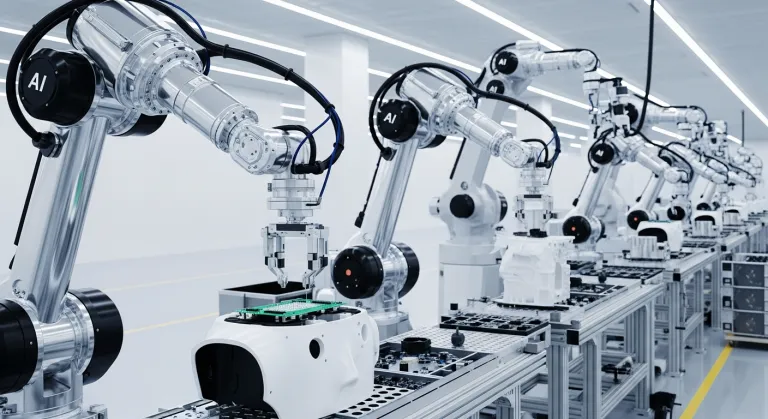
From Laboratory to Production Line: 10,000 Robots in Operation
AGIBOT, a Shanghai-based robotics firm founded in 2023 by Peng Zhihui — a former Huawei engineer — reached a milestone in March 2026 that the entire industry only dreams of: its ten-thousandth robot was deployed into real-world operation. These are not prototypes in research laboratories, but machines working on production lines. Specifically, the company confirmed deployment at Longcheer Technology, which uses AGIBOT robots in tablet manufacturing.
At the APC 2026 (AGIBOT Partner Conference), held on April 18, 2026, in Shanghai, the company announced a fundamental strategic shift: from technological demonstrations to measurable productivity in real-world operations. The slogan "Deployment Year One" is not a marketing phrase — it is a response to the three-year pace in which the company has progressed from research through mass production to commercial operation.
Five New Platforms: From Humanoid to Quadruped
At APC 2026, AGIBOT unveiled five new robotic platforms, solidifying its position as the only company in the world offering a complete product line across various forms, sizes, and deployment scenarios.
A3 — The New Humanoid Standard for Interactive Environments
The flagship humanoid A3 measures 173 cm, achieves a power-to-weight ratio of 0.218 kW/kg, and can operate for up to 10 hours. A key breakthrough is the rapid battery replacement system — the entire process takes just 10 seconds. This is crucial for industrial deployment, where downtime means direct financial losses. A3 targets interactive environments, the entertainment industry, and areas where robots come into direct contact with people.
G2 Air — Mobile Manipulator for Logistics and Retail
G2 Air is a compact mobile manipulator with a single-arm design, seven degrees of freedom, and a payload capacity of 3 kg. Its chassis with a zero turning radius allows movement in narrow spaces under 800 mm — i.e., in typical store aisles or warehouse corridors. G2 Air is designed for scenarios where robots collaborate with people in retail, hospitality, or logistics.
D2 Max — The First L3 Autonomous Quadruped for All Terrains
AGIBOT designates its quadruped robot D2 Max as the world's first quadruped with L3 level autonomy for all terrains. L3 level — inspired by the SAE scale for autonomous vehicles — means that the robot handles complex situations without continuous human supervision. D2 Max targets industrial inspections and security applications in environments where wheeled vehicles are insufficient.
OmniHand 3 Ultra-T — Hand with Haptic Feedback for Industrial Precision
The dexterous hand OmniHand 3 Ultra-T combines 22+3 degrees of freedom with tendon drive and three-dimensional tactile sensing. This is a direct answer to one of the key challenges of industrial robotics: manipulating small, fragile, or irregularly shaped parts with human-level dexterity. Such performance has previously been reserved only for specialized industrial robotic arms.
Eight AI Models: The "One Robotic Body, Three Intelligences" Architecture
In parallel with the hardware, AGIBOT introduced eight foundational AI models organized around the „One Robotic Body, Three Intelligences" architecture:
- Locomotion Intelligence: Behavioral Foundation Model (BFM) and Generative Control Foundation Model (GCFM) — models that control the robot's movement in space
- Manipulation Intelligence: GO-2 (VILLA) model with an Action Chain-of-Thought approach, which plans sequences of actions similar to how large language models plan text
- Interactive Intelligence: WITA Omni multimodal system processing vision, speech, and gestures in real-time
The entire software stack is complemented by the simulation platform Genie Sim 3.0, introduced at CES 2026 — an open-source environment integrated with NVIDIA Isaac Sim and Omniverse, which contains over 10,000 hours of synthetic data from real-world robotic operations. Simulation allows models to be trained on scenarios that would be too expensive or dangerous to test physically.
AIMA: "Android of Robotics" as an Open Ecosystem
One of the most ambitious announcements was the AIMA (AI Machine Architecture) ecosystem — an open software stack built on the Link-U OS operating system. AGIBOT openly compares it to Android: a platform on which third parties will be able to build applications and extend robot capabilities without dependence on proprietary hardware.
If this analogy holds true, it could fundamentally change market dynamics. Today, every humanoid manufacturer builds a closed ecosystem — Tesla Optimus, Figure AI, Boston Dynamics, and Apptronik. An open standard could attract developers and partners, similar to how Android surpassed proprietary mobile platforms.
Deployment in Asia Pacific: Partnership with NCS
Immediately after the APC 2026 conference, NCS announced a partnership with AGIBOT and Huazhi Tiancheng for the deployment of humanoid robots in the Asia Pacific region. NCS, a technology integrator operating in Singapore, Australia, and other countries, will facilitate commercial implementations in industry, logistics, and the public sector.
For the Czech and European scene, AGIBOT robots are not yet available for direct commercial sale. The company focuses on Asian markets and the manufacturing ecosystem in China. However, the pace at which Chinese humanoid manufacturers — alongside AGIBOT, also Unitree, Fourier Intelligence, or UBTECH — are expanding suggests that the European market is a realistic destination within two to three years. At CES 2026, Chinese humanoid manufacturers accounted for half of the exhibitors in the robotics category.
Where Does AGIBOT Stand in the Global Race?
While American firms like Figure AI (deployed at BMW) or Apptronik (collaboration with NASA and Samsung) dominate the media space, Chinese firms are quietly building manufacturing capacity. AGIBOT, with 10,000 deployed robots, claims to be ahead of most American competitors in terms of actual operational units.
Tesla Optimus — the world's most anticipated humanoid — still lacks publicly confirmed commercial deployment outside of Tesla's own factories. AGIBOT, meanwhile, confirms specific customers, specific production lines, and specific data. This is a significant difference in an industry that has long been full of promises and little proof.
The L1–L5 scale for robot autonomy, introduced by AGIBOT, could be another standardization impulse — similar to how SAE introduced it for autonomous vehicles. Currently, the company claims that its systems achieve L3 level in both movement and task execution.
What Does This Mean for Industry — and for the Czech Republic?
The Czech Republic is among the countries with the highest density of industrial robots per worker in Europe, especially in the automotive industry. Humanoid robots like A3 or G2 Air arrive as a potential complement — not a replacement — for classic industrial arms. Their ability to work in environments designed for humans (narrow aisles, unstructured spaces) is a key advantage over fixed robotic arms.
The EU AI Act, which will regulate high-risk AI systems including autonomous robots from 2025, will be a key obstacle and opportunity for AGIBOT's potential entry into the European market. Companies that manage to comply with this regulatory framework will gain a competitive advantage — and AGIBOT, with its open AIMA architecture, could be better prepared than closed platforms.
How much does the AGIBOT A3 robot cost and where can it be bought?
AGIBOT has not yet released retail prices for its new platforms introduced at APC 2026. The company is currently focusing on industrial customers and commercial partners in Asia. Direct sales are not available for the European market — the company collaborates with regional integrators. Earlier models like A2 were priced approximately in the tens of thousands of dollars.
How does AGIBOT differ from Tesla Optimus or Boston Dynamics?
AGIBOT distinguishes itself in three ways: an open software ecosystem (AIMA/Link-U OS) reminiscent of Android, its own Genie Sim 3.0 simulation platform for AI training, and a proven number of deployed robots — 10,000 units as of March 2026. Tesla Optimus has no confirmed commercial deployment outside of Tesla's own factories yet. Boston Dynamics focuses on industrial inspections, not humanoid workers.
What is the L1–L5 scale for humanoid robots and how does AGIBOT use it?
AGIBOT introduced a five-level scale of robot autonomy inspired by SAE standards for autonomous vehicles. L1 is basic assisted movement, L5 is full autonomy without human supervision. The company claims that its current systems achieve L3 level — meaning they can handle complex situations without continuous human intervention, but still with the possibility of remote oversight. For comparison: most industrial robots today operate at L1–L2 levels.
