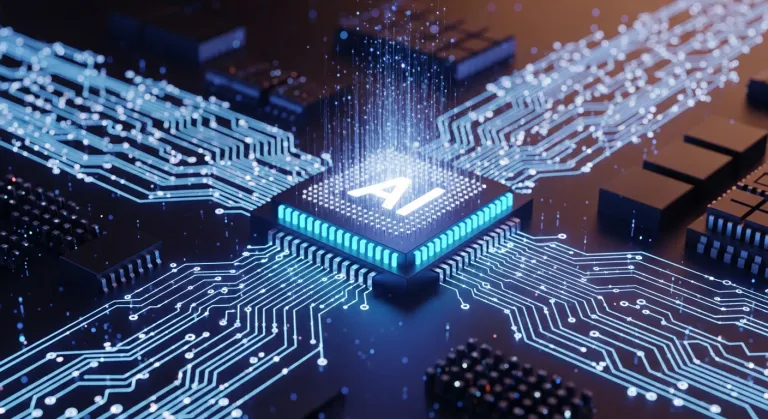
The world of semiconductors stands on the threshold of a new phase. While earlier efforts at performance focused primarily on shrinking transistors (so-called scaling), attention is now shifting to architecture. One of the greatest technological challenges of today is 3D IC design — a technology that enables stacking chips on top of each other into vertical structures, similar to buildings in a metropolis. This method dramatically increases performance and data density, but at the same time brings extreme complexity in the area of thermal management and interconnections between individual layers.
This is precisely where agentic AI comes in. Unlike common models such as ChatGPT, which merely generate text or code based on a query, agentic systems can independently plan, execute steps, evaluate results, and correct their own mistakes. In the context of chip design, this means that an AI agent can be given a task: "Design the component layout for this 3D chip to minimize heating and maximize data transfer speed." And then carry it out.
Strategic Alliance of Cadence and NVIDIA
According to the official announcement from Cadence and NVIDIA, their partnership focuses on transforming engineering processes for the era of accelerated computing. Cadence, a leader in electronic design automation (EDA) software, combines its tools with NVIDIA's computing power and technologies.
The key pillars of this collaboration are platforms such as Cadence.AI and the Millennium Platform, an AI-driven digital twin supercomputer. The goal is to create an environment where hardware design takes place in a simulated digital space with incredible precision before actual physical manufacturing occurs. This significantly reduces the risk of errors and costs associated with prototyping.
What exactly is Agentic AI and why is it important?
For a layperson, the term "agentic AI" can be confusing. Imagine the difference between a map and a car's navigation system. Traditional AI is like a map: it shows you the way, but you have to drive it yourself. Agentic AI is like an autonomous vehicle: you set the destination (e.g., "get me to Prague") and the car itself decides when to slow down, when to turn, and how to avoid traffic jams.
In the field of 3D IC design, this means that AI agents can solve millions of variables simultaneously. When designing vertically stacked chips, an engineer must solve not only electrical interconnections but also how heat spreads between layers. If one layer overheats, the entire chip fails. Agentic AI can simulate thermal maps in real time and adjust the chip's geometry to prevent overheating, without the human designer having to run each simulation manually.
Comparison: Traditional EDA vs. AI-driven design
Until now, chip design relied on algorithms that engineers had to configure manually. Let's look at the differences in efficiency:
| Property | Traditional EDA tools | Agentic AI (Cadence/NVIDIA) |
|---|---|---|
| Iteration speed | Days to weeks | Hours |
| Complexity of 3D stacking | High demand on human computation | Automatic optimization of multiple parameters |
| Error rate | Dependent on engineer experience | Minimized through continuous simulation |
If we were to compare it with general models, traditional AI in design functioned more like an advanced assistant (similar to GitHub Copilot for programmers). Agentic AI from Cadence, however, behaves like a junior engineer who can carry out the entire workflow from concept to final verification.
Practical impact: What does it mean for us?
You might be thinking: "I'm not a chip engineer, what do I care?" The answer is simple: everything you use today will run on these chips.
- For consumers: The result is cheaper and more powerful hardware. If the design process is accelerated and streamlined, the costs of developing new processors for phones, laptops, or cars decrease, which can lead to faster availability of innovations.
- For companies: Companies that specialize in AI (such as OpenAI or Google) need increasingly powerful chips. 3D IC technology will enable creating chips capable of serving massive language models with much lower energy consumption.
- For the Czech and European scene: Europe is striving for technological sovereignty through the EU Chips Act. Although the Czech Republic is not a producer of the smallest chips like TSMC, we have a strong tradition in research, electronics design, and software. Tools from Cadence and NVIDIA are key for European design houses and research institutes (e.g., within projects in Brno or Prague), which are striving to develop their own specialized chips for industrial automation or medical technologies.
Price and availability
It is important to emphasize that tools such as Cadence Cerebrus AI Studio are not for ordinary users or individuals. This is enterprise software for professional engineering teams.
- Price: Cadence does not publish a public price list for individuals because licensing fees depend on the scope of use and company size. In the B2B segment, these are investments in the order of tens to hundreds of thousands of dollars annually.
- Availability: The software is primarily available in English. For the Czech market, it is available through global partners and distribution channels for professional engineering software.
- Free tier: Cadence offers free trials for companies that want to test their tools within pilot projects.
Conclusion
The integration of agentic AI into 3D integrated circuit design is not just another step in automation. It is a transformation of the entire way humanity creates computing capacity. The Cadence and NVIDIA alliance creates the infrastructure that will enable building hardware for an era we previously dared not even dream of. For the Czech technology sector, this represents a huge opportunity in the area of specialized design and implementation of these advanced systems.
Will agentic AI replace human engineers in chip design?
No, agentic AI serves as an extremely powerful tool for augmenting human capabilities. Engineers will be able to focus on high-level architecture and solving complex problems, while AI takes over repetitive and mathematically demanding optimization tasks.
Is this technology relevant for small Czech technology companies?
Yes, especially if companies specialize in designing specific chips (ASICs) for industry, automotive, or IoT. More efficient design processes allow even smaller teams to compete with global players thanks to higher productivity.
What is the main disadvantage of 3D IC design that AI solves?
The main challenge is thermal management (heat dissipation) and the extreme density of interconnections between layers. In a 3D structure, heat can accumulate in the center of the chip, leading to its damage. Agentic AI can predict and solve these thermal issues already in the early design phase.