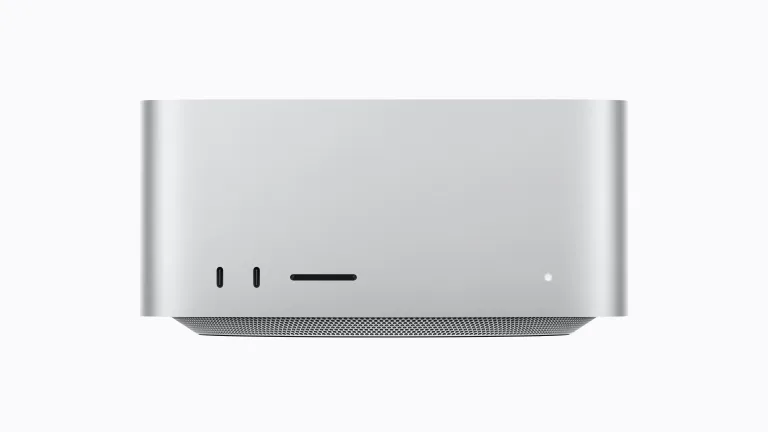
What Apple Actually Announced
On August 25, Apple opened pre-orders for the updated Mac Studio, bringing the M5 family to the desktop in two tiers. The M5 Max configuration offers an 18-core CPU (6 super cores, 12 performance cores), a 40-core GPU with Neural Accelerators in every core, and up to 128 GB of unified memory at 614 GB/s bandwidth. The M5 Ultra goes further: up to a 36-core CPU, an 80-core GPU (the most powerful Apple silicon GPU to date), and up to 512 GB of unified memory. Both chips bring Wi-Fi 7 and Bluetooth 6 to Mac Studio for the first time, alongside Thunderbolt 5 at 120 Gb/s and a PCIe Gen 6 SSD architecture that doubles storage speed over the previous generation.
Pre-orders opened in 30 countries on August 25. Units ship September 22, with the 512 GB Ultra configuration following in late October. The device is available in all EU member states through Apple's online store and authorized resellers.
On-Device AI: The Numbers That Matter
Apple's benchmark comparisons are, as always, measured against its own previous generation. In LM Studio, the M5 Ultra processes LLM prompts up to 4× faster than the M3 Ultra and 9.8× faster than the M1 Ultra. Text-to-image generation is up to 4.3× faster than M3 Ultra. In DaVinci Resolve, Magic Mask performance jumps 3× over M3 Ultra. For DNA sequencing in Oxford Nanopore MinKNOW, basecalling is 1.9× faster than M3 Ultra.
Those multipliers matter less than the memory ceiling. A 512 GB unified memory configuration can hold a large language model entirely in local RAM. That is not a marketing scenario — it is the difference between a developer who can fine-tune a 70-billion-parameter model on a single desk and one who needs a datacenter reservation.
For context on what "local" means in practice: our AI Arena benchmark rig runs on an NVIDIA RTX 5060 Ti with 16 GB of VRAM. That card handles quantised 7–14B parameter models comfortably. The gap between 16 GB and 512 GB is not incremental; it is a different class of workload. A Mac Studio with M5 Ultra is closer to a single-node inference cluster than to a workstation, and Apple knows it. The company even notes that multiple Mac Studio units can be linked over Thunderbolt 5 for distributed inference, delivering up to 3× the throughput of a single system.
Apple also introduced Core AI, a new macOS framework for building, running, and deploying models natively on Apple silicon, optimised for the unified memory architecture. Together with MLX (Apple's open-source ML framework) and Xcode, the stack covers the full loop from experimentation to deployment without leaving the platform.
European Pricing: What You Actually Pay
Apple lists U.S. prices first, but the EUR figures are what European buyers and procurement teams need. Based on Apple's German online store (prices include 19% VAT, the standard EU rate):
Mac Studio M5 Max (18-core CPU, 32-core GPU, 36 GB, 512 GB SSD): from €2,999 / $2,499.
Mac Studio M5 Ultra (30-core CPU, 64-core GPU, 96 GB, 1 TB SSD): from €6,599 / $5,499.
Mac Studio M5 Ultra (top config, 512 GB, available late October): price at launch was not separately confirmed, but the 512 GB tier on the previous generation carried a substantial premium over the base Ultra.
At the ECB reference rate of 1.1662 USD/EUR (25 August 2026), the U.S. list price converts to roughly €2,138 and €4,714 respectively — meaning European buyers pay a VAT-inclusive premium of approximately 30–40% over the raw U.S. conversion, which is standard across Apple's EU pricing.
Apple's education pricing (for EU educational institutions) starts at €2,799 for M5 Max and €5,999 for M5 Ultra, saving roughly €200–600 depending on configuration. AppleCare+ for Mac and the AppleCare One multi-device plan are available at point of purchase.
What This Means for European AI Work
The most practical consequence for EU-based developers and researchers is straightforward: a 512 GB Mac Studio is a local inference appliance that does not require a cloud datacenter reservation. For teams processing medical imaging, genomics, financial documents, or any data subject to GDPR residency requirements, the ability to run a 70B+ parameter model on-premises — with zero data egress — is not a nice-to-have. It is a compliance architecture.
The EU AI Act, whose enforcement phase began in August 2026, does not prohibit local model deployment. But it does push organisations toward transparent, auditable AI pipelines. A self-contained hardware platform where the model, the data, and the inference all live in the same physical location simplifies the documentation burden considerably compared to a hybrid cloud setup with multiple jurisdictions.
Apple's position in this ecosystem is unusual: the company is not selling a GPU, not selling a model, not selling a cloud. It is selling a desktop that happens to be the most memory-dense consumer-grade AI platform on the market. For European SMEs and research labs that cannot justify a dedicated AI server room, the M5 Ultra Mac Studio occupies a gap that NVIDIA workstations (starting well above €10,000 for comparable memory) and cloud contracts (per-hour, per-token) do not fill at this price point.
How It Compares: The Honest Picture
The 512 GB unified memory figure is impressive, but it is not unlimited. Memory bandwidth (Apple does not state the exact figure for M5 Ultra, but the M5 Max is rated at 614 GB/s) determines tokens-per-second throughput, not just model capacity. For high-throughput serving — hundreds of concurrent users, low latency — a dedicated inference server with HBM-equipped GPUs still wins. The Mac Studio is an interactive tool, a research sandbox, a prototyping machine, and a private deployment target. It is not a replacement for a Kubernetes cluster.
Apple's own press release positions the device for "creatives, developers, AI researchers, data scientists." The creative workloads (8K video, VFX, 3D rendering with third-gen ray tracing) remain a major selling point, and the Media Engine's hardware decode for H.264, HEVC, ProRes, and AV1 means the box handles production video pipelines alongside AI inference without context-switching hardware.
One caveat for European buyers: the 512 GB configuration arrives in late October, not September. Teams planning to deploy before year-end should confirm the exact shipping date with their Apple reseller. The base 96 GB Ultra (from €6,599) is available for pre-order now and ships in September.
Who Should Care
If you are a solo developer or a small European team working with sensitive data — patient records, legal documents, R&D IP — and you have been paying for cloud inference to avoid sending that data to a third-party datacenter, the M5 Ultra Mac Studio is the first Apple product that makes the "just keep it local" argument economically viable at the 70B+ parameter scale. The €6,599 entry price is not cheap, but it is a one-time hardware cost rather than a recurring API bill, and the payback point against a mid-tier cloud inference contract typically lands within 12–18 months of regular use.
If you are a creative professional doing 8K colour grading, VFX, or large 3D scenes, the M5 Max at €2,999 is a significant generational uplift over the M4-era Studio, and the Thunderbolt 5 + PCIe Gen 6 storage stack removes the bottleneck for large project files.
And if you are simply curious about what 512 GB of unified memory actually feels like when you load a large open-weight model and watch it respond without a single network round-trip — that is the demo Apple is not going to show you, because it does not need to. You just have to be in the room.
Is the Mac Studio with M5 Ultra available in all EU countries?
Yes. Pre-orders opened August 25 in 30 countries and regions, including all EU member states. Units ship from Apple.com, Apple Stores, and authorized resellers starting September 22, 2026. The 512 GB memory tier follows in late October.
Can I run LLMs locally without an internet connection?
Yes. With up to 512 GB of unified memory, the M5 Ultra Mac Studio can hold and serve large language models entirely on-device. No API key, no cloud, no data leaves the machine. This is particularly relevant for GDPR-sensitive workloads in the EU.
How does the Mac Studio compare to a dedicated NVIDIA GPU server for AI inference?
For single-user interactive work, research, and private deployment, the Mac Studio is competitive and far simpler to operate. For high-concurrency serving (hundreds of simultaneous users) or the largest model architectures with HBM memory, a dedicated inference server still has the edge in throughput. The Mac Studio fills a different niche: the on-premises AI workstation that does not require a server room.